
What Happens After Storm Damage to a Florida Roof?
Severe weather across central Florida is a routine part of owning a home here, and a damaged roof almost always starts with a decision point: is this something to fix out of pocket, or does it make sense to file a claim? The answer usually comes down to scope. A handful of missing tiles or a small leak might not clear your deductible, while a widespread loss of covering or structural damage almost always does.
Once you decide to file, the process follows a fairly predictable order no matter which Florida carrier you're insured with. Understanding that order ahead of time means fewer surprises, and it helps you know what's a normal pause versus what's worth a follow-up call. The stages below cover documentation, the adjuster visit, scope negotiation, the deductible, the build itself, and the final paperwork that closes the file.
Why Does the Claims Process Follow a Set Order?
Insurance carriers process claims in a sequence because each step depends on information gathered in the one before it. You can't negotiate a scope of work before an adjuster has documented the damage, and you can't start construction before the carrier has approved a scope. Skipping ahead, like signing a contract before you've seen an estimate, tends to create friction later rather than speed anything up.
Documentation Comes First
Before anyone from the carrier shows up, it helps to have your own record of the damage. Photos from the ground, dated and clear, give you a reference point if the adjuster's assessment seems incomplete later. If there's an active leak, getting it covered is a reasonable first move, since most policies expect the homeowner to prevent further damage while the claim is pending.
This is also the point where you call your carrier to open the claim, which generates a claim number and usually triggers the adjuster scheduling process. Having your policy number and a general description of the damage ready makes this call quicker. Some homeowners also loop in a contractor at this stage so there's a second set of eyes documenting the same areas the adjuster will look at.
The Adjuster's Role in the Process
The adjuster's job is to inspect the damage and write an estimate the carrier will use to determine payment. They're working from the carrier's pricing software and their own observations, which is why their scope doesn't always match what a contractor finds once covering comes off during the actual work. This gap is normal and is usually addressed through a supplement rather than a dispute.
It's worth being present for the adjuster visit if your schedule allows it, or having your contractor there in your place. A contractor familiar with roof repair and full residential roofing scopes can point out damage an adjuster walking the property quickly might miss, especially around flashing, valleys, or areas that aren't visible from the ground.
| Payment Type | What It Covers | When It's Released |
|---|---|---|
| Actual Cash Value (ACV) | Depreciated value of the roof at time of loss | Typically issued first, shortly after the estimate is approved |
| Deductible | Your portion of the claim, set by your policy | Due to the contractor, not held back by the carrier |
| Recoverable Depreciation | The difference between ACV and full replacement cost | Released after the work is completed and the final invoice is submitted |
Understanding ACV, Depreciation and Your Deductible
Most Florida homeowners' policies pay roof claims on a replacement cost basis, but they release the money in two parts. The first check reflects actual cash value, which factors in the age and condition of your old roof before the damage. The second check, the recoverable depreciation, only gets released once the carrier has proof the work is finished, which is why the final invoice matters so much to this process.
Your deductible is subtracted from the total claim regardless of how the ACV and depreciation are split. It's a fixed cost built into your policy, not something a contractor can waive or negotiate around, and any contractor who implies otherwise is describing a shortcut your policy doesn't support. Florida homeowners also have specific protections written into state law, including FL-627.7152, which governs how contracts involving insurance proceeds can be structured.
Step-by-Step: What to Expect From Storm to New Roof
Every claim is a little different depending on the carrier and the scope of damage, but the general sequence below holds true across most Florida roof claims.
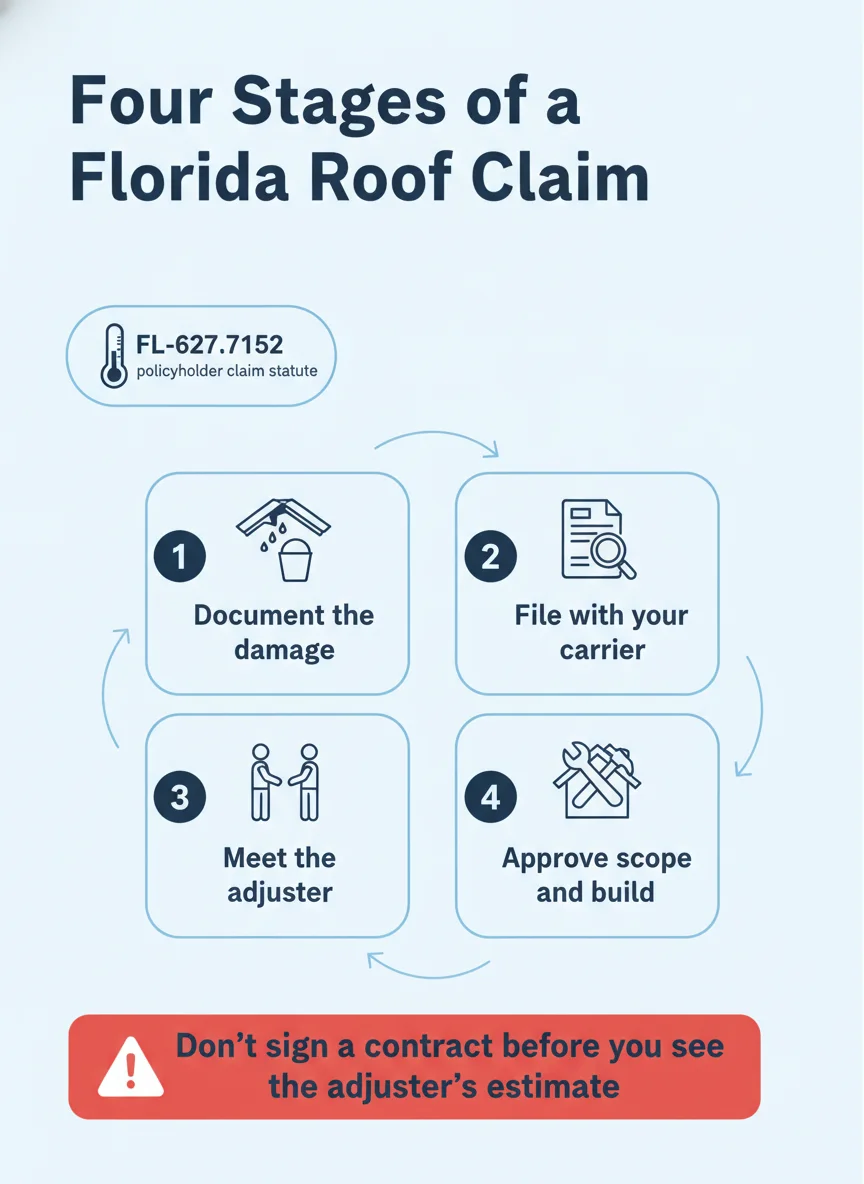
- Document the damage: Take dated photos from the ground and, if there's an active leak, get it temporarily covered to limit further damage before the adjuster arrives.
- File the claim: Call your carrier with your policy number and a description of the damage to open the file and start the adjuster scheduling process.
- Meet the adjuster: Be present or have your contractor present during the inspection so nothing gets missed in the carrier's written estimate.
- Review the estimate: Compare the adjuster's scope against what your contractor finds, and submit a supplement if there's a documented gap in materials or labor.
- Sign and schedule: Once the scope is agreed on, sign the contract, pay your deposit, and schedule the build around permitting and material delivery.
- Complete the project: The crew tears off the old covering, installs the approved materials, and closes out any required permit inspections.
- Submit the final invoice: Send the completed invoice to your carrier to release the recoverable depreciation and close the claim.
What You'll Run Into at Each Stage
When the Adjuster's Estimate Falls Short
It's common for an adjuster's first estimate to undercount what's actually needed, especially on tile or metal roofs where damage isn't always visible from a drive-by inspection. This isn't usually bad faith, it's just the limits of a visual estimate compared to what a crew finds once covering is removed during the actual build.
A supplement is the normal fix. Your contractor documents the additional scope, usually with photos and measurements taken during the project, and submits that back to the carrier for review. This can add time to the schedule, but it's part of making sure the final payout actually matches the real cost of the work.
Choosing a Contractor for the Build
You're generally free to choose your own contractor for an insurance-driven roof job, the carrier approves the scope of work, not the crew doing it. Look for a licensed, insured contractor who's comfortable reviewing the adjuster's estimate line by line and who can speak to both commercial roofing and residential claims if your situation involves either.
It also helps to ask how a contractor handles supplements and final paperwork, since that's often where claims stall. A crew that's done this before will know what documentation the carrier typically wants before you ever get to the final invoice stage.
DIY Documentation vs Calling a Licensed Contractor
Homeowners can absolutely handle some of this process themselves. Taking initial photos, calling the carrier to open the claim, and keeping a basic log of dates and conversations are all things you don't need a professional for, and doing them early helps everything downstream move faster.
Where a licensed contractor earns their place is in the technical parts, climbing the structure to assess damage safely, identifying issues an adjuster's visual walk-through might miss, and writing an estimate that holds up against the carrier's own pricing software. This is especially true for tile and metal roofing, where damage patterns aren't always obvious at ground level.
The final invoice and any supplement paperwork are also worth having a professional handle, since recoverable depreciation only gets released once the carrier has documentation that matches their approved scope. Getting this part wrong is one of the more common reasons a claim stalls near the finish line instead of closing out cleanly.
Getting Through the Process Without the Guesswork
A roof insurance claim can feel like a lot of moving parts, but it really comes down to documentation, a fair estimate, an approved scope, and a final invoice that matches the work performed. Homeowners who understand that sequence tend to move through it with fewer delays and fewer surprises on the final payout. If your roof is still holding but showing early wear, it's also worth reading when a roof is past repair before a storm forces the decision for you.
Whether you're in Lakeland or elsewhere across central Florida, the carrier process stays largely the same, even if the adjuster assigned to your file changes from claim to claim. Quality Plus Roofing & Solar works through this sequence with homeowners regularly, from the first photos to the final invoice that closes the claim.
Frequently asked questions
How long does a roof insurance claim take in Florida?
It varies by carrier workload and the scope of damage, but most claims move through documentation, adjuster review, and scope negotiation before a contractor ever starts work. Weather events that affect a wide area tend to slow adjuster scheduling, so patience in the early weeks is normal.
What is the difference between ACV and RCV on a roof claim?
ACV, or actual cash value, is the depreciated value of your roof at the time of loss, while RCV, or replacement cost value, is what it costs to replace it new. Many policies pay ACV first and release the depreciation difference, called recoverable depreciation, after the work is finished.
Do I have to pay my deductible if my roof is damaged?
Yes, your deductible is your portion of the claim and it's built into your policy regardless of who does the repair. A contractor who tells you otherwise is describing something your policy doesn't actually say.
Can I choose my own contractor for an insurance roof claim?
In most cases yes, the carrier approves a scope of work but doesn't assign you a contractor. It's worth choosing a licensed, insured crew who's comfortable working directly with adjusters on the estimate.
What happens if the adjuster's estimate is lower than my contractor's?
This is common and is usually resolved through a supplement, which is additional documentation and pricing submitted back to the carrier to close the gap. A contractor experienced in claims will typically handle this paperwork as part of the project.