Why Shingle Cost Varies So Much Across Central Florida
Ask five homeowners in Lakeland what they paid for a new roof and you'll get five different numbers, even on houses that look similar from the street. Shingle cost isn't one line item, it's a stack of smaller decisions that add up differently on every property.
In Central Florida specifically, sun exposure, humidity, and the occasional high wind event all play into which shingle grade makes sense for a given roof. That context matters more here than in a drier, cooler climate, and it's part of why a quote built for a Florida home looks different from a generic national estimate.
How Shingle Pricing Actually Gets Built
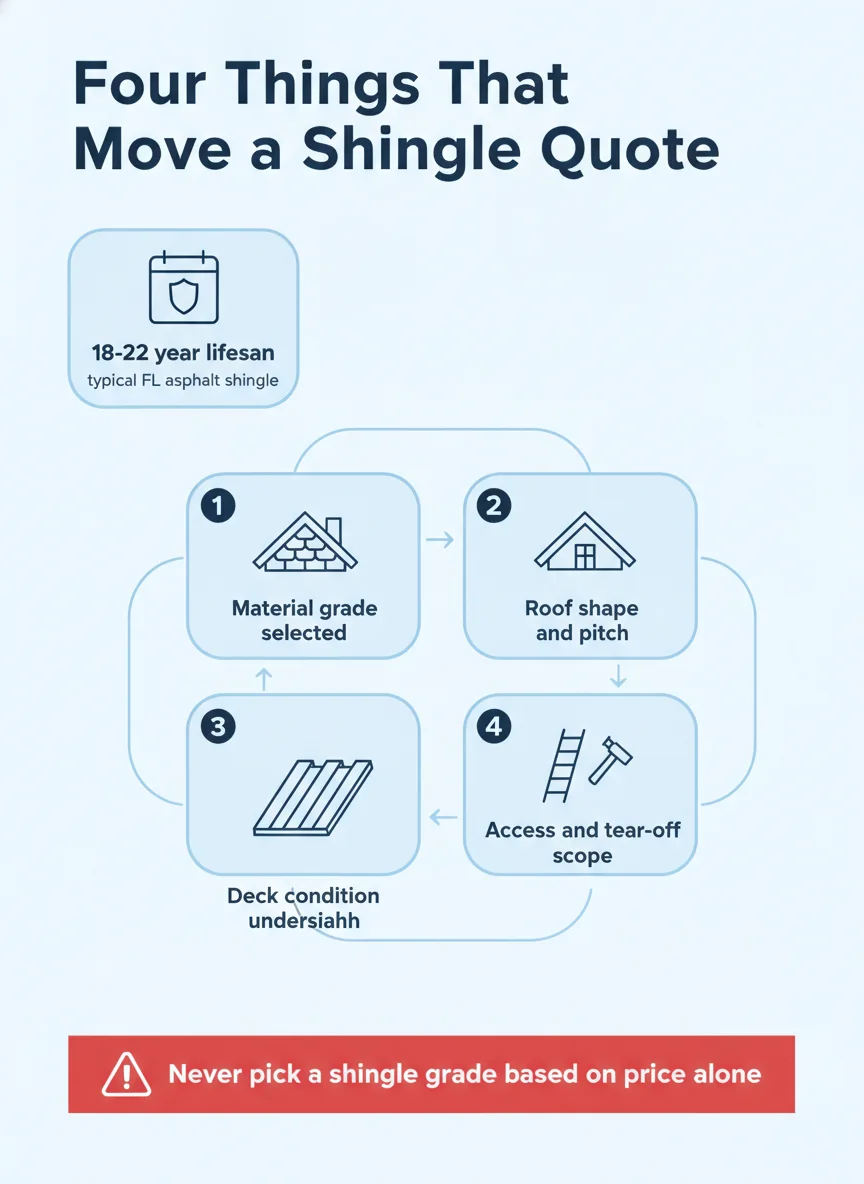
A roofing quote isn't just shingles times square footage. It's material grade, labor to remove the old roof, labor to install the new one, underlayment, flashing, ventilation components, and the dump fees for hauling away the old material.
Material Grade
Asphalt shingles come in a few tiers, from basic three-tab up through heavier architectural and designer styles. The heavier the shingle, the more material goes into each bundle, and the more it typically costs per square, but it also tends to hold up better under Florida sun and wind over the life of the roof.
Metal, tile, and TPO are separate categories entirely with their own cost structures and install methods. If you're comparing a shingle quote against a metal or tile quote, you're not comparing apples to apples, you're comparing two different systems with different lifespans and different upfront costs.
Roof Shape and Pitch
A simple gable roof with few penetrations is the fastest, most straightforward roof to shingle. Add hips, valleys, dormers, skylights, and chimneys, and labor time climbs even if the total square footage stays the same.
Steep pitches slow a crew down further and require more safety equipment and staging, which is why many contractors build in a steep-roof multiplier on top of the base rate. A roof that looks modest from the ground can still carry a steep pitch that adds real labor hours.
| Factor | Lower Cost Scenario | Higher Cost Scenario |
|---|---|---|
| Shingle grade | Standard architectural shingle | Premium or designer-grade shingle |
| Roof shape | Simple gable, few penetrations | Multiple valleys, hips, skylights |
| Pitch | Low to moderate slope | Steep slope requiring extra staging |
| Deck condition | Solid deck, no repair needed | Rotted or soft decking requiring replacement |
What's Actually Under the Shingle
The shingle is the visible layer, but underlayment, flashing, and ventilation components do a lot of the real work protecting the house. Underlayment is the water barrier between the shingle and the deck, flashing seals the transitions around chimneys and walls, and ventilation keeps the attic from trapping heat and moisture.
Skipping or skimping on any of these to save money upfront is one of the most common ways a shingle roof fails early, even if the shingle itself is rated for a long lifespan. A quote that only itemizes the shingle brand and skips these components is worth a second look.
Step-by-Step: How a Shingle Roof Gets Quoted and Installed
Most legitimate roofing quotes follow a similar sequence, whether the job is a straightforward roof repair or a full residential roofing replacement. Here's the general order.
- Measurement: The roof gets measured, either by satellite imagery or an on-site visit, to establish total squares and roof complexity.
- Material selection: You choose a shingle grade and color, usually with a few options at different price points.
- Deck inspection: Once tear-off begins, the crew checks the decking underneath for soft spots or rot that need repair before new shingles go down.
- Underlayment and flashing: A water-resistant underlayment and new flashing go down first, sealing the vulnerable transitions.
- Shingle installation: Shingles are installed in courses from the eave up, with proper nailing patterns for wind resistance.
- Final walkthrough: The finished roof gets a final check for ridge caps, vents, and clean site cleanup before the job closes out.
Reading a Quote: What the Numbers Are Actually Telling You
Low Quotes
A quote that comes in noticeably lower than others usually means something is being left out, not that you found a deal. It could be a lighter shingle grade, a skipped deck inspection, or underlayment that doesn't meet current wind-resistance standards.
It's worth asking directly what's included in a low number before assuming it's a bargain. A missing ventilation upgrade or a thinner underlayment won't show up on the invoice, but it will show up in how the roof holds up over time.
High Quotes
On the other end, a high quote isn't automatically the better roof either. Sometimes it reflects a premium designer shingle you don't need, and sometimes it reflects a roof with genuine complexity, like multiple valleys or a steep pitch, that's going to cost more no matter who installs it.
The useful comparison isn't the bottom-line number, it's whether each quote breaks out material grade, tear-off scope, deck repair allowance, and warranty terms in enough detail that you can compare them line by line.
What a Homeowner Can Evaluate vs. What Needs a Licensed Roofer
You can absolutely do your own groundwork before calling anyone. Walking the exterior with binoculars to spot missing or curling shingles, checking the attic for daylight or water stains, and pulling up your home's permit history to see when the roof was last replaced are all things a homeowner can reasonably do.
What you can't reasonably evaluate from the ground is deck condition, proper nailing pattern, or whether the underlayment and flashing meet current wind codes, since all of that is hidden under the shingle until tear-off starts. That's the part a licensed roofer has to assess in person.
If you're trying to decide whether your current roof needs a patch or a full roof repair versus a full tear-off and replacement, that's also a judgment call best made after a professional has walked the roof and checked the deck, not from curb appeal alone. For more on that decision, see When Does a Roof Need to Be Replaced?
Getting a Quote You Can Actually Compare
The best way to compare shingle costs across contractors isn't to ask for a single number over the phone, it's to ask for an itemized quote that breaks out material grade, tear-off and disposal, deck repair allowance, and warranty terms. That's the only way to know you're comparing the same scope of work.
If your roof is in Lakeland or anywhere across Central Florida and you want a clear, itemized read on what a shingle roof would actually cost on your specific house, Quality Plus Roofing & Solar can walk the roof and break it down line by line.
Frequently asked questions
Why do two roofing quotes for the same house come back so different?
The shingle brand or grade is usually only one line item. The bigger swings come from how much of the old roof needs to be torn off, whether the deck needs repair once it's exposed, and how complex the roof shape is to work around.
Does a steeper roof cost more to shingle?
Yes, a steep pitch typically adds cost because it slows the crew down and requires extra safety gear and staging. Many contractors apply a steep-roof factor on top of the base material and labor price.
Are more expensive shingles actually worth it?
It depends on what you're buying with the upgrade. A heavier architectural shingle usually holds up better to Florida sun and wind than a basic three-tab, but the real value is in the installation quality underneath it, not just the shingle label.
Does the number of layers already on my roof affect the cost?
It can. A roof with an existing layer that needs to come off adds tear-off labor and disposal, and most codes in Florida require a full tear-off rather than a roof-over in many situations.
Will a bigger roof always cost proportionally more?
Generally yes, but not in a straight line. A larger simple roof can actually cost less per square than a smaller roof with lots of valleys, hips, and penetrations, because complexity drives labor more than raw size.