
Why This Decision Matters More in Central Florida
Roofs across central Florida take a beating that most of the country never deals with. Intense UV exposure, heavy summer rain, and swings between scorching afternoons and sudden downpours all work on shingles, tile, and metal year round. That combination shortens the practical lifespan of roofing materials compared to drier, milder climates, which means homeowners here face the repair-or-replace question earlier and more often than homeowners in other regions.
Knowing where that line sits matters because the wrong call in either direction costs money. Replacing a roof too early wastes years of remaining service life. Patching a roof too long lets water find its way into decking, insulation, and eventually drywall, turning a roofing job into a much bigger repair bill. This guide walks through the specific signs that tell a trained eye a roof has crossed from repairable into replacement territory.
How Do You Know When a Roof Can't Be Patched Anymore?
A roof can't be patched anymore once the damage is spread across the surface instead of isolated to one spot, or once the material underneath the visible layer has started to fail. A single leak at a pipe boot is a repair. The same leak pattern showing up at three different penetrations, paired with granule loss and a soft spot near a valley, is a roof telling you it's done.
Spread Versus Isolated Damage
Isolated damage means one clear cause in one clear location, like a cracked pipe boot seal or a single lifted shingle from wind. That kind of problem has a defined fix and a defined cost, and addressing it typically stops the leak for good as long as the surrounding material is still sound.
Spread damage looks different. It shows up as multiple active or past leak stains on a ceiling, granule buildup collecting in more than one gutter section, or flashing pulling away at several penetrations rather than just one. When the same type of failure keeps appearing in new places, the material itself is aging out rather than suffering a single bad break.
What's Happening Below the Surface
The visible shingles, tile, or metal panels are only the top layer of the system. Underneath sits the underlayment and the decking, and those layers take the real damage once water starts getting past the surface material. A roof can look reasonably intact from the ground while the decking underneath has already gone soft from repeated small leaks over several seasons.
That's why a roofer presses and checks decking during an inspection rather than relying on a visual scan alone. Soft or spongy decking, found by walking the roof or checking from the attic, is one of the clearest signs that surface-level repairs won't hold because the structure supporting the surface is already compromised.
| Issue Found | Repair Likely Fits | Replacement Likely Fits |
|---|---|---|
| One active leak at a single penetration | Yes, if surrounding material is sound | Only if decking is already soft |
| Granule loss in multiple gutter sections | Rarely, this signals broad wear | Yes, surface is aging out |
| Flashing failing at 2+ locations | Sometimes as a stopgap | Yes, pattern points to system age |
| Roof has a prior layover and new leaks starting | Rarely | Yes, layovers mask underlying issues |
The Roofing System, Not Just the Top Layer
A roof is a system made up of several layers working together: the decking, the underlayment, the flashing at every penetration and transition, and the visible surface material whether that's shingle, tile, or metal. Each layer has its own job, and a failure in one layer puts extra strain on the others. Flashing that's failed, for example, lets water reach the underlayment and decking even if the shingles above look fine.
Understanding that system is what separates a quick patch from a real assessment. A patch addresses the top layer. A full evaluation checks whether the layers underneath are still doing their job, because replacing surface material over compromised decking or underlayment just delays the same problem rather than solving it.
Step-by-Step: How a Roof Gets Evaluated for Repair or Replacement
A thorough evaluation follows a consistent sequence so nothing gets missed, whether the roof is asphalt shingle, tile, metal, or a flat commercial surface.
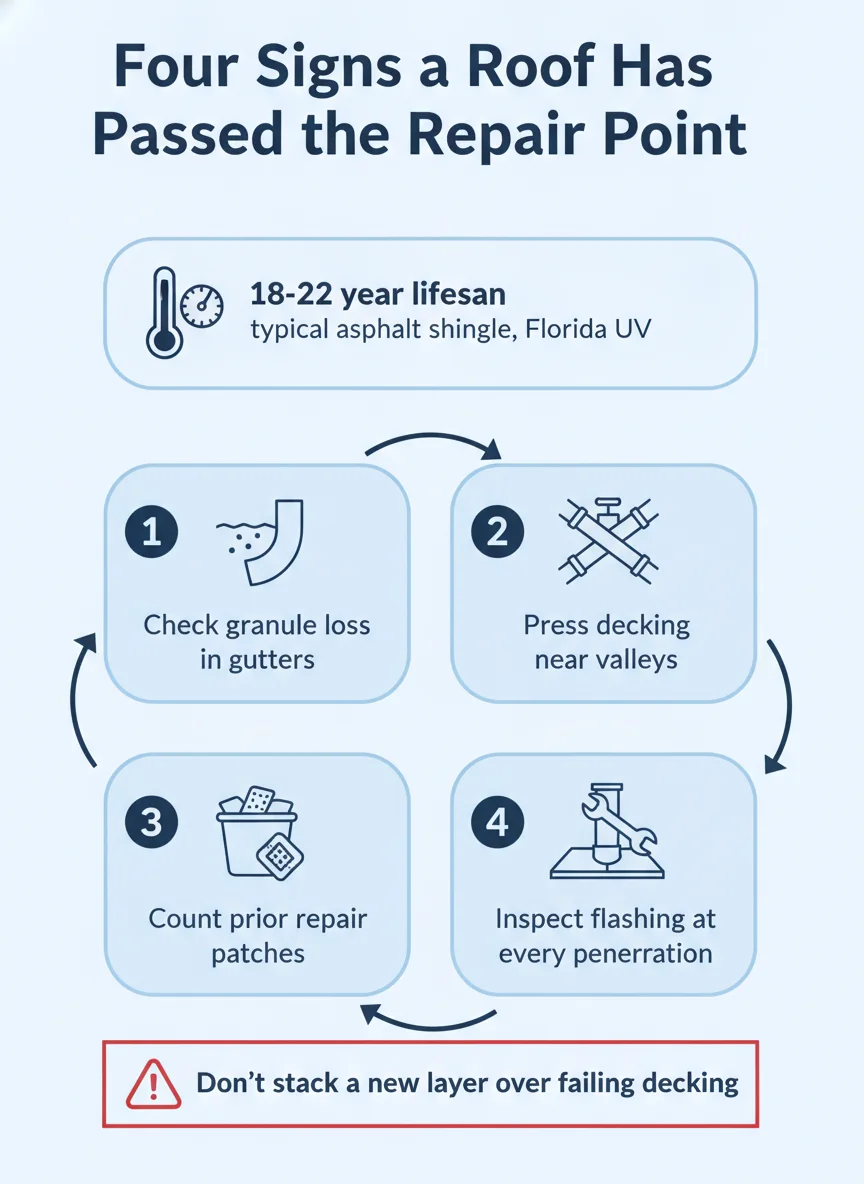
- Walk the full surface: A roofer walks the entire roof rather than viewing it from the ground, looking for lifted, cracked, or missing material across every section.
- Check granule accumulation: Gutters and downspouts get checked for granule buildup, which signals how much protective coating has already worn off the shingles.
- Press and test decking: Soft spots get identified by pressing on the decking near valleys, penetrations, and any area with a history of leaks.
- Inspect every flashing point: Chimneys, vents, skylights, and wall transitions all get checked individually since flashing failures are a common source of hidden leaks.
- Review the attic from inside: Water stains, daylight gaps, or damp insulation visible from inside the attic confirm whether moisture has already made it past the surface.
- Check for prior repairs or layovers: A roof with several past patches or an existing layover gets extra scrutiny since those often mask bigger problems underneath.
- Compare findings to expected lifespan: The material's age and typical service life get weighed against what the inspection found to make a final repair-or-replace recommendation.
What the Findings Usually Mean
When the Signs Point to Repair
If the inspection turns up one clear cause, the surrounding material tests firm, and the attic shows no signs of ongoing moisture beyond the immediate area, a repair is typically the right call. This is common on roofs that are still well within their expected service life and simply took isolated damage from wind, a falling branch, or a single failed seal.
A well-executed repair in this scenario should hold for the remaining life of the roof. The key is making sure the repair addresses the actual source of the problem, not just the visible symptom, which is why checking the layers underneath matters even for a small fix.
When the Signs Point to Replacement
If the inspection finds soft decking, flashing failures in multiple spots, widespread granule loss, or a roof already past its typical material lifespan, replacement usually makes more financial sense than continued repairs. At that point, the roof is no longer failing in one place, it's failing as a system, and repairs become a cycle of treating new symptoms as old ones keep surfacing.
Replacement at this stage also resets the clock on materials and workmanship, which matters since a new roof installed today uses the full expected service life of modern shingle, tile, or metal products rather than whatever years are left on an aging system.
Is This Something a Homeowner Can Check Themselves?
A homeowner can safely do a first-pass check from the ground and the attic without ever climbing onto the roof. Walking the yard after a windy day to look for shingle pieces, checking gutters for granule buildup, and looking in the attic for water stains or damp insulation are all reasonable DIY steps that can tell you whether it's time to call someone out.
What a homeowner shouldn't do is walk the roof surface itself or attempt to diagnose flashing or decking condition up close. Roofing materials can be deceptively fragile underfoot, especially aging shingle or tile, and a fall risk isn't worth saving a service call. Pressing on decking and inspecting flashing closely requires being on the roof safely, which is a job for someone trained and equipped for it.
The practical approach is to do the ground-level and attic checks yourself, and bring in a licensed roofer for anything that requires getting on the surface. That split keeps you informed about your own roof's condition without taking on unnecessary risk, and it means the professional evaluation starts with useful information rather than from scratch.
Getting a Straight Answer on Repair Versus Replace
The clearest way to settle whether a roof is still repairable is a hands-on evaluation that checks the decking, flashing, and underlayment, not just the surface material. Homeowners weighing a roof repair against a full residential roofing replacement in Lakeland, Tampa, or anywhere across central Florida are better off with that full picture before deciding, since the visible damage rarely tells the whole story on its own.
If the roof in question has already had a roof-over done in the past, that history matters too, since layovers often hide the exact kind of decking issues covered above. For homeowners in Sarasota or elsewhere in the region who aren't sure which side of the line their roof falls on, Quality Plus Roofing & Solar can walk the full system and give a straight answer before any work gets scheduled.
Frequently asked questions
How do I know if my roof needs to be replaced instead of repaired?
A roof usually needs replacement instead of another repair when the problems show up in more than one spot or the decking underneath has gone soft. A single isolated leak around one pipe boot is often a fair repair, but widespread granule loss, multiple flashing failures, or a roof already near the end of its expected lifespan point toward replacement being the better long-term move.
Does the age of my house tell me the age of my roof?
No, the year a house was built is not the same as the age of its roof. Roofs get replaced, recovered, or repaired independently of the home itself, so the only reliable way to know a roof's real age is a permit history, prior invoice, or a physical inspection of the materials.
Can a roof be repaired more than once in the same spot?
Yes, but repeated repairs in the same area are usually a sign the underlying material has reached the end of its service life rather than a sign of bad luck. Each patch addresses the symptom, not the aging shingle, underlayment, or flashing causing it, so repeat failures in one location are worth a closer look.
What happens if I keep patching an old roof instead of replacing it?
Patching an old roof past its useful life usually means paying for repairs more often while the risk of water reaching the decking or interior keeps climbing. Once moisture gets under aged materials in multiple places, repairs stop being cost-effective compared to one replacement that resets the clock.
Is it ever better to repair a roof that is close to its expected lifespan?
Sometimes, if the damage is isolated and the rest of the roof is sound, a targeted repair can still make sense even on an older roof. The decision comes down to whether the issue is confined to one area or whether it's a symptom showing up across the whole surface.