
Why Shingle Grade Matters in Florida
Walk down almost any street in central Florida and you'll see roofs that look similar from the curb but are built from completely different products underneath. The shingle grade a home uses, whether it's a basic three-tab, a laminated architectural shingle, or a premium designer shingle, affects how that roof performs through years of sun, humidity, and wind events.
For homeowners planning a residential roofing project in Lakeland, Tampa, or anywhere across the region, understanding these grades before getting quotes helps you compare apples to apples. A lower bid using a lighter shingle isn't automatically a bad deal, but you should know what you're trading for that price.
What Actually Separates the Grades?
The core differences come down to how many layers of asphalt and fiberglass mat go into each shingle, how much the shingle weighs per 100 square feet (a 'square' in roofing terms), and how the manufacturer rates it for wind resistance. More material generally means more durability, but it also means more weight on the structure and a higher price tag.
Three-Tab Shingles
Three-tab shingles are a single flat layer of asphalt cut into three even tabs, giving the roof a uniform, repeating pattern. They're the lightest and least expensive option, which made them the default choice for decades before architectural shingles took over the market.
Because they're built from one layer, three-tab shingles typically carry a shorter service life and a lower wind rating than laminated products. They're still manufactured and used in some budget-conscious projects, but fewer roofing suppliers stock them compared to a decade ago.
Architectural (Laminated) Shingles
Architectural shingles, sometimes called laminated or dimensional shingles, are built from two layers of material fused together. That extra layer creates a thicker, textured appearance that mimics natural wood shake or slate from a distance, and it's become the standard choice for most residential replacements.
The added thickness generally translates to a higher wind rating and a longer expected service life compared to three-tab shingles, which matters in a region that sees regular wind events. This is the grade most homeowners land on when balancing appearance, durability, and overall project cost.
| Shingle Grade | Layers | Typical Use Case |
|---|---|---|
| Three-tab | Single layer | Budget replacements, rental properties |
| Architectural | Two laminated layers | Most residential replacements |
| Designer | Heaviest, multi-layer construction | Premium curb appeal, historic-style homes |
What Goes Into a Designer Shingle
Designer shingles sit at the top of the asphalt shingle category, built with the heaviest materials and often cut into irregular shapes to mimic the look of natural slate or cedar shake. Manufacturers market these as a premium upgrade, and the weight and construction quality generally reflect that positioning.
These shingles tend to carry the longest manufacturer warranties in the asphalt category and the strongest wind ratings, but they also come at the highest price point of the three grades. Homeowners choose designer shingles when the architectural style of the home calls for a distinct look that standard laminated shingles can't replicate.
Step-by-Step: How to Compare Shingle Grades Before You Buy
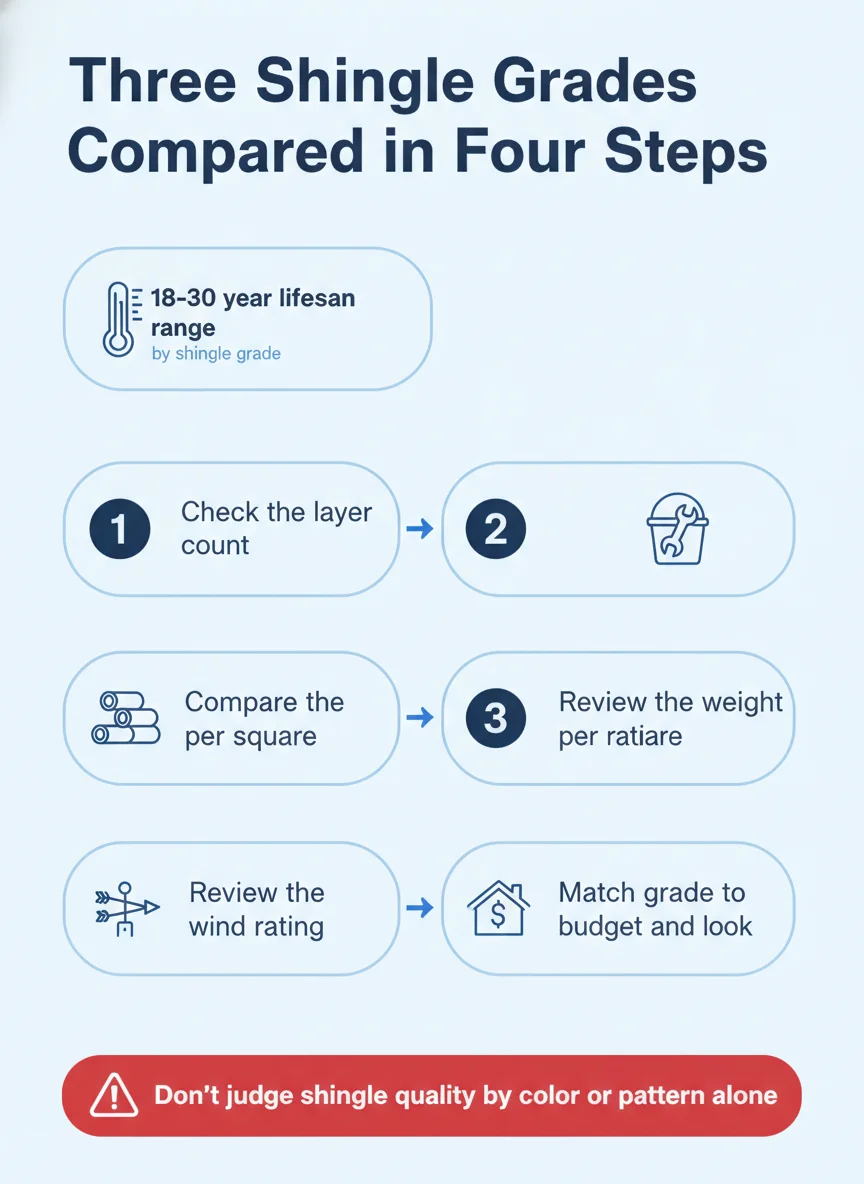
When you're collecting quotes for a new roof, use this sequence to make sure you're comparing the right things instead of just the bottom-line price.
- Ask for the brand and line: Get the exact manufacturer and product line listed on every quote, not just 'architectural shingle,' so you can look up the spec sheet yourself.
- Check the wind rating: Compare the manufacturer's stated wind rating for each product, since this varies even within the architectural category.
- Review the warranty terms: Look at what's actually covered under the manufacturer's material warranty versus the installer's workmanship warranty.
- Compare weight per square: Heavier shingles generally mean more material and more durability, so ask for this figure if it's not on the quote.
- Match the grade to your roof's pitch: Steeper roofs show shingle texture and shadow lines more, which matters if you're choosing between architectural and designer for appearance.
- Confirm installation includes underlayment upgrades: A higher shingle grade paired with basic underlayment undercuts the investment, so ask what's included underneath.
What You'll Notice on the Roof Itself
Once shingles are installed, the visual differences between grades become more obvious than most homeowners expect. Three-tab roofs read as flat and uniform from the street, while architectural and designer shingles create shadow lines and depth that change how the whole house looks.
Spotting a Three-Tab Roof
A three-tab roof has a repeating, grid-like pattern because every tab is the same size and shape, cut from a single flat sheet. From the ground, the roof looks noticeably flatter than a laminated shingle roof, and up close the edges lie in one plane with no layered texture.
Over time, three-tab shingles can show granule loss and curling at the tabs more visibly than laminated products, since there's less material mass to resist UV breakdown. This is usually the first sign an older three-tab roof is nearing the end of its service life.
Spotting Architectural or Designer Shingles
Architectural and designer shingles have an irregular, staggered pattern that creates visible shadow lines across the roof plane, giving it a dimensional, textured look. The tabs vary in size and overlap unevenly, which is intentional and mimics the look of natural roofing materials.
Designer shingles push this further with more pronounced shaping, often cut to resemble individual slate tiles or cedar shakes rather than a repeating tab pattern at all. If you're standing in front of a home and can't tell the roof is made of asphalt at first glance, it's likely a designer product.
DIY or Call a Licensed Roofer?
Choosing a shingle grade is something a homeowner can absolutely research and decide on their own, since it mostly comes down to budget, appearance preference, and how long you plan to stay in the home. Reading manufacturer spec sheets and comparing wind ratings doesn't require a license, just some patience.
Installation is a different story. Shingle performance depends heavily on correct nailing patterns, proper overlap, and underlayment that matches the product's warranty requirements, all of which a licensed roofer is trained to get right the first time. An improperly installed architectural shingle can underperform a well-installed three-tab roof.
If you're weighing roof repair against a full replacement because of shingle wear, a licensed contractor can also tell you whether patching the current grade makes sense or whether it's time to upgrade. That's a judgment call worth getting a professional opinion on, especially if the existing shingles are already past their expected service window, a topic covered in more depth in When a Roof Is Past Repair: The Signs Roofers Look For.
Choosing the Right Grade for Your Home
There's no single right answer across every home in Lakeland or the surrounding region, since the best shingle grade depends on your budget, how long you plan to own the home, and the look you're going for. Architectural shingles cover the needs of most homeowners well, while designer shingles make more sense for a specific aesthetic goal.
Whatever grade you land on, the installation quality matters just as much as the product itself. Quality Plus Roofing & Solar installs all three grades across residential and new construction projects and can walk you through which one fits your home and budget.
Frequently asked questions
What is the difference between three-tab and architectural shingles?
Three-tab shingles are a single flat layer cut into even tabs, while architectural shingles (also called laminated shingles) are built from two layers fused together for extra thickness. That second layer is what gives architectural shingles their dimensional look and generally higher wind rating.
Are designer shingles worth the extra cost?
Designer shingles cost more because they use heavier materials and mimic the look of slate or wood shake, so the value comes down to whether you want that premium appearance. For straightforward performance and curb appeal, architectural shingles cover most homes just fine.
Which shingle grade is most common on new roofs today?
Architectural shingles are the standard choice on most residential replacements today because they balance cost, appearance, and durability well. Three-tab shingles have become harder to find as manufacturers shift production toward laminated products.
Do higher shingle grades really last longer?
Generally yes, heavier shingles with more layers tend to hold up longer under UV exposure and wind than a thin single-layer product. Actual lifespan still depends on installation quality, attic ventilation, and how the roof is maintained over time.
Can you mix shingle grades on one roof?
It's technically possible but not common practice, since mixing grades can create uneven wear patterns and complicate warranty coverage. Most roofing contractors recommend sticking with one grade across the whole roof for consistent performance.