
Hail Season in Central Florida
Central Florida sees its share of fast-moving afternoon storms that can drop hail without much warning, and homeowners from Lakeland to Tampa and Orlando often don't realize their property took a hit until weeks later. A loud ten minutes of hail hitting the roof, then it's over and the sun's back out, so it's easy to assume everything's fine.
The truth is hail damage is sneaky. It rarely punches a hole you'd notice from the yard. Instead it bruises materials in ways that only show their full effect over time, which is exactly why a ground-level check right after a storm matters, even if it's just step one before a closer look.
Why Hail Damage Is Hard to See From the Yard
Most of what hail does happens on the horizontal planes of a roof, the parts facing straight up at the sky, which are the slopes you generally can't see standing on the ground. What you can see are the vertical and near-vertical surfaces around the property, like gutters, vent stacks, and AC units, and those give you real clues even though they're not the roof itself.
What Hail Does to Shingles
On asphalt shingles, hail typically causes what's called bruising, a soft spot where the impact has cracked or displaced the mat underneath without necessarily breaking through the surface. Granule loss often follows, where the protective gravel coating gets knocked loose around the impact point, leaving the asphalt beneath more exposed to sun and water.
Because these marks sit flush with the shingle and don't always break the surface right away, they're close to invisible from the ground. A bruised shingle can look completely normal in a photo from the driveway. That's part of why hail claims get disputed so often, the damage is real but subtle.
What Hail Does to Soft Metals
Soft metal components take hail differently than shingles do. Gutters, downspouts, vent caps, and AC condenser fins are often made of thinner aluminum or similar material, and they dent on impact in a way that's genuinely visible. A fresh dimple pattern on a gutter run is one of the clearest hints a property took a real hailstorm, not just rain.
This is the part of a ground check that actually works. Walk the perimeter of the house and look at anything metal and exposed. Circular dents clustered in a pattern, especially on the side of the house that faced the storm, are a strong signal that the roof above likely saw the same hail.
| Hail Size | What It Can Damage | Ground-Level Clue |
|---|---|---|
| Pea-size | Minor granule disturbance | Usually nothing visible from the yard |
| Marble to quarter-size | Shingle bruising, soft metal dings | Dented vent caps and gutter dimples |
| Golf ball or larger | Cracked shingles, bent metal panels, screen damage | Visible dents, debris, broken screens or plants |
What You're Actually Looking For
A useful ground check isn't about staring at the roofline, it's about checking the things that catch the same hail the roof did. Granules in your downspouts or pooling at the base of a downspout after a storm are a direct sign that shingle surfaces got knocked around somewhere above.
Screens, soft landscaping, and even patio furniture cushions can show hail impact too. If you've got dented patio screens or shredded leaves on one side of the yard, that tells you the direction and rough intensity of the storm, which helps you know how seriously to take a closer look at the roof itself.
Step-by-step: Checking Your Property After a Hailstorm
Do this walk-around the same day or the next morning while the damage is still fresh and before rain washes away loose granules.
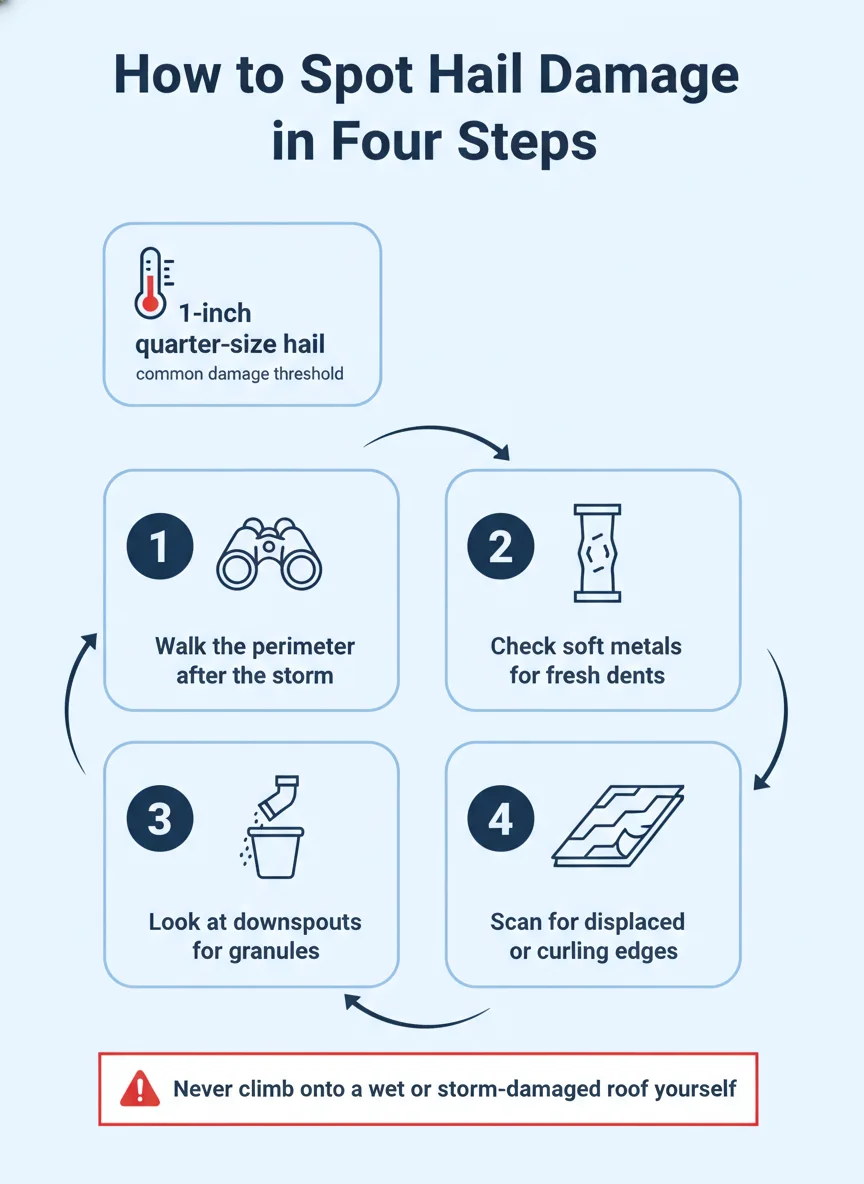
- Walk the perimeter: Circle the house slowly on the side that faced the storm, checking gutters, downspouts, and fascia for dents.
- Check soft metals: Look closely at vent caps, flashing, and AC fins for fresh circular dings that weren't there before.
- Inspect downspout openings: Loose granules collecting at the base of a downspout point to shingle surfaces losing material above.
- Scan landscaping and screens: Shredded leaves, bruised plants, or dented patio screens confirm the storm's intensity on that side of the property.
- Photograph everything: Take wide and close-up photos of any dents or debris the same day, with a date stamp if your camera allows it.
- Note the storm date: Write down when the hail hit, since that date matters if you end up filing a claim later.
- Call for a closer look: If you find consistent dents or granule loss, schedule a roof repair inspection before small bruising turns into a leak.
What Do These Signs Usually Mean?
What the signs mean depends mostly on how widespread and consistent they are across one side of the property. A single dented vent cap isn't much on its own, but a pattern of dents across gutters, vents, and AC fins on the same side of the house usually means the roof slopes facing that direction took comparable hits.
Minor Granule Loss
Light granule loss without other signs often isn't urgent on its own. Asphalt shingles naturally shed some granules over their life, so a little in the gutter after a storm isn't automatically a red flag.
The concern comes when granule loss shows up alongside soft metal dents or a storm with hail reported in the area. At that point it's worth having the slopes checked directly rather than guessing from what's visible below.
Exposed Mat or Bent Metal
Visible dents in metal paired with heavier granule loss is a stronger signal. It usually means the hail was large enough or the storm long enough to cause real impact across multiple surfaces, not just a light dusting.
This is the scenario where it's worth getting someone up on the roof fairly soon. Bruised or cracked shingle mat left unaddressed is what eventually turns into a leak, sometimes months after the storm that caused it.
DIY vs. Calling a Pro
The ground-level walk-around is something every homeowner can and should do themselves, it costs nothing and takes fifteen minutes. Checking gutters, vent caps, and landscaping for storm signs doesn't require any special tools or training, just a careful eye right after the storm passes.
What you shouldn't do is get on a ladder to look at the slopes yourself, especially right after a storm when materials may be loosened and footing is unpredictable. That part genuinely needs a licensed professional who knows what bruised shingle mat looks like versus normal wear.
If your ground check turns up consistent dents or granule loss, the next move is a direct slope inspection rather than more guessing from below. A professional can document the actual condition with the kind of detail an insurance conversation requires.
After the Walk-Around
A ground check after a hailstorm won't give you the full picture, but it tells you whether it's worth getting a closer look. Consistent dents on soft metal, granules collecting in downspouts, and storm-side landscaping damage are the clues that matter most, and they're the ones you can actually see without a ladder.
If your property in Lakeland, Tampa, or anywhere else across Central Florida shows those signs after the next storm, don't wait for a leak to confirm it. Lakeland homeowners dealing with roof uncertainty after a storm can read more in our guide on missing shingles after a windstorm, and Quality Plus Roofing & Solar is available to take the closer look the ground can't give you.
Frequently asked questions
Can you tell if hail damaged your roof just by looking at it from the yard?
You can spot some clues from the ground, like dented gutters, dinged vents, or granules collecting in your downspouts, but most hail bruising on shingles happens on the slopes you can't see from the driveway. A ground check is a good first screen, not a final answer.
What size hail actually causes roof damage?
Hail around an inch across, roughly quarter-size, is generally where damage starts showing up on asphalt shingles and soft metals. Smaller hail can still cause cosmetic marks, but it's less likely to break the shingle mat or dent downspouts.
Why does hail damage sometimes not show up until months later?
Hail can bruise a shingle without breaking it open right away, and that bruised spot loses its protective granules over time until water finally finds a way in. That's why a storm from months back can turn into a leak well after the fact.
Should you call your insurance company before or after an inspection?
Most homeowners get an inspection first so they know what they're actually dealing with before they open a claim. A documented inspection gives you something concrete to bring to the conversation instead of guessing.
Do soft metals like vents and gutters show hail damage before the roof does?
Often, yes, because they're softer than shingle material and dent more easily on impact. If you see fresh circular dings on gutters, vent caps, or AC fins after a storm, it's a strong sign the roof slopes took a hit too.