
Why Metal Roofs Are Showing Up More Often in Florida
Drive through central Florida neighborhoods today and you'll spot more standing seam panels glinting in the sun than you would have a decade ago. Homeowners across the Lakeland, Tampa and Orlando corridor are asking about metal roofing more often, usually after watching a neighbor's shingle roof take a beating from another summer of sun and afternoon storms.
Part of the shift is about longevity, part is about look, and part is just curiosity about an option that used to feel like a commercial or agricultural material rather than something you'd put on a house. Whatever the reason someone starts researching it, the questions tend to be the same: how does it hold up, what's it actually made of, and is it worth the switch from a traditional roof.
How Does a Metal Roof Actually Handle Florida Weather?
A metal roof handles Florida weather by shedding water fast, resisting wind uplift through its fastening method, and reflecting more solar heat than darker asphalt. The two most common systems you'll see on homes are standing seam panels and exposed-fastener (screw-down) panels, and they behave differently enough that the distinction matters.
Standing Seam Panels
Standing seam panels interlock along raised vertical seams with hidden clips, so there are no exposed fasteners punched through the panel face. That design keeps water moving straight down the roof slope without ever meeting a screw head, which is part of why standing seam systems tend to carry the longest service life expectations in the industry.
Because the panels float on clips rather than being screwed flat, they can expand and contract with temperature swings without stressing the fasteners. That flexibility matters in a state where a roof deck can swing from a cool overnight low to well over 150 degrees of surface temperature on a sunny summer afternoon.
Exposed-Fastener Panels
Exposed-fastener, or screw-down, panels are fastened directly through the panel face with gasketed screws spaced along the ribs. They cost less to produce and install than standing seam, which makes them a common choice on outbuildings, porches, and some residential applications where budget is a bigger factor than maximum lifespan.
The tradeoff is that every one of those screw penetrations is a potential leak point if the gasket degrades or a fastener backs out over the years. Exposed-fastener roofs typically need the fasteners checked and occasionally re-torqued or replaced as part of normal upkeep, something a standing seam system doesn't require.
| Feature | Standing Seam Metal | Exposed-Fastener Metal |
|---|---|---|
| Fastening method | Hidden clips, no face penetrations | Screws driven through panel face |
| Typical upkeep | Minimal, mostly visual checks | Periodic fastener inspection |
| Common use | Full residential roof systems | Outbuildings, porches, budget installs |
| Expansion handling | Panels float on clips | Fixed to deck at each screw |
What's Actually in a Metal Roof System
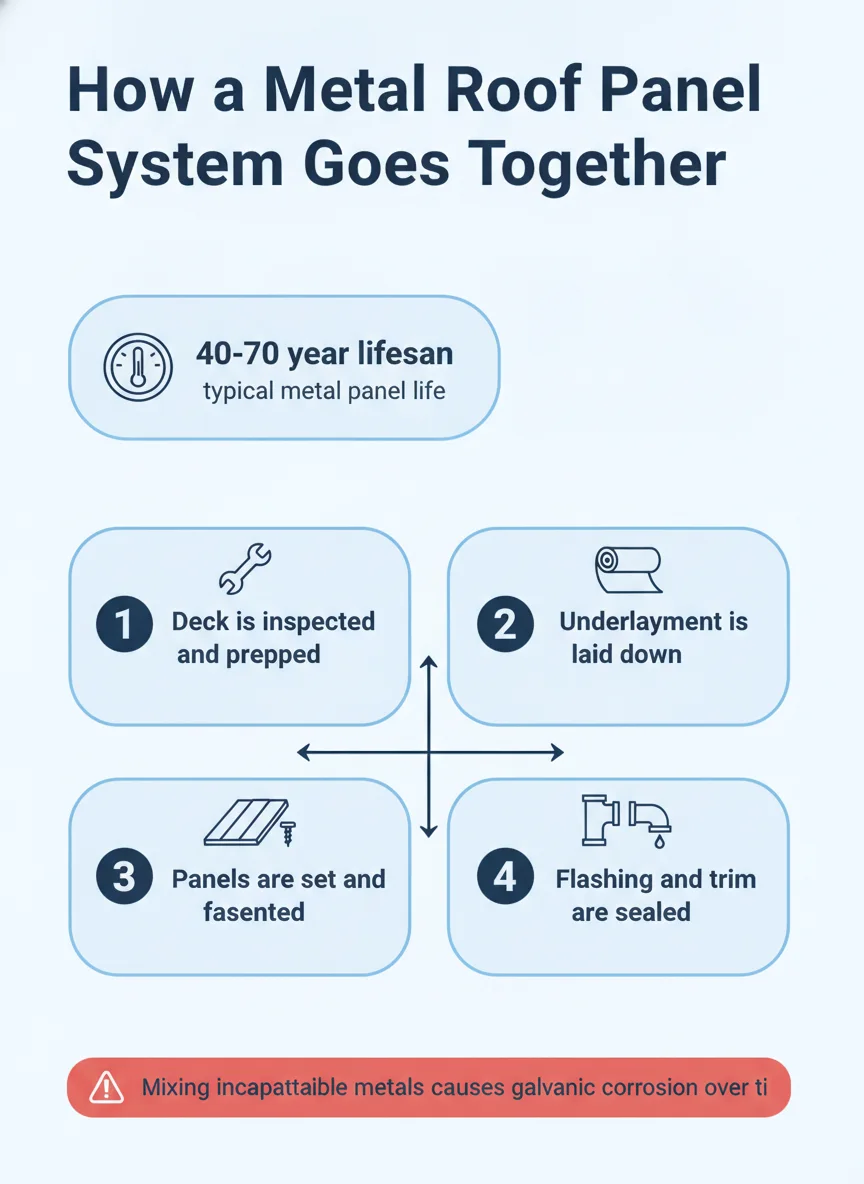
A metal roof is more than the panels you see from the street. Underneath, it relies on a solid deck, a layer of underlayment rated to handle the heat and moisture that build up beneath metal, and a network of trim, flashing and closures that seal every edge, ridge and penetration.
Flashing details matter more on a metal roof than on most other systems because the panels themselves are rigid. Valleys, chimneys, vent stacks and wall transitions all need custom-formed metal flashing that's sealed and fastened correctly, which is a big reason metal roofing is considered more of a specialty install than a standard shingle tear-off and replace.
Step-by-step: How a Metal Roof Installation Comes Together
Every metal roof job follows roughly the same sequence, whether it's going over new construction or replacing a worn-out roof on an existing home. Here's the general order a new construction or replacement metal roof project typically follows.
- Deck inspection: The existing deck is checked for soft spots, rot or damage that needs to be addressed before anything goes down on top of it.
- Underlayment install: A high-temperature-rated underlayment is rolled out across the deck to act as the roof's secondary water barrier.
- Panel layout: Panels are measured, cut and laid out so seams line up correctly and runoff flows cleanly toward the gutters.
- Panel fastening: Panels are either clipped into place for standing seam or screwed down with gasketed fasteners for exposed-fastener systems.
- Flashing and trim: Custom flashing is formed and installed at every valley, penetration and edge to keep water from working its way underneath.
- Final seal check: Seams, fasteners and flashing are checked and sealed as needed before the job is considered complete.
What Homeowners Notice After a Metal Roof Goes On
Rain Noise and Heat
Most homeowners are surprised by how quiet a properly installed metal roof actually is during a downpour, since the underlayment and solid decking absorb most of the sound before it reaches the attic. The loud-tin-roof reputation comes mostly from older agricultural buildings with open framing underneath, not modern residential systems.
On the heat side, lighter-colored and reflective metal finishes can help bounce back solar radiation rather than absorbing it the way dark asphalt shingles do. Combined with proper attic ventilation, that can translate into a cooler attic space during the hottest stretches of the year.
Appearance and Upkeep Over Time
A metal roof tends to hold its color and shape well for years, especially with factory-applied finishes designed to resist chalking and fading under constant UV exposure. Unlike shingles, there's no granule loss to watch for, since there are no granules to begin with.
Upkeep mostly comes down to keeping debris out of valleys, checking fasteners on exposed-fastener systems periodically, and making sure flashing stays sealed at penetrations. It's a different kind of maintenance checklist than shingles, but not necessarily a heavier one.
DIY vs Calling a Licensed Roofer
There are a few things a handy homeowner can reasonably manage on a metal roof, like clearing debris from valleys, rinsing off the surface occasionally, and keeping an eye out for obvious issues such as a lifted panel edge or a loose fastener head visible from the ground.
Anything involving the panels themselves, the underlayment, or flashing is a job for a licensed roofer. Metal panel work requires specific tools for cutting and forming trim, knowledge of how different panel profiles interlock, and an understanding of how expansion and contraction affects fastening over time, none of which are forgiving to get wrong.
Walking a metal roof at all carries real fall risk given how slick the surface gets when wet, and stepping in the wrong spot can dent or damage a panel. If you're planning residential roofing work involving metal, it's worth having a professional handle both the install and the periodic checkups rather than getting up there yourself.
Is a Metal Roof Right for Your Florida Home?
Metal roofing isn't the right fit for every budget or every home, but for homeowners planning to stay put long-term, the combination of a long service life and lower long-term upkeep makes it worth a serious look. If you're weighing it against a more traditional option, it helps to read through what actually drives the cost of residential roofing in Florida before deciding.
Homeowners in Lakeland and across the surrounding area are asking more questions about metal roofing every season, and having a clear picture of standing seam versus exposed-fastener systems is the best starting point. Quality Plus Roofing & Solar can walk through both options and help you figure out which one actually fits your home.
Frequently asked questions
How long does a metal roof last in Florida?
Quality metal roofing systems are built to last for decades, with industry norms in the 40 to 70 year range depending on the panel type and finish. Humidity, salt air near the coast, and UV exposure all play a role in how a specific roof actually performs over that span.
Is a metal roof louder in the rain than shingles?
A metal roof installed over solid decking and underlayment is not noticeably louder than shingles for most homeowners. The noise myth comes from older barn-style installs over open framing with no insulation layer underneath.
Does a metal roof make a Florida home hotter?
No, most metal roofing actually reflects more solar heat than dark asphalt shingles, which can help reduce attic temperatures. Reflective coatings and proper attic ventilation make the biggest difference either way.
Can you walk on a standing seam metal roof?
You can walk on a standing seam roof, but it has to be done carefully and usually with soft-soled shoes stepping on the flat pans, not the seams. This is one of the reasons routine upkeep on a metal roof is better left to someone who works on them regularly.
Do metal roofs rust in Florida's climate?
A properly coated and installed metal roof resists rust for its full service life, but cut edges, scratches, or mismatched fasteners can create weak points over time. Panel finish quality and correct installation matter more than the base metal alone.