
What shingle line does Quality Plus Roofing & Solar actually install?
We install asphalt shingle lines from Owens Corning, GAF, and Tamko across our Central Florida service area, from Lakeland out to Tampa, Sarasota, and Orlando. These are three of the most widely used shingle manufacturers in the country, and each one publishes its own wind, impact, and warranty specs for the lines we carry.
We don't lock every customer into one brand. The right shingle line depends on the home's roof pitch, the budget, and what look the homeowner wants, from a standard architectural profile to a heavier designer shingle. What stays constant is that every residential roofing job gets backed by our lifetime workmanship warranty, regardless of which manufacturer's product goes on the deck.
Why does the shingle brand matter if they all look similar from the ground?
From the curb, a mid-grade architectural shingle from one manufacturer can look almost identical to another brand's version. The difference is underneath, in the fiberglass mat weight, the asphalt coating, and the granule adhesion, and that's what determines how the shingle holds up to UV exposure and wind uplift over two decades of Florida weather.
Wind rating
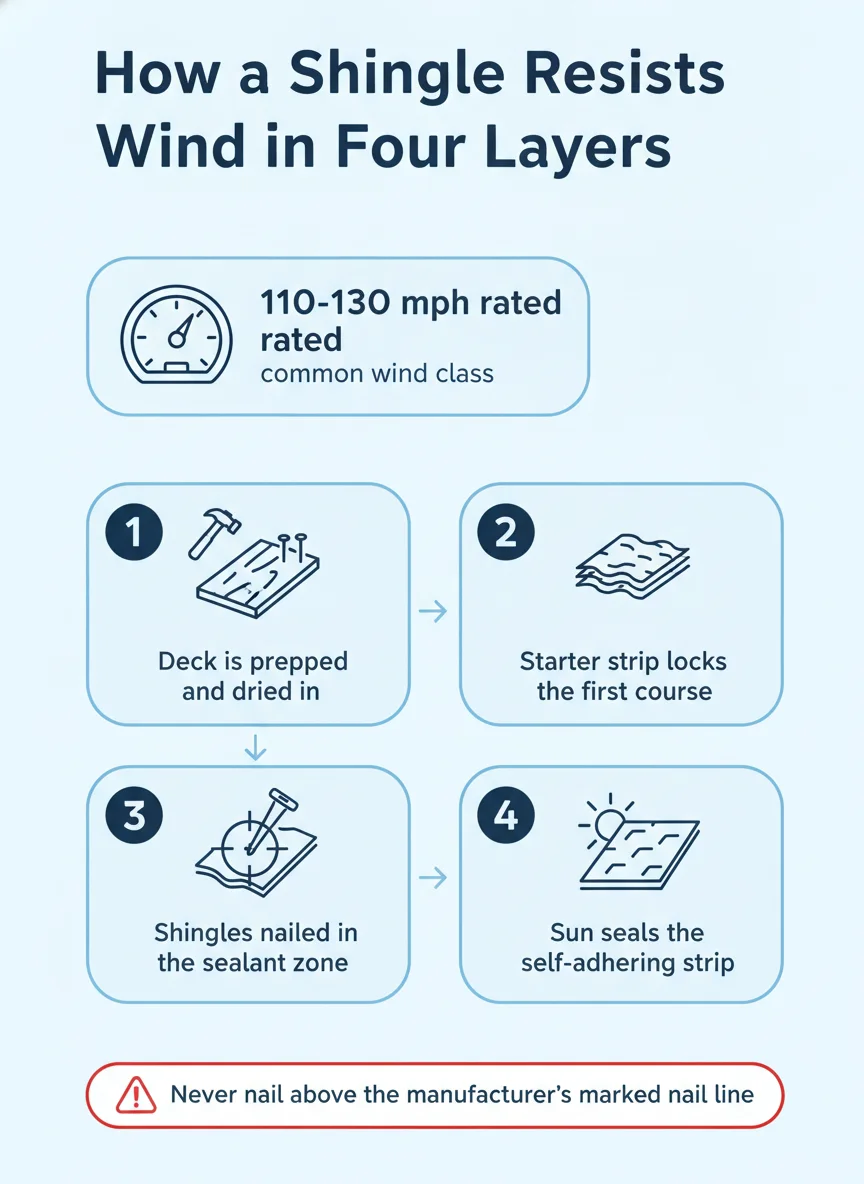
Every shingle line carries a wind rating published by the manufacturer, and that number reflects laboratory testing under a specific nailing pattern. A shingle rated for a certain wind speed only performs to that spec if it's installed with the correct number of fasteners in the manufacturer's marked nail line, which is why install quality matters as much as the product itself.
Higher-end architectural and designer lines generally carry stronger wind ratings than entry-level 3-tab shingles, partly because the laminated construction gives the tab more resistance to lifting at the edge. That's one reason we steer most Florida homeowners toward an architectural or heavier line rather than a 3-tab product.
Impact resistance
Some shingle lines also carry an impact rating, tested on a scale that measures how the product holds up to repeated impact without cracking or granule loss. A Class 4 rating is the top of that scale, and it's become a common upgrade option across the manufacturers we work with for homeowners who want the extra durability.
Impact rating and wind rating are tested separately, so a shingle can carry a strong impact rating without the highest available wind rating, or vice versa. We walk homeowners through both numbers for the lines we carry before they choose.
| Shingle grade | Typical build | Where it fits best |
|---|---|---|
| 3-tab | Single layer, flat profile | Budget-conscious projects, lower-pitch roofs |
| Architectural | Laminated, dimensional profile | Most residential re-roofs in Florida |
| Designer | Heaviest laminate, premium look | Higher-end homes, strong curb appeal goals |
What's actually inside a modern asphalt shingle?
A fiberglass mat forms the base of the shingle, and it's saturated with asphalt that's then coated with ceramic-coated granules on the exposed surface. The granules do more than give the shingle its color, they shield the asphalt underneath from direct UV exposure, which is the main thing that breaks asphalt down over time in a Florida climate.
Most architectural and designer shingles also include a self-adhering sealant strip just below the granule line. Once that strip is exposed to roof-deck heat after install, it bonds the shingle above it down to the course below, which is a big part of what gives the roof its wind resistance once it's fully sealed in.
Step-by-step: how we install a shingle roof
The shingle itself is only half the equation, the install sequence underneath it is what makes the manufacturer's published ratings mean anything in practice. Here's the general sequence our crews follow on a residential roofing job.
- Tear off and inspect deck: The old roofing material comes off down to the deck, and we check the plywood or OSB underneath for soft spots or rot before anything new goes on.
- Install underlayment: A water-resistant underlayment goes down across the entire deck, giving the roof a second layer of protection before the shingles are installed.
- Set starter strip and flashing: Starter shingles go along the eaves and rakes, and flashing is set at valleys, walls, and penetrations to direct water away from vulnerable seams.
- Lay shingle courses: Shingles go up course by course, nailed inside the manufacturer's marked nail line at the fastener count the wind rating calls for.
- Finish ridge and vents: Ridge cap shingles and ventilation components finish the roofline, giving the attic the airflow it needs to help the shingles last.
- Final walk and cleanup: We walk the finished roof, check every seam and penetration, and clear the property of old material and debris before closing out the job.
What should a homeowner look for once the shingles are on?
Right after install, a new shingle roof should look uniform in color and lay flat, with no lifted tabs or visible nail heads. Ridge lines should run straight, and valleys and flashing points should be tight with no gaps where water could get behind the shingle.
In the first few months
The sealant strips need heat from the sun to fully bond, so a brand-new roof can look slightly less sealed down in its first weeks, especially if the install happened during a cooler or rainy stretch. That's normal and generally resolves once the roof sees a few warm, sunny days.
Over the following years
As the roof ages, granule loss in the gutters or downspouts in small amounts is normal wear, but heavy granule loss, curling tabs, or bald patches are signs the shingle is reaching the end of its service life. Keeping an eye on those details year to year is the easiest way to catch a problem before it turns into an interior leak.
Can a homeowner handle any of this, or is it strictly a licensed job?
Choosing a shingle color, line, and style is something a homeowner can absolutely research and decide on their own, and most manufacturers publish sample images and spec sheets for exactly that reason. That part of the process doesn't require a license.
The actual tear-off, deck inspection, and install are a different story. Nailing pattern, fastener count, flashing detail, and ventilation all affect whether the manufacturer's wind and warranty terms hold up, and getting any of those wrong can void a warranty without the homeowner realizing it until there's a problem.
In Florida specifically, a licensed roofer also knows how local building code requirements apply to the install, which isn't something a product spec sheet covers on its own. That's the layer a licensed crew adds on top of the shingle itself.
Choosing the right shingle for your home
The best shingle for a given home comes down to roof pitch, budget, desired look, and how long the homeowner plans to stay in the house, not just which brand has the flashiest marketing. A conversation with whoever is doing the install should cover all of that before a decision gets made.
We walk every homeowner through the shingle lines available for their project, what each one's wind and impact ratings look like, and what the warranty covers, so the choice is an informed one rather than a guess. That's the approach Quality Plus Roofing & Solar takes on every shingle roof we install.
Frequently asked questions
What's the difference between a 3-tab and an architectural shingle?
A 3-tab shingle is a single flat layer with cutouts that give it the classic tab look, while an architectural shingle is laminated from two layers for a thicker, dimensional profile. Architectural shingles generally carry a longer manufacturer warranty and a higher wind rating than 3-tab products.
Do all shingles carry the same wind rating?
No, wind ratings vary by product line and depend on the fastening pattern used during install. Manufacturers publish a rated wind speed for each shingle, but that rating only holds if the shingle is installed according to their nailing and sealing instructions.
What does a Class 4 impact rating mean?
A Class 4 impact rating means the shingle passed a manufacturer-run test simulating repeated impacts without cracking or splitting, the highest rating in that testing scale. It's a measure of impact resistance, not a guarantee against every type of damage a roof can take.
How long should asphalt shingles last in Florida?
Most asphalt shingle lines are built for an 18-22 year service life under constant Florida sun and humidity, though actual lifespan depends on ventilation, installation quality, and maintenance. A roof that's shaded, well-ventilated, and properly installed tends to land on the higher end of that range.
Can I mix shingle brands on a repair?
We try not to, because color, thickness, and granule texture vary enough between manufacturers that a mixed repair stands out and can affect how the patch seals. When we [repair a roof](/services/roof-repair), we match brand and line wherever the original product is still available.