
Why the Adjuster Meeting Matters More Than You'd Think
Across Central Florida, homeowners file property damage claims every year after wind and weather take a toll on their homes, and for most of them the adjuster meeting is the moment that sets the direction of the whole claim. It's a short visit, often under an hour, but the measurements taken and the conversation that happens on the roof tend to carry more weight with the insurer than almost anything that comes after.
That's why going in prepared matters so much. An adjuster is working from a checklist and a limited amount of time on site, while a homeowner is usually seeing this process for the first time. Having your paperwork in order and a roofer who knows what the adjuster is looking for closes that gap and keeps the visit from becoming a one-sided conversation.
What the Adjuster Is Actually Measuring
The adjuster's job during this visit is to document damage, not to decide what repairs should look like. They're taking photos, taking measurements, and filling out a report that goes back to the insurance company, and that report becomes the basis for whatever estimate the insurer offers.
The Test Square
Most adjusters work off a test square, a marked section of the roof, often around 10 feet by 10 feet, where they count every point of damage they can find. That count gets used to estimate damage across the rest of the roof rather than requiring a full walk of every square foot.
The placement of that square matters a lot. A square placed on a section with less damage than the rest of the roof can lead to an estimate that undercounts what actually needs repair. This is one of the biggest reasons to have a roofer on-site who can point out where the worst damage actually sits.
Photos and Measurements
Beyond the test square, the adjuster is typically photographing the overall roof condition, any visible damage to flashing or penetrations, and the general age and wear of the materials. They'll also take roof measurements if they don't already have satellite or prior data on file.
Your roofer's job during this part is to make sure nothing gets missed, especially damage in areas that aren't obvious from a quick walk, like valleys, behind chimneys, or along less visible slopes. A second set of trained eyes on the roof catches things a single adjuster moving quickly might not.
| Scenario | What Typically Happens | Risk to You |
|---|---|---|
| Roofer present at the meeting | Damage is documented from both sides and discrepancies get flagged on the spot | Lower, since nothing gets missed without pushback |
| Homeowner alone, no roofer | Adjuster's findings stand largely unchallenged in the moment | Higher, since there's no one to question a low estimate |
| Neither party reviews the written estimate after | Scope gaps go unnoticed until repair work starts | Repairs may be delayed by a supplement request later |
Your Policy and the Paperwork That Backs You Up
Before the adjuster shows up, it helps to have your policy document pulled up or printed, along with your deductible amount and the date the damage occurred, as best you can pin it down. The adjuster will reference your policy's coverage terms throughout the visit, and having it on hand means you can follow along instead of taking their word for what's included.
Florida homeowners also have rights under the state's insurance statutes, including FL-627.7152, which governs how certain roofing claims and contracts are handled. You don't need to memorize the statute, but it's worth knowing that protections exist so you aren't pressured into signing anything you haven't had a chance to read fully.
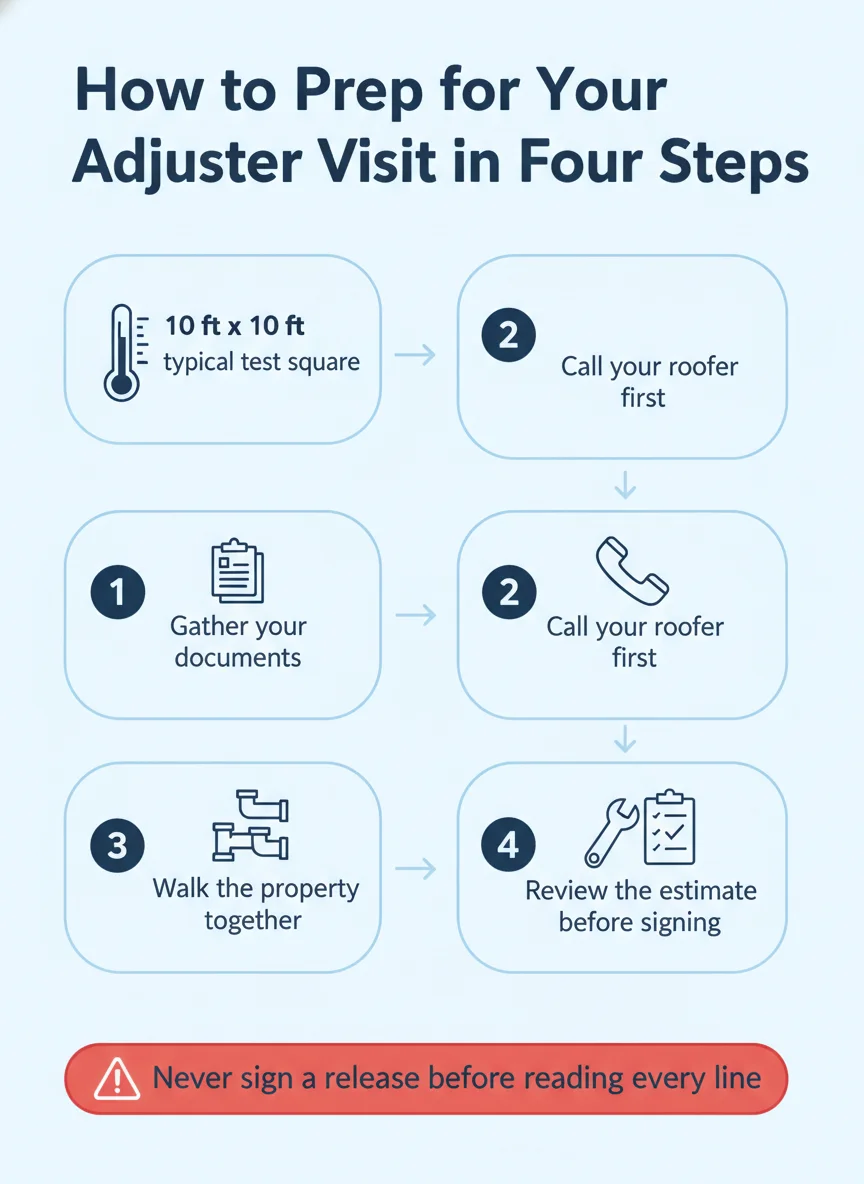
Step-by-step: Preparing for Adjuster Day
Most of the prep work for an adjuster visit takes less than an hour and can be done the day before. Walking through these steps in order keeps the meeting itself short and keeps you from scrambling for paperwork while the adjuster is standing in your driveway.
- Pull your policy: Have your policy document and your deductible amount ready so you can reference exact coverage terms during the conversation.
- Call your roofer first: Loop in your roofer before the adjuster arrives so they can walk the property with you and speak to the technical scope.
- Photograph the damage yourself: Take your own dated photos of the damage ahead of time as a backup record independent of the adjuster's report.
- Write down the timeline: Note the approximate date the damage occurred and anything you noticed changing since, like a leak or missing material.
- Walk the property together: Stay present for the walkthrough so you can hear what's being measured and ask questions in real time.
- Ask for a copy of the report: Request the adjuster's written findings before they leave so you have something to compare against your roofer's estimate.
- Review before you sign: Read any release or acceptance form fully before signing, and ask your roofer to review it with you if anything is unclear.
What Happens When the Estimates Don't Match?
A difference between your roofer's estimate and the adjuster's estimate doesn't mean the claim is denied, it usually just means more paperwork. This happens often enough that insurers have a standard process for it called a supplement.
Supplementing the Claim
A supplement is a formal request to add items the original adjuster's report missed or underscoped. Your roofer typically handles this by submitting additional photos, measurements, and a written scope explaining why the extra items are necessary for a complete, code-compliant job.
This process can take some back and forth, and it's normal. The goal isn't to argue with the insurer, it's to make sure the paperwork reflects the actual condition of the roof so the repair or roof repair work that follows is fully covered.
When to Get a Second Opinion
If the gap between estimates is large or the adjuster's report seems to have missed obvious damage, it's reasonable to ask a second roofer to walk the property and give their own read. A second opinion carries weight with insurers because it shows the discrepancy isn't a one-off judgment call.
Keep in mind that a second opinion works best when it comes with its own photos and measurements, not just a verbal disagreement. Written documentation is what actually moves a supplement request forward.
DIY vs Calling a Pro for Adjuster Day
There's plenty a homeowner can and should do without any outside help. Gathering your policy paperwork, writing down a timeline of events, and taking your own photos are all things you can handle on your own the day before the adjuster arrives.
What usually calls for a licensed roofer is anything involving the roof itself, getting up on a ladder, walking the slopes, or speaking to technical scope like underlayment, flashing, or decking condition. This isn't about liability alone, it's that an adjuster's report is taken more seriously when there's a licensed professional's documentation sitting alongside it.
The split, in short, is paperwork and timeline on your end, roof and technical scope on the roofer's end. Trying to handle the roof side yourself, especially getting up on the structure to inspect damage, adds risk without adding much leverage to the claim.
Walking Into Adjuster Day With Confidence
An adjuster visit doesn't have to feel like something happening to you. With your policy pulled, your timeline written down, and a roofer walking the property alongside you, it becomes a conversation you're part of instead of one you're watching from the driveway.
If you're staring down a claim and aren't sure where to start, read through our claim timeline guide for what comes before and after this meeting, and consider having a local roofer like Quality Plus Roofing & Solar walk the property with you before the adjuster ever shows up.
Frequently asked questions
Should I be there when the insurance adjuster inspects my roof?
Yes, being present or having your roofer there in your place is a good idea, since the adjuster's visit is often the single meeting that shapes your whole claim. If you can't attend, make sure someone who knows the property and the damage is standing in for you.
Can my roofer meet the adjuster without me being there?
In most cases yes, a roofer can meet the adjuster on your behalf as long as you've given them that authorization in writing ahead of time. It still helps to be reachable by phone during the visit in case a decision needs your sign-off.
What is a test square and why does the adjuster use one?
A test square is a marked-off section of the roof, commonly around 10 feet by 10 feet, that the adjuster uses to count damage in a small area and extrapolate it across the whole roof. It's meant to speed up the inspection, but a small or poorly placed square can undercount real damage.
What happens if my roofer's estimate and the adjuster's estimate don't match?
A mismatch isn't unusual and doesn't mean your claim is denied. Your roofer can document the difference with photos and measurements and submit a supplement request so the insurer can review the additional items.
What should I avoid saying to the insurance adjuster?
Avoid guessing at dates, causes, or costs you aren't sure of, since a wrong guess can end up working against you later in the claim. Stick to what you know for certain and let your roofer speak to the technical scope of the damage.