
Why Roof Pitch in Degrees Matters in Florida
Most roofers and homeowners talk pitch in the familiar rise-over-run format, like a 6-in-12 or an 8-in-12, but plans and engineering documents sometimes list the angle in degrees instead. A 33 degree roof is a steep slope, and if you're reading a blueprint, a permit document, or an engineer's letter that uses degrees, it helps to know what that converts to on a tape measure and framing square.
Across central Florida and the surrounding region, roof angles run anywhere from low-slope commercial sections to steep residential gables, and the pitch on a given home affects everything from material choice to how fast water clears the surface during a heavy afternoon storm. Knowing how to translate degrees to pitch means you can read any document a builder, inspector, or insurance adjuster hands you and understand exactly what's being described.
How the Degree-to-Pitch Conversion Actually Works
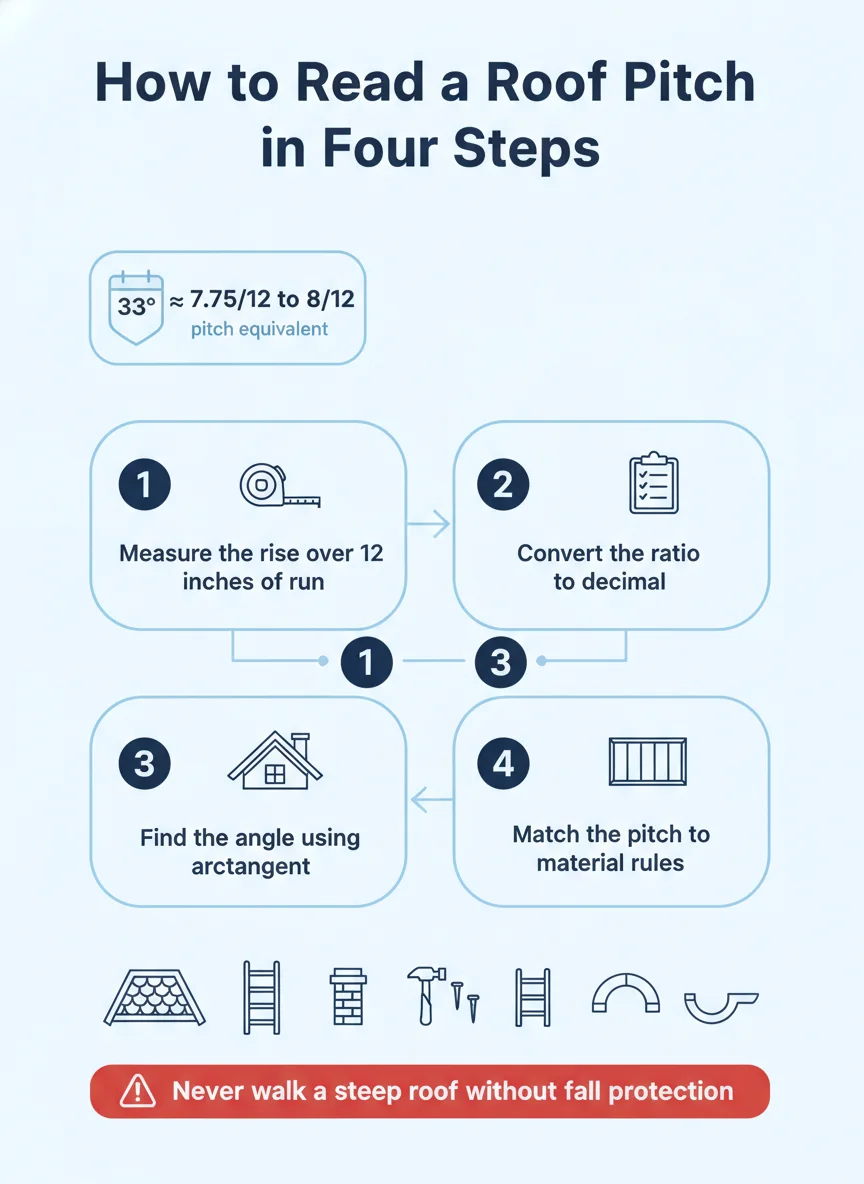
Roof pitch is a ratio: inches of vertical rise for every 12 inches of horizontal run. Degrees measure the same slope as an angle from horizontal. The math connecting them uses trigonometry, specifically the tangent function, and once you know the formula you can convert either direction without needing a chart.
Converting Degrees to a 12-Inch Run
To go from degrees to pitch, take the tangent of the angle and multiply by 12. For 33 degrees, the tangent works out to approximately 0.6494. Multiply that by 12 and you get about 7.79, which rounds to a 7.75-in-12 or roughly 8-in-12 pitch depending on how a builder rounds it on a framing plan.
That means for every 12 horizontal inches a roof plane runs, it climbs just under 8 vertical inches. On a typical gable home that translates to a noticeably steep roofline, the kind you'd see on a traditional farmhouse profile or a steeper Craftsman design rather than a flatter ranch-style roof.
Why the Conversion Isn't Always a Round Number
Pitch numbers on a framing plan are almost always rounded to something a carpenter can cut cleanly, like 7/12 or 8/12, because exact degree equivalents rarely land on whole inches. A 33 degree roof sits between two common pitch call-outs, so you'll sometimes see it listed either way depending on which the designer rounded toward.
This rounding matters most when you're comparing a permit drawing to an as-built roof. If the plan says 8-in-12 and a field measurement comes back closer to 7.75-in-12, that's normal variance, not necessarily a construction error. It becomes a real issue only if the measured pitch is meaningfully off from what the plan specifies.
| Angle in degrees | Pitch equivalent | Typical description |
|---|---|---|
| 18.4° | 4-in-12 | Low slope, common on ranch homes |
| 26.6° | 6-in-12 | Moderate slope, most common residential pitch |
| 33° | ~7.75 to 8-in-12 | Steep slope, faster drainage, more fall protection needed |
| 45° | 12-in-12 | Very steep, often seen on dormers and accent gables |
What a Steep Pitch Like 33 Degrees Changes About the Roof System
A roof in the 7.75 to 8-in-12 range drains water faster than a moderate or low-slope roof, which is a real advantage during Florida's heavy rain seasons. Water has less time to sit on the surface or find its way under a lifted edge, and debris tends to slide off rather than build up in valleys.
The tradeoff is access and labor. A steeper roof means crews work at a sharper angle, move more carefully, and typically need additional fall protection and staging compared to a gentler slope. That's true whether the covering is shingle, tile, or metal, and it's one of the bigger factors in how long a job takes and how it gets priced.
Step-by-Step: Measuring Your Own Roof Pitch
You don't need to climb onto the roof to get a reasonable pitch reading. A level, a tape measure, and basic math from the attic or eave line will get you close enough to know roughly what category your roof falls into.
- Find a flat section: Locate an accessible rafter or roof edge, either in the attic or from a ladder at the eave, where you can hold a level steady against the slope.
- Hold the level flush: Place a 12-inch level against the underside of the rafter or roof deck so the 12-inch mark lines up exactly with the end of the level.
- Measure the drop: From the 12-inch mark on the level, measure straight down to the roof surface or rafter edge to get your rise in inches.
- Record the ratio: That rise-over-12 number is your pitch, for example 8 inches of drop over 12 inches of level equals an 8-in-12 pitch.
- Convert to degrees if needed: Divide the rise by 12, then take the arctangent of that number to get the angle in degrees for any paperwork that requires it.
- Cross-check at two points: Repeat the measurement at a second spot on the same roof plane since older framing can settle unevenly over time.
- Note the result: Write down both the pitch and the degree equivalent so you have it on hand for permits, material specs, or a contractor's estimate.
What You'll Find Once You Know the Real Pitch
Matching Materials to a Steep Slope
Once you know a roof sits around 33 degrees, you can confirm the covering on it is actually rated for that slope. Asphalt shingles, metal panels, and most tile systems all perform well on steep pitches like this one, and in fact many of these materials shed water and debris better on a steeper plane than on a low-slope roof.
If you're planning a residential roofing project or a full replacement, the pitch is one of the first things worth confirming before picking a material, since manufacturer specs for underlayment and fastening patterns often shift at steeper angles.
What It Means for Repairs and Access
A steep pitch also changes what a simple roof repair looks like in practice. A small leak fix on a 4-in-12 roof might take a tech twenty minutes of walking the surface, while the same fix on a 33 degree slope needs harnesses, roof jacks, or staging just to work safely, which can affect how a job gets scheduled.
Knowing your actual pitch ahead of a service call also helps you describe the job accurately over the phone, so whoever you're talking to can bring the right gear on the first trip instead of a second visit.
DIY Measurement vs. Calling a Pro
Measuring pitch from the ground or the attic with a level is a reasonable DIY task, and most homeowners can get an accurate reading in a few minutes without any risk. This is the part worth doing yourself if you just need the number for a permit question or a material comparison.
Where it makes sense to bring in a licensed roofer is anything involving actually walking the slope, verifying the covering condition, or confirming the framing can support a different material at that angle. A steep roof in the 33 degree range carries real fall risk, and a trained crew has the harness systems and roof jacks to move across it safely.
A professional visit also gives you more than a pitch number. A trained eye can flag fastening patterns that don't match the slope, underlayment that's aging out, or flashing details that need attention before they turn into a bigger repair.
Getting the Right Pitch Confirmed Before You Build or Replace
Whether you're reading an old set of plans, comparing a quote against manufacturer specs, or just curious what that steep roofline across the street actually measures, converting degrees to pitch is simple math once you know the formula. A 33 degree angle lands you right around 7.75 to 8-in-12, solidly in steep-slope territory with all the drainage benefits and access considerations that come with it.
If you're weighing material options for a steep roof or want a second set of eyes on an existing pitch, Quality Plus Roofing & Solar has been working on residential and commercial roofs across central Florida for 22 years and can walk you through what fits your home.
Frequently asked questions
What pitch is a 33 degree roof?
A 33 degree roof angle works out to roughly a 7.75-in-12 to 8-in-12 pitch, meaning the roof rises about 7.75 to 8 inches for every 12 inches of horizontal run. It's considered a steep slope in most building codes, which changes some of the install requirements.
How do you convert roof degrees to pitch?
You convert by taking the tangent of the angle and multiplying by 12, which gives you the rise in a 12-inch run. For 33 degrees, the tangent is about 0.65, so 0.65 times 12 lands right around 7.75 to 8 inches of rise.
Is a 33 degree roof considered steep?
Yes, a 33 degree angle sits in the steep-slope range, generally anything above roughly 21 degrees or a 4-in-12 pitch. Steep roofs drain faster but require more fall protection and different fastening patterns during installation.
Can you install asphalt shingles on a 33 degree roof?
Asphalt shingles are rated for steep slopes like this and are a common choice on roofs in this range. The steeper angle actually helps shingles shed water faster, which is a plus in a heavy-rain climate.
Does a steeper roof pitch cost more to install?
Steeper pitches generally cost more to install because crews move slower, need more safety equipment, and often work in smaller sections at a time. Material choice, roof size, and access still matter as much or more than the pitch itself.