Why This Question Comes Up So Often in Central Florida
Homeowners across Lakeland, Tampa, Orlando, and the rest of Central Florida tend to ask the same question every few years: is this roof still doing its job, or is it quietly failing? The region's combination of intense UV exposure, heavy summer rain, and seasonal wind events puts more wear on a roof here than in most parts of the country, which means the decision point arrives sooner than homeowners moving from other states might expect.
The good news is that a roof rarely fails all at once. It tells you it's struggling well before a leak shows up on the ceiling. Learning to read those signals, rather than waiting for water damage to force the issue, is what separates a planned replacement from an emergency one.
What Actually Causes a Roof to Wear Out
A roof is a layered system, and every layer has a lifespan shaped by heat, moisture, and ventilation. Understanding the two biggest factors helps explain why some roofs make it 25 years and others start showing trouble at 15.
UV and heat cycling
Florida sun bakes roofing material day after day, and the constant heating and cooling cycle makes asphalt shingles brittle over time. The oils that keep shingles flexible evaporate faster in this climate than in cooler regions, which is a big part of why asphalt shingle lifespan skews toward the lower end of the national range here.
Tile and metal hold up differently to UV exposure since the wear shows up more in the underlayment and fasteners than in the surface material itself. That's one reason material choice matters so much when a homeowner is weighing a residential roofing replacement against another round of repairs.
Moisture and ventilation
Trapped heat and humidity in the attic accelerate decking damage from the inside, often well before anything is visible from the ground. Poor attic ventilation lets moisture linger against the underside of the roof deck, which can lead to rot and mold long before the shingles themselves look obviously worn.
This is why two roofs of the same age and material can be in very different condition. The one with better airflow and drainage is simply aging slower, even under the same Central Florida sun.
| Sign | Usually Means Repair | Usually Means Replace |
|---|---|---|
| A few missing shingles after wind | Yes, if surrounding shingles are intact | No |
| Granule loss across large sections | Rarely | Yes |
| One active leak, isolated area | Often | Only if decking is compromised |
| Daylight visible through the decking | No | Yes |
The Roofing System Itself
A roof is more than the visible layer. Underneath the shingles, tile, or metal sits an underlayment that acts as a secondary water barrier, flashing around penetrations like vents and chimneys, and decking that everything is fastened to. When homeowners ask whether a roof needs replacing, they're really asking whether this whole system is still working together.
A roof can look fine from the curb while the underlayment has already failed, which is why a surface-level glance usually isn't enough to make the call. It's also why a licensed roofer checks more than just the shingles during an evaluation, looking at flashing, decking, and ventilation as a system rather than isolated parts.
Step-by-Step: How to Evaluate Your Own Roof Before Calling a Pro
A homeowner can get a reasonable read on roof condition with a pair of binoculars and a flashlight before ever scheduling a visit. Here's the order that makes the most sense.
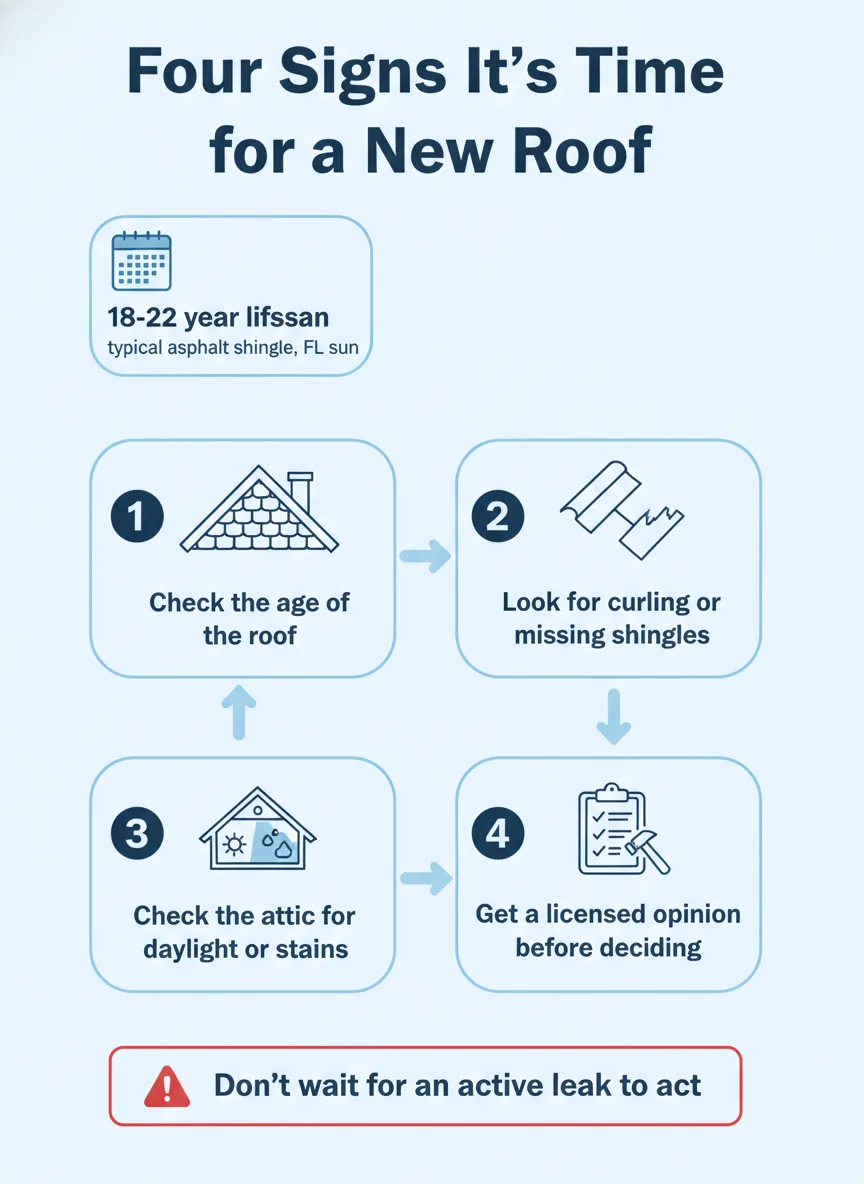
- Pull the paperwork: Find out the age of the roof and what material it's made of, since lifespan expectations differ by material and matter to every decision after this.
- Look from the ground: Use binoculars to scan for curling, cracking, or missing shingles, and note any obviously dark or bald patches where granules have worn away.
- Check the attic: Bring a flashlight up and look for daylight coming through the decking, dark water stains, or a musty smell that suggests trapped moisture.
- Note any leak history: Write down where and when leaks have happened, since a pattern of recurring leaks in different spots is a stronger signal than one isolated incident.
- Check the gutters: Granules collecting in the gutters are a sign of accelerated shingle wear, and clogged or sagging gutters can make roof-edge damage worse over time.
- Get a professional opinion: Bring in a licensed roofer to confirm what you've found and check the parts of the system that aren't visible from the ground or the attic hatch.
What You'll Typically Find Once You Look Closer
Most Central Florida homeowners land in one of two camps once they've actually inspected the roof: localized wear that's still manageable, or widespread deterioration that's better addressed all at once.
Localized damage
If the issue is confined to one slope, one flashing point, or a small cluster of shingles, a roof repair is usually the right call. This is common after a single wind event or where a tree limb has rubbed against the surface over time.
The key test is whether the rest of the roof is still flexible and intact. If the surrounding material snaps or crumbles when gently lifted, the damage is more widespread than it first appears, and a repair may only buy a short amount of time.
Widespread deterioration
When granule loss, curling, and brittleness show up across most of the roof's surface, or when the roof is already near or past the upper end of its expected lifespan, replacement tends to make more financial sense than chasing repairs one at a time.
This is especially true for homes getting ready for new construction additions or anyone planning to add solar systems, since pairing panel installation with a new roof avoids opening up a surface that was just repaired.
DIY vs. Calling a Licensed Roofer
A homeowner can safely handle the ground-level and attic-level checks described above, since none of that requires getting on the roof itself. Clearing debris from gutters and visually scanning the surface from a ladder on the ground is also reasonable for most people.
Actually walking the roof, removing shingles to check the decking, or evaluating flashing and ventilation in detail should be left to a licensed roofer. Florida's building code requires proper permitting and installation standards for roofing work, and a professional knows how to evaluate the system without causing additional damage in the process.
This isn't just about safety, though that matters too. A licensed roofer carries the training to spot the difference between cosmetic wear and a structural issue, which is exactly the distinction that determines whether a repair holds up or a replacement is the smarter long-term move.
Making the Call with Confidence
The signs are rarely subtle once a homeowner knows what to look for: age past the expected range, granule loss spread across the roof, recurring leaks, or daylight in the attic all point in the same direction. Catching these signs early turns a roof decision into a planned project instead of an emergency one.
If any of this sounds familiar, a straightforward evaluation is the next step, and it's the kind of visit Quality Plus Roofing & Solar handles across Central Florida every week.
Frequently asked questions
How do I know if my roof needs to be replaced or just repaired?
If the damage is isolated to one area and the rest of the roofing material is still in good shape, a repair usually makes sense. Once damage is spread across multiple sections, or the roof is past its expected lifespan, replacement is typically the more cost-effective path.
How long does a roof last in Florida before it needs replacing?
Asphalt shingle roofs in Florida's sun and humidity typically run 18 to 22 years, while tile and metal can last considerably longer with proper maintenance. Age alone isn't the only factor, but it's a strong starting point when deciding whether to repair or replace.
What are the warning signs that a roof is failing?
Curling or cracking shingles, bald spots where granules have worn off, daylight visible in the attic, and recurring leaks after storms are the clearest signs. Sagging decking or soft spots underfoot are more serious and usually mean replacement is close.
Does a few missing shingles mean I need a whole new roof?
Not necessarily. A handful of missing shingles after a windstorm is often a straightforward repair, but if the surrounding shingles are also brittle or granule-bare, it's worth having a roofer look at the whole roof rather than just the obvious spot.
Can I wait another year before replacing my roof?
It depends on what's driving the concern. If it's just cosmetic wear with no leaks or soft decking, waiting a season is often fine, but a roof already showing interior water stains should be addressed sooner rather than later to avoid damage spreading into the home.