
Why This Question Comes Up So Often in Central Florida
Homeowners across Florida live with more weather exposure than most of the country, and that means more roof damage questions land on an insurance adjuster's desk every year. The trouble is that most policies weren't written with a single, easy rule. They separate damage into categories, and which category your situation falls into decides whether you get a check or a denial letter.
This matters because the gap between what a homeowner assumes is covered and what the policy actually says is where most frustration starts. Knowing the general categories before you ever pick up the phone puts you in a much stronger position, whether you're dealing with a sudden event or noticing problems that have been building for a while.
Why Insurers Separate Sudden Damage From Gradual Wear
Every standard homeowners policy is written around the idea of insurable risk, meaning sudden, accidental events that a homeowner couldn't reasonably have prevented. Gradual deterioration doesn't fit that model because it's considered a maintenance responsibility, not a loss. Understanding this split explains almost every coverage decision you'll run into.
Sudden and Accidental Damage
This category covers things like wind tearing off material, a tree limb coming down on the structure, or hail impact denting metal panels or bruising shingles. These events have a clear start and end point, which is exactly what insurers are built to respond to. A clear cause and a clear date make these claims far easier to document and process.
Even within this category, coverage can vary based on your specific policy, your deductible structure, and whether you carry replacement cost or actual cash value coverage. That's why reading your declarations page matters as much as understanding the general rule.
Gradual Wear and Neglect
This category covers the slow stuff: materials that have simply aged out, fastener systems that have loosened over years of thermal cycling, or ventilation problems that let heat and moisture cook the underlayment from below. None of this has a single triggering event, so insurers treat it as part of ordinary ownership.
Deferred maintenance falls here too. If an adjuster can show that a problem existed for a long stretch before it was reported, that's often enough to deny the claim even if the underlying damage looks dramatic by the time anyone notices it.
| Situation | Typically Covered | Typically Not Covered |
|---|---|---|
| Wind tears off material during a storm | Yes, usually | N/A |
| Tree limb falls and punctures the surface | Yes, usually | N/A |
| Material cracking from UV exposure over many years | N/A | Yes, usually excluded |
| Leak traced to a years-old installation flaw | N/A | Yes, usually excluded |
What Your Policy Actually Looks At
Three things drive most coverage decisions: the cause of loss, the age and condition of the roof before the event, and the type of coverage you carry. An adjuster isn't just looking at the hole in your roof, they're trying to reconstruct what happened before and during the event that caused it.
Your policy's declarations page spells out your deductible, your coverage type, and any endorsements or exclusions specific to your home. Pulling that document out before you file anything gives you a realistic sense of what to expect, instead of guessing based on what happened to a neighbor's claim.
Step-by-step: What to Do After You Notice Damage
The sequence you follow in the first few days after damage shows up can make a real difference in how smoothly your claim moves.
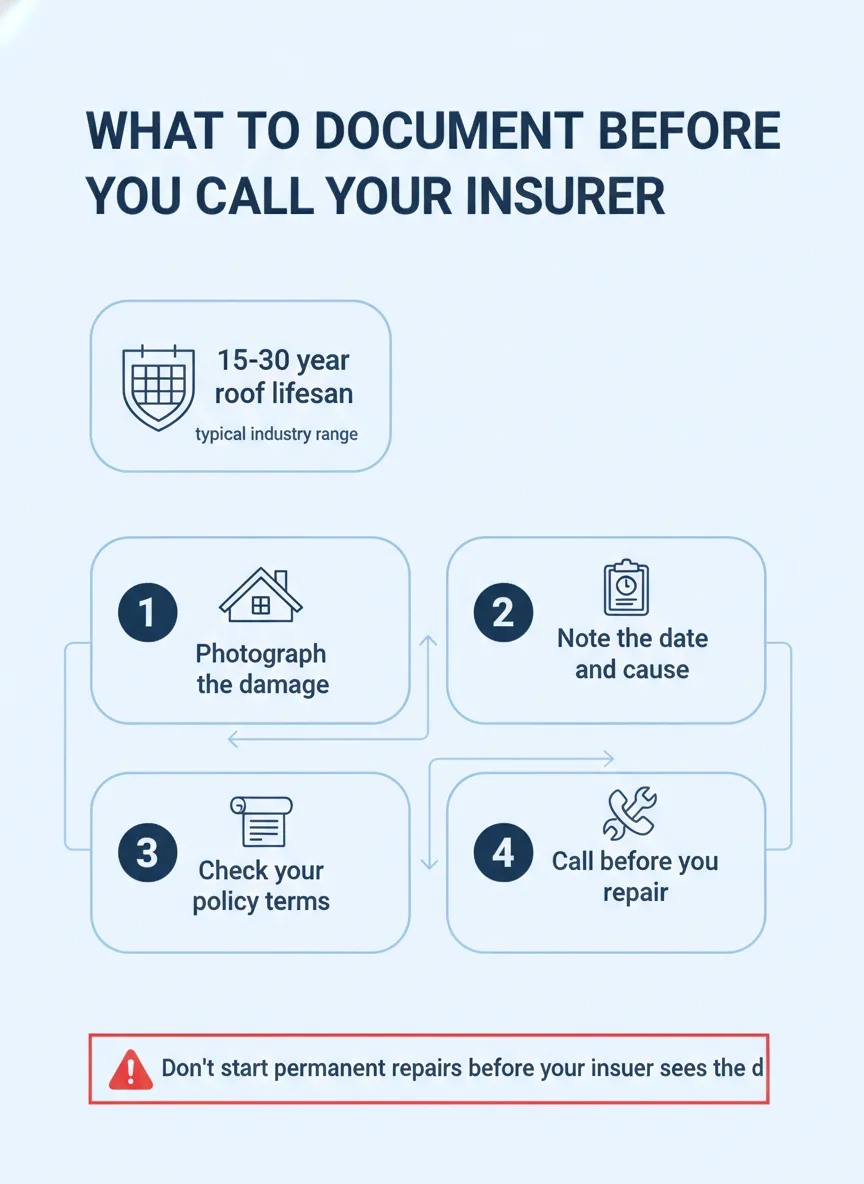
- Photograph everything: Take wide and close shots of the damage from multiple angles, including anything that shows a clear cause like a fallen branch or visible wind lift.
- Note date and conditions: Write down the date you noticed the damage and any weather event tied to it, since insurers weigh timing heavily.
- Review your policy: Check your declarations page for your deductible, coverage type, and any exclusions before you call anyone.
- Get a professional look: Have a licensed residential roofing contractor document the damage so you have a second, trained set of eyes on record.
- File with your insurer: Report the claim promptly, since many policies set expectations around timely reporting.
- Avoid permanent repairs first: Only make temporary, protective fixes until the adjuster has seen the damage in its original state.
- Keep all documentation: Save photos, notes, and correspondence together in case you need to appeal a decision later.
What an Adjuster Looks For When They Inspect
An insurance adjuster isn't just confirming that damage exists, they're trying to pinpoint cause and timeline. The way they read a roof surface often decides the outcome before any paperwork is signed.
Signs That Point to a Covered Event
Fresh creasing in flexible material, scattered impact marks concentrated on one slope, or displaced sections near the edges all suggest a specific weather event. Adjusters are trained to look for patterns that match known wind or impact behavior rather than isolated, random wear.
Debris still present near the damage, or a clear line between damaged and undamaged sections, also supports a sudden-event claim. These details are exactly what a roof repair crew will document if you bring one in before or alongside the adjuster visit.
Signs That Point to Gradual Deterioration
Uniform brittleness across the entire surface, granule loss spread evenly rather than concentrated, or soft decking found in multiple unrelated spots all read as age and wear rather than a single event. These patterns tend to work against a claim rather than for it.
Discoloration patterns that look consistent across years of sun exposure, or fastener corrosion that's uniform across the whole structure, also point toward normal aging in an adjuster's eyes.
What You Can Check Yourself vs. When to Call a Pro
A homeowner can safely do a ground-level visual check after a storm, looking for obvious debris, displaced material visible from the yard, or staining on ceilings and in attic spaces. This kind of walk-around doesn't require climbing anything and can flag whether a closer look is warranted.
Anything beyond that, actually walking the surface, assessing structural decking, or determining whether damage is covered-event or wear-and-tear, calls for a licensed professional. Getting onto a sloped surface without the right equipment is a real fall risk, and an untrained eye can easily misread what caused a given problem.
A professional inspection also gives you documentation that carries weight with an insurer in a way that homeowner photos alone sometimes don't. If your home is part of a larger project, like new construction or a commercial roofing property, that documentation becomes even more important given the scale involved.
Putting It All Together
Knowing the difference between a covered event and ordinary wear won't change what your policy says, but it will change how you approach the next step. Document early, read your policy before you call, and get a trained set of eyes on the damage before anything gets repaired permanently. For more on related topics, see how long roof replacement takes once a claim moves forward.
If you're in Lakeland or anywhere across Central Florida and you're not sure which category your situation falls into, a second opinion from a licensed contractor is a reasonable first move before you file. Quality Plus Roofing & Solar can take a look and help you understand what you're working with.
Frequently asked questions
Does homeowners insurance cover a roof leak?
It depends on what caused the leak. A policy generally covers a leak that starts from a sudden, identifiable event like wind or falling debris, but it typically won't cover a leak that developed slowly from age or lack of maintenance.
Is normal wear and tear on a roof covered by insurance?
No, normal wear and tear is almost never covered. Insurance is built to cover sudden, accidental loss, not the gradual aging that every roof goes through over its service life.
What is the difference between actual cash value and replacement cost coverage?
Actual cash value pays out based on your roof's depreciated worth at the time of the claim, while replacement cost coverage pays to replace it with new materials of similar kind and quality. The difference can be significant, so it's worth checking which one your policy includes.
Will my insurance company drop me if I file a roof claim?
Insurers evaluate claims individually, and a single legitimate claim for storm or accidental damage usually doesn't trigger cancellation on its own. Patterns of frequent claims or claims tied to deferred maintenance are more likely to affect your policy status, so talk with your agent about your specific history.
Do I need a professional to confirm roof damage before filing a claim?
It helps, because a trained eye can spot damage that isn't visible from the ground and document it the way an adjuster expects. Many homeowners bring in a roofer to do a walk-through before or alongside the adjuster's visit.