
Why Ventilation Matters More in Florida
Attic ventilation gets overlooked because it's invisible from the ground, but it directly affects how long a roof lasts and how hard your air conditioning has to work. Homes across Sarasota and the rest of Central Florida deal with intense summer heat and humidity, which makes proper airflow more important than in cooler climates.
An attic that traps heat and moisture puts extra stress on the shingles from underneath, not just from sun exposure above. Getting the ventilation right is one of the more affordable ways to protect a roof investment over the long run.
How Attic Airflow Actually Works
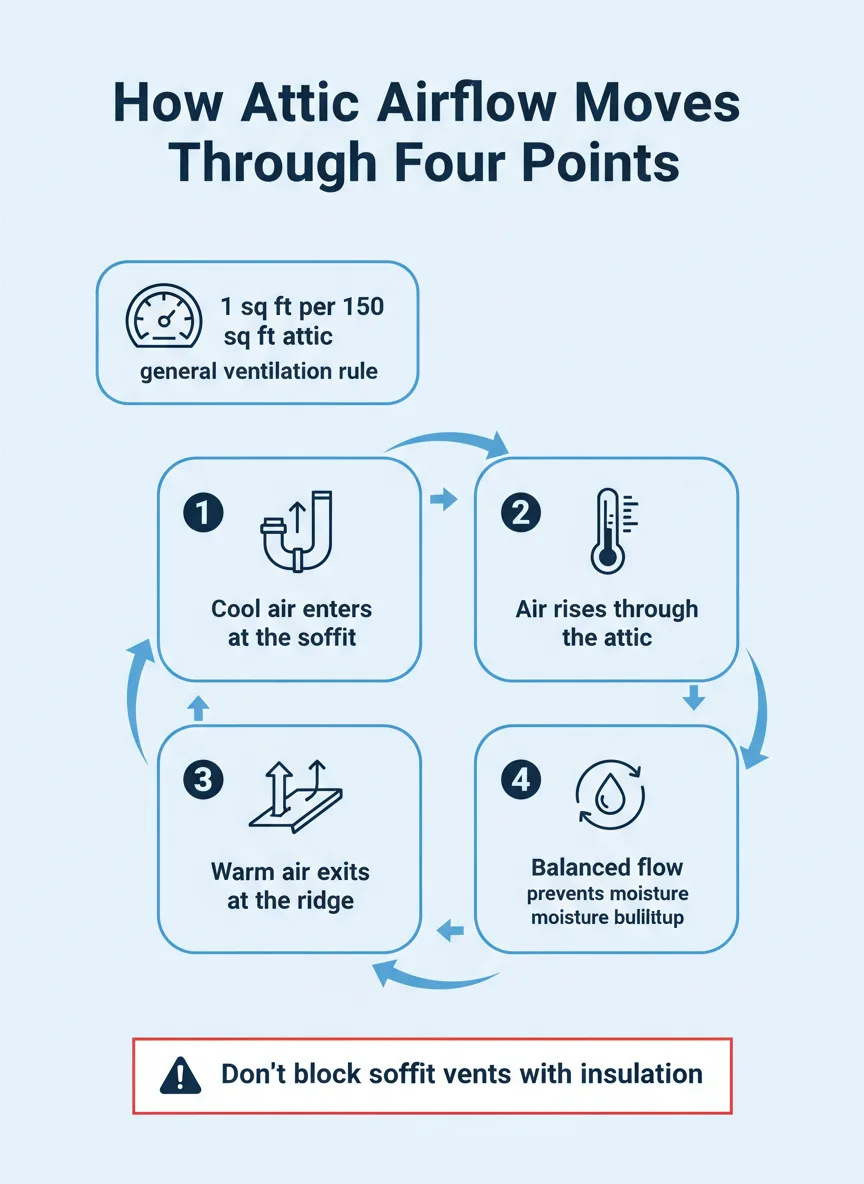
A properly ventilated attic works on a simple principle: cooler air enters low and warmer air exits high, creating continuous airflow that carries heat and moisture out.
Intake Ventilation
Intake typically happens through soffit vents along the eaves, drawing outside air into the attic space. If those vents are blocked by insulation or paint, the whole system stops working even if the exhaust side looks fine.
Intake needs to be distributed evenly around the perimeter of the attic, not concentrated on one side, or airflow becomes uneven across the roof.
Exhaust Ventilation
Exhaust vents sit at or near the ridge and let the rising warm air escape. Ridge vents, box vents, and power vents are all common exhaust methods, each with different capacity.
Exhaust capacity has to roughly match intake capacity. An exhaust system that's oversized relative to intake can pull air from inside the home instead of the attic, which wastes energy.
| Vent Type | Location | Function |
|---|---|---|
| Soffit vent | Under the eaves | Intake, draws in cool air |
| Ridge vent | Peak of the roof | Exhaust, releases warm air |
| Gable vent | Attic end wall | Can serve as intake or exhaust |
How Ventilation Gets Sized
The industry standard most roofers use as a starting point is roughly 1 square foot of ventilation for every 150 square feet of attic floor space, split evenly between intake and exhaust. That ratio can shift depending on whether the attic has a vapor barrier and how the home is insulated.
This is a general guideline, not a fixed rule for every attic. Roof shape, existing insulation, and whether the attic is currently unbalanced all factor into what a specific home actually needs.
Step-by-step: Checking Your Attic Ventilation
A basic check can be done from inside the attic on a dry day and gives a good first read on whether airflow looks balanced.
- Check soffit vents: Look from inside the attic to confirm soffit vents aren't blocked by insulation.
- Check exhaust vents: Confirm ridge or box vents are clear of debris and not painted over.
- Feel for airflow: On a breezy day, check whether air is noticeably moving through the attic space.
- Look for moisture signs: Check the underside of the decking for staining, mold, or damp spots.
- Note attic temperature: An attic that feels excessively hotter than outside air can point to poor airflow.
What Poor Ventilation Looks Like
Heat-Related Signs
An attic that runs significantly hotter than the outside temperature is one of the clearest signs airflow isn't working. That trapped heat radiates down into living spaces and makes the air conditioner work harder to keep up.
Shingles installed over a poorly ventilated attic can also age faster than expected, since heat builds from both above and below.
Moisture-Related Signs
Condensation on the underside of the decking, visible mold spots, or a musty smell in the attic are signs moisture isn't escaping properly. In Florida's humidity, that moisture buildup can happen faster than in drier climates.
Left unaddressed, trapped moisture can eventually affect insulation performance and, over time, the decking itself.
DIY vs. Calling a Licensed Roofer
Checking for blocked soffit vents, clearing visible debris off exterior vent covers, and noting obvious hot spots or moisture in the attic are reasonable homeowner tasks that don't require going up on the roof itself.
Adding or resizing ventilation, on the other hand, means cutting into the roof deck and working with the existing roofing material, which is roofing work, not a weekend project. A licensed roofer can calculate the right balance for your attic and install it without compromising the roof's weatherproofing.
This is also a good conversation to have during any roof repair visit, since ventilation issues are often easier and more affordable to correct while other work is already underway.
Getting Your Attic Right
Ventilation is one of the least visible parts of a roof system but one of the most impactful for how long the materials above it last. If you're also wondering how ventilation ties into overall roof lifespan, our guide on how long a roof lasts covers that connection in more detail.
Quality Plus Roofing & Solar checks attic ventilation as part of its roofing visits across Central Florida, so airflow problems get caught before they shorten the life of a new or existing roof.
Frequently asked questions
How much attic ventilation do I actually need?
The commonly used industry rule is about 1 square foot of ventilation for every 150 square feet of attic floor space, split between intake and exhaust. A licensed roofer can measure your specific attic to confirm the right amount for your home.
What happens if a roof doesn't have enough ventilation?
Poor ventilation traps heat and moisture in the attic, which can shorten shingle life and lead to condensation issues on the decking. Over time that trapped moisture can also affect insulation performance and indoor comfort.
Can I add ventilation without replacing the whole roof?
Yes, additional vents can often be added to an existing roof without a full tear-off, depending on the current setup. A roofer can assess whether your intake and exhaust are balanced or whether more venting is needed.
Does more ventilation always mean better?
No, ventilation needs to be balanced between intake at the soffit and exhaust at the ridge or roof line. Too much exhaust without matching intake can actually pull conditioned air out of the living space below.
How do I know if my current ventilation is working?
Signs like a noticeably hot attic, visible moisture or mold on decking, or higher than expected cooling bills in summer can point to a ventilation problem. A visual attic check is usually the fastest way to confirm.