
Why This Math Matters Before a Florida Re-Roof
Getting the shingle count right matters more in Central Florida than people expect, because a shortfall mid-install means a delay waiting on a special order, and the sun here does not wait politely for a truck to show up with the missing bundles. Homeowners planning a residential roofing project often want a ballpark number before they ever call for a quote, and that's a reasonable thing to want.
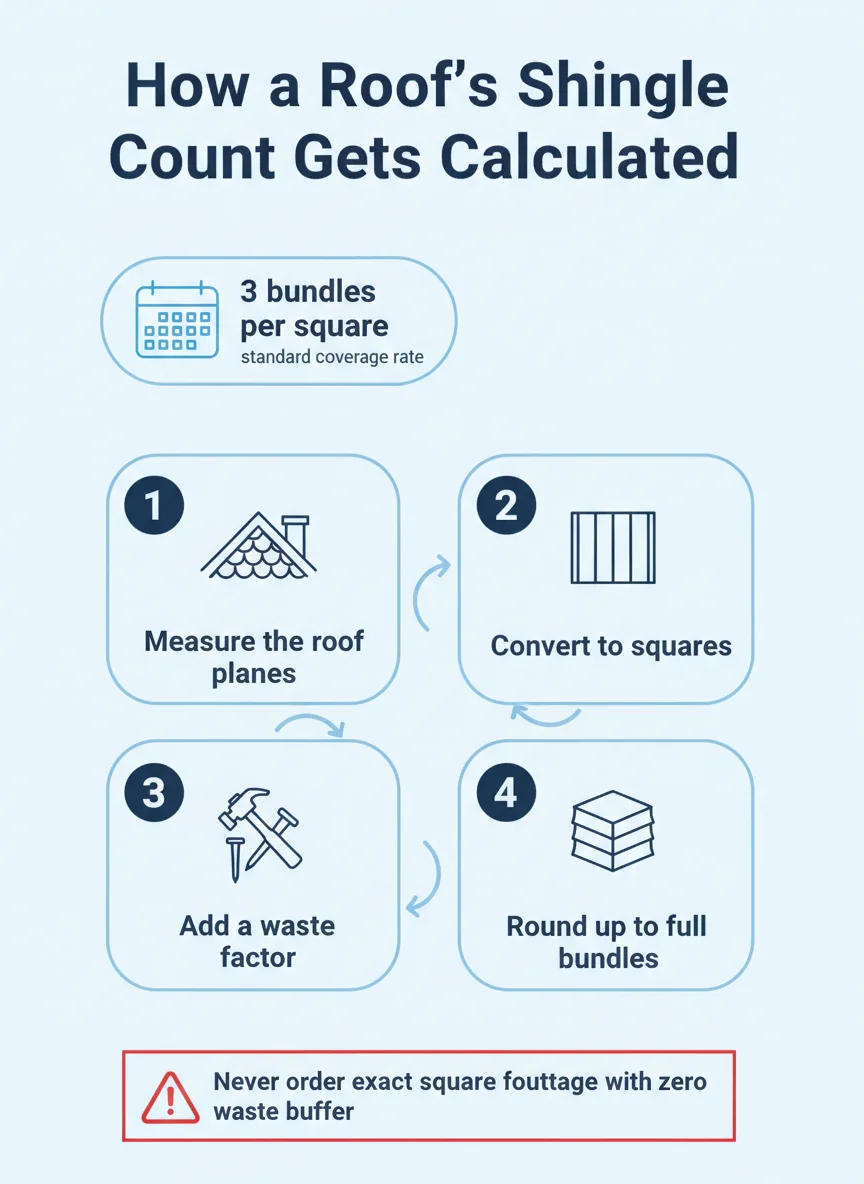
The honest answer is that nobody gets an exact bundle count from a tape measure and a ladder. Roofers convert the actual roof planes into squares, apply a waste factor based on the roof's complexity, and then round up to full bundles because manufacturers don't sell partial ones. Understanding each step helps a homeowner sanity-check a quote instead of just trusting a number on a page.
How the Industry Actually Calculates the Number
The math has three moving parts: total roof area, shingle coverage rate, and waste factor. Each one pulls the final bundle count in a different direction, and skipping any of them is how homeowners end up comparing quotes that look wildly different for the same roof.
Converting Footprint to Actual Roof Area
A roof's footprint, meaning the shape you'd see looking straight down from above, is not the same as its actual surface area. Pitch adds real material because the roof plane is longer than the flat distance it covers. A low-slope roof and a steep roof over the identical footprint can differ by several squares once pitch is factored in.
This is why two homes of similar size can need noticeably different material counts. A roofer working from satellite measurement or an on-roof walk accounts for every plane and pitch change separately, rather than applying one flat number to the whole house.
Coverage Rate and Waste Factor
Standard architectural shingles cover roughly a third of a square per bundle, so three bundles per 100 square feet is the baseline most estimates start from. From there, a waste percentage gets added on top of the raw square count to cover cuts, overlaps at valleys and hips, and starter and ridge pieces.
A simple roof with few cuts might only need a small waste cushion. A roof with multiple valleys, dormers, or a cut-up footprint needs considerably more, since every valley and hip line generates offcuts that can't be reused.
| Roof Type | Typical Waste Factor | Why |
|---|---|---|
| Simple gable, few cuts | Lower end of the range | Long straight runs, minimal trimming |
| Hip roof with several planes | Mid-range | More cuts at hips and ridges |
| Roof with valleys, dormers, or turrets | Higher end of the range | Frequent angled cuts that can't be reused |
What's Actually Being Ordered Beyond Shingles
Shingles are the visible part of the order, but a full material list includes underlayment, starter strip, ridge cap, and fasteners, each calculated off the same square footage with its own coverage rate. Flashing and drip edge get measured by linear foot along eaves, rakes, and any walls the roof meets rather than by square footage at all.
This is part of why a one-line "how many bundles" question doesn't capture the whole order. A quote worth trusting breaks out shingles, underlayment, and accessories separately rather than bundling everything into one vague material line.
Step-by-Step: How a Roofer Builds the Material Count
Here's the general sequence a quote goes through before a bundle count ever gets written down, whether the measurement comes from a satellite tool or a crew member on the roof with a tape.
- Measure each plane: Every distinct roof section gets measured separately, since pitch and shape can change plane to plane on the same house.
- Calculate true area: Footprint measurements get adjusted for pitch to arrive at actual surface area rather than flat ground coverage.
- Convert to squares: Total area gets divided into 100-square-foot units, the standard unit roofing material is priced and ordered in.
- Apply waste factor: A percentage gets added based on how many valleys, hips, and cuts the roof actually has.
- Divide by coverage rate: Total adjusted squares get divided by the shingle's coverage rate per bundle to get a raw bundle count.
- Round up to full bundles: Since partial bundles aren't sold, the final number always rounds up, never down, from the raw calculation.
What the Final Number Tells You About a Quote
Once you understand the math, a quote starts to make more sense as a document rather than a mystery figure. A roof quoted in whole squares with a stated waste percentage is being measured properly.
Signs the Math Was Done Carefully
A careful quote lists total squares, the shingle line, underlayment separately, and a stated or implied waste percentage that matches the roof's actual complexity. If a roof clearly has several valleys and dormers but the waste factor looks like it was applied for a simple gable, that's worth asking about.
It's also reasonable to ask how the measurement was taken, whether by satellite tool, aerial imagery, or a crew member physically walking the roof, since each method has different accuracy for capturing every plane and cut on a complex roof.
Signs Worth a Second Look
A quote with a single lump material number and no square breakdown makes it hard to tell whether waste factor was even considered. Similarly, two quotes with wildly different bundle counts for the same roof usually means one of them measured the roof differently, not that one is simply cheaper to be competitive.
When comparing estimates, ask each contractor what total square footage and waste percentage they used. That single question usually explains most of the gap between two numbers that otherwise look confusing side by side.
What a Homeowner Can Check vs. What Needs a Professional Measurement
A homeowner can reasonably estimate their home's rough square footage from a property survey or by pacing off the footprint, and that's enough to get a ballpark sense of whether a quote is in the right neighborhood. What a homeowner generally can't do safely or accurately is measure pitch, count every hip and valley, or climb onto the roof to verify plane by plane.
Roof measurement for an actual material order should come from a licensed roofer, whether through satellite measurement software or an on-roof walk, because the waste factor and plane count genuinely change the final order. Getting those wrong by even a few percent can mean an extra delivery trip mid-project.
Where a homeowner's judgment is genuinely useful is in catching obvious mismatches, like a quote that doesn't account for a visibly complex roofline, or one that seems to assume a much simpler shape than the home actually has. That's the kind of gap worth asking about before signing anything.
Getting an Accurate Count Before Material Day
The bundle math isn't complicated once you break it into its parts: true roof area, coverage rate, and waste factor for the roof's actual shape. What's harder to get right from the ground is the measurement itself, which is why an accurate quote usually starts with a real look at the roof rather than a guess from the driveway.
If you're trying to figure out the right number for your own home, it helps to understand how much roofing material a full project typically needs as a companion read, and to compare it against options like metal roofing for a Florida home if you're weighing materials before a roof repair or full replacement. For homes in the Lakeland area, Quality Plus Roofing & Solar measures every plane before material ever gets ordered.
Frequently asked questions
How many shingles come in a bundle?
Most architectural shingle bundles cover about a third of a square, so three bundles typically cover 100 square feet of roof. Exact bundle weight and coverage can shift slightly by manufacturer, so the final count depends on the product line selected.
What is a roofing square?
A roofing square is simply 100 square feet of roof surface, and it's the standard unit roofers use to price and order material. A typical single-story home might run anywhere from 15 to 35 squares depending on footprint and roof shape.
Why do roofers order more material than the roof's actual size?
Roofers add a waste factor to cover cuts at hips, valleys, and edges, since very little of that trimmed material can be reused elsewhere on the roof. A simple gable roof needs less waste allowance than a roof with lots of valleys, dormers, or cut-up planes.
Does roof pitch change how much material I need?
Yes, steeper pitches have more actual surface area than the footprint below them suggests, so a steep roof needs more squares than a flat-ish roof of the same home size. Roofers account for this with a pitch multiplier when converting footprint measurements into true roof area.
Can I just measure my roof from the ground and get an accurate count?
Ground measurements give a rough starting point but rarely capture every valley, dormer, and plane accurately enough to order material. A proper measurement, whether by a crew on the roof or satellite measurement tools, is what most quotes are actually built on.