
Why the Morning After Matters in Central Florida
Central Florida sees its share of fast-moving wind and heavy rain, and most of it passes through without leaving a mark worth worrying about. But every so often a system rolls through hard enough to loosen shingles, dent soft metal, or clog a gutter system with debris, and the damage isn't always visible from inside the house. The morning after is the best time to look, while the ground is still wet and anything that came off the roof is easy to spot in the yard.
A calm, methodical walk-around takes twenty minutes and tells you a lot. You're not trying to diagnose anything technical. You're looking for signs that something changed overnight, whether that's a scatter of granules by the downspout or a gutter hanging at a different angle than it did yesterday. If something looks off, you photograph it and move on to the next stop rather than trying to fix or inspect it yourself.
What Actually Happens to a Roof During High Wind and Rain
Wind doesn't usually rip a roof apart in one dramatic moment. More often it works at the edges and the weak points, the places where a shingle tab is already a little loose, where a flashing seam has started to lift, or where a gutter hanger was never quite tight. Rain follows behind and finds anywhere wind created an opening, which is why the two problems show up together.
Wind and the Edges of the Roof
The perimeter of a roof, the ridge line, and any valleys take the brunt of uplift in a wind event because that's where the roofing material has the least support underneath it. A shingle that lifts even slightly can crack at the seal line, and once that seal is broken it won't reattach on its own even after the wind dies down.
This is why a roof can look mostly fine from a distance the morning after, yet have a handful of shingles that are structurally compromised along an edge or ridge. It's a pattern worth scanning for specifically rather than just glancing at the whole roof once and calling it good.
Rain, Gutters, and Where Water Goes Next
Gutters are the roof's drainage system, and a storm puts more water through them in an hour than a normal week of rain does. If a gutter was already sagging or a downspout was partly clogged, that's when it tends to separate, overflow, or pull away from the fascia board entirely.
A downspout that's clogged or disconnected after a storm doesn't just mean a messy yard. Water that should be carried away from the foundation ends up pooling against the house instead, which is its own slow problem if it goes unnoticed for more than a day or two.
| Sign | Likely Cause | What To Do |
|---|---|---|
| Granules piled in gutter corners or downspout | Wind-driven rain stripping shingle surface | Photograph and note the location, watch for recurrence |
| Gutter sagging or pulling from fascia | Hangers overloaded by heavy water volume | Avoid leaning on it, call for an evaluation |
| Dented vent caps or flashing | Wind-blown debris impact | Note the spot on the roofline for a closer look |
| Water stain or damp spot on ceiling | Roof leak traveling along decking or framing | Check the attic directly above that spot |
The Parts of the System Worth Knowing Before You Look
You don't need to know roofing to do this walk-around well, but it helps to know the handful of parts most likely to show stress. Shingles or tile cover the main field of the roof, flashing seals the transitions at chimneys, vents, and valleys, and the gutter and downspout system carries water away from the foundation. Soffit and fascia sit at the edge where the roof meets the wall, and they're often the first place a loose piece of trim or a dented gutter calls attention to itself.
The attic ties all of it together from underneath. Decking, insulation, and the underside of the roof deck are the last line before water reaches your living space, so a quick look up there after a hard storm is one of the most useful five minutes you can spend.
Step-by-Step: Your Morning-After Walk-Around
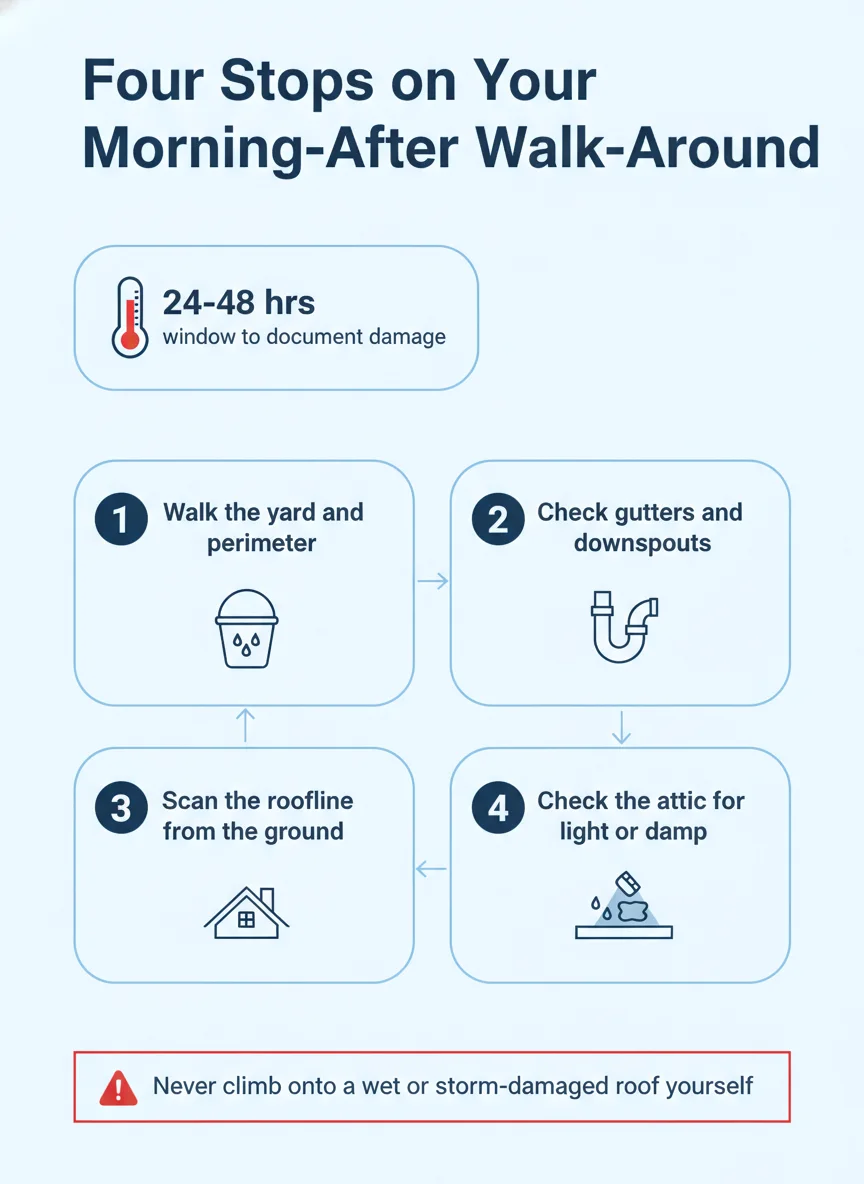
Work this in order, from the outside in, and keep your phone handy for photos at every stop. You're not fixing anything yet, just documenting and deciding what needs a closer look.
- Walk the perimeter: Circle the house and look for shingle pieces, granules, soft metal fragments, or broken branches on the ground near the foundation and walkways.
- Check downspouts: Run a hose or wait for a dry moment to confirm water is flowing freely through each downspout rather than pooling or dripping from a seam.
- Inspect gutter alignment: Look along the gutter line for sections that sag, pull away from the fascia, or sit at a different angle than the rest of the run.
- Scan the roofline from the ground: Use binoculars if you have them and look for missing or lifted shingles, dented vents, and any obvious gap along the ridge or valleys.
- Check the attic: Bring a flashlight and look for daylight through the decking, damp or discolored insulation, and any musty smell that wasn't there before.
- Photograph everything: Take wide shots of each area and close-ups of anything that looks damaged, timestamped photos are useful whether or not you end up needing a claim.
- Note the date and conditions: Write down when the storm hit and what you observed, this detail matters if you talk to an insurer or a roofer later in the week.
What You Might Find, and What It Usually Means
Scattered Granules or a Few Loose Shingles
A light scatter of granules in the gutter or at the base of a downspout is common after any hard rain and isn't automatically a problem. But if you also see a shingle or two that looks lifted, cracked, or missing entirely in that same area, that's a sign wind got under the material and broke the seal, and roof repair is worth scheduling before the next rain finds that same spot.
This kind of localized damage rarely requires a full residential roofing replacement. It's usually a targeted fix, but it's not something to leave for later since an open seal is an open door for water the next time weather rolls through.
A Damp Spot in the Attic or a Ceiling Stain
If your attic check turned up a wet patch on the decking or insulation, or you spot a new stain on a ceiling below, that points to an active leak somewhere above it. Water doesn't always travel straight down, so the stain's location and the leak's actual source on the roof can be several feet apart.
This is the one finding on the list that shouldn't wait. A leak that's active today will still be active tomorrow, and every additional rain event adds more water into framing and insulation that's already compromised.
What You Can Check Yourself vs. What Needs a Professional
Everything on this walk-around list is safe and reasonable for a homeowner to do alone. Looking at the yard, checking downspout flow, scanning the roofline with binoculars, and inspecting the attic with a flashlight don't require any special equipment or training, just a careful eye and a little patience.
Where it's time to call in a pro is anything above the gutter line. Climbing onto a roof after a storm to check for yourself is genuinely risky, both because the surface may still be wet and because storm-loosened material can shift under your weight in a way it wouldn't on a calm, dry day. A licensed roofer also knows what a small lifted tab looks like up close versus what's actually structural, which is a distinction that's hard to make from the ground.
The same goes for rain gutters that are sagging or pulled away from the house. A homeowner can clear debris from a gutter that's still solidly attached, but reattaching hangers or realigning a run that's pulled loose from the fascia is a job for someone with the right ladder setup and hardware on hand.
Keep the Photos and Make the Call Early
Whatever you find on your walk-around, hang onto the photos and the date even if nothing looks urgent. A pattern that seems minor the morning after a storm can be the first sign of something that gets worse over the following weeks, and having a dated record makes any later conversation, whether with a contractor or an insurer, much easier.
If your check turns up missing material, a leak, or damage you're not sure how to read, it's worth getting a second set of eyes on it sooner rather than later. Homeowners across the Tampa and Lakeland area who want a professional look after a rough night of weather can count on Quality Plus Roofing & Solar to walk the roof and gutters properly and tell you exactly what they find.
Frequently asked questions
What should I check first after a storm hits my house?
Start on the ground, not the roof. Walk the yard and the base of the house looking for shingle granules, pieces of soft metal, or branches that came down, then look up at the roofline and gutters from a safe distance before you consider anything up close.
How do I know if my roof has storm damage from the ground?
Look for a roofline that seems to wave or dip, shingles that look curled or missing in a patch, and dented vents or flashing catching the light differently than the rest of the roof. Binoculars from the yard are safer and nearly as effective as climbing up.
Is it normal to find granules in my gutters after a storm?
A handful of granules after any hard rain is normal wear, but a heavy pile that looks like coarse sand filling a downspout or gutter corner usually means the storm stripped more than it should have. That's worth a closer look from a professional.
Should I go into my attic after a storm?
Yes, if it's safe to do so, because the attic is often the fastest place to confirm a leak before it shows up on your ceiling. Bring a flashlight and look for daylight coming through the decking, damp insulation, or a musty smell.
How soon should I call a roofer after storm damage?
Call as soon as you spot a pattern of missing material, an active leak, or damage you can't fully assess from the ground. Acting within a day or two also puts you in a better position if you end up filing an insurance claim.