Two Warranties, One Roof
Every new roof installed in Florida carries two separate layers of protection, and homeowners often assume it's just one warranty covering everything. The shingle, tile, or metal panel manufacturer stands behind the product itself, while the roofing contractor who installed it stands behind the labor. Confusing the two is one of the most common and costly mistakes a homeowner makes, usually discovered only after a leak shows up and the claim gets denied for the wrong reason.
In Florida's climate, where roofs face intense UV exposure and heavy seasonal rain year round, this distinction matters more than in milder states. A material defect and an installation error can look identical from inside the attic, a water stain is a water stain, but which warranty applies determines who pays and how fast the problem gets fixed. Knowing the difference before you sign a contract for Residential Roofing or Commercial Roofing saves real frustration later.
Why These Warranties Exist Separately
The split exists because two different parties are responsible for two different kinds of failure, and neither one wants to be on the hook for the other's mistake. A manufacturer can control exactly how its shingles are made in a factory, but it has no control over how a given crew nails them down on a given afternoon. A contractor controls the install, but has no control over whether a batch of material had a manufacturing flaw. The warranty split simply mirrors who actually has control over each part of the outcome.
What the Manufacturer Warranty Covers
A manufacturer warranty, sometimes called a material warranty, covers defects in the product itself. That means granules prematurely falling off a shingle, a tile cracking from a factory flaw rather than impact, or a metal panel's coating failing before its expected service life. Companies like GAF, Owens Corning, and Tamko each publish their own terms, and most offer tiered coverage where a basic warranty comes standard and an extended warranty requires using a certified installer and registering the product after installation.
What it does not cover is just as important. A manufacturer warranty generally will not pay for a leak caused by improper flashing, incorrect nailing patterns, or inadequate attic ventilation, even if the shingle itself is still structurally sound. If an adjuster or inspector traces a failure back to the install rather than the product, the manufacturer claim gets denied and the homeowner is pointed back to the contractor's workmanship coverage instead.
What the Workmanship Warranty Covers
A workmanship warranty, issued by the contractor rather than the material maker, covers the quality of the labor. That includes things like flashing that wasn't sealed correctly around a chimney or skylight, fasteners driven at the wrong angle, or ventilation components installed out of spec. If a leak shows up two years after install and traces back to how the roof was put together rather than a flaw in the shingle itself, this is the warranty that applies.
Workmanship warranties vary enormously from one roofing company to the next, both in length and in what's actually included, which is why the paper is only as good as the company issuing it. A lifetime workmanship warranty, like the one Quality Plus Roofing & Solar backs every installation with, means the company stands behind its labor for as long as you own the home, not just for a year or two after the invoice is paid.
| Situation | Manufacturer Warranty | Workmanship Warranty |
|---|---|---|
| Granule loss or factory defect in the shingle | Covered | Not applicable |
| Leak from improperly sealed flashing | Typically denied | Covered |
| Premature coating failure on metal panels | Covered | Not applicable |
| Leak from poor attic ventilation install | Typically denied | Covered |
What Actually Voids These Warranties
Most manufacturer warranties are voided by the same handful of issues: inadequate attic ventilation, improper installation that doesn't follow the published spec sheet, and layering new shingles over an old roof instead of a full tear-off. Manufacturers test their products assuming a specific ventilation rate and a specific nailing pattern, and when either is off, heat and moisture can build up in ways the product wasn't engineered to handle, which the manufacturer considers an installation failure rather than a product one.
Workmanship warranties get voided differently, usually by unauthorized repairs. If a homeowner hires a second contractor to patch a leak or add a vent after the original install, most workmanship warranties no longer apply to that section of the roof, since the original installer can no longer vouch for work they didn't perform. This is also why it matters whether a company handles Roof Repair in-house rather than subcontracting it out.
Step-by-Step: Protecting Both Warranties From Day One
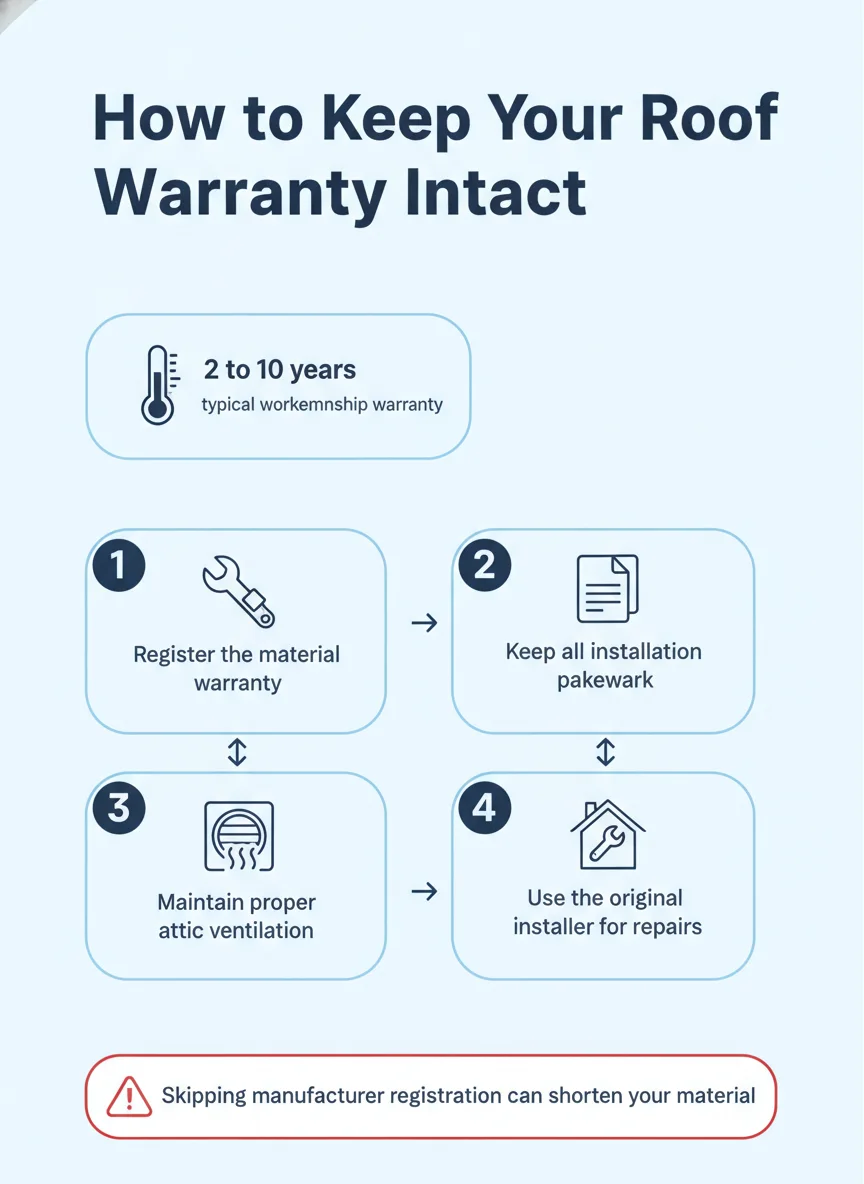
Protecting roof warranties isn't complicated, but it does require a little follow-through right after installation and some restraint about who touches the roof afterward. These are the steps that keep both warranties intact for the long haul.
- Register the material: Most extended manufacturer warranties require registering the product within a set window after install, so don't skip the paperwork your contractor hands you.
- Keep the install file: Save the contract, the permit, and any photos from the job, since you'll need them if you ever file a claim with either party.
- Maintain ventilation: Don't block soffit vents or add insulation that restricts attic airflow, since inadequate ventilation is one of the top reasons claims get denied.
- Use the original installer for repairs: Call the company that installed the roof for any future repair work so your workmanship warranty stays valid on that section.
- Review transfer terms before selling: If you're listing the house, check both warranties for transfer language so the next owner knows what coverage carries over.
How to Tell Which Warranty Applies to Your Problem
When a leak or a failure shows up, the fastest way to figure out which warranty applies is to look at where the problem is located. Trouble concentrated around penetrations, valleys, or edges, the places where two materials meet and have to be sealed by hand, usually points to a workmanship issue. Trouble spread evenly across a wide field of the material, like widespread granule loss or a coating that's failing uniformly, usually points to a product issue.
Signs That Point to a Material Problem
Shingles curling or losing granules in patches unrelated to sun exposure, tiles cracking without any sign of impact, or metal panels showing coating failure in a consistent pattern across the roof all suggest the material itself didn't perform as expected. These are the cases where contacting the manufacturer, usually through your original installer, makes the most sense.
Signs That Point to an Installation Problem
A leak that only shows up during driving rain and traces back to a single penetration point, nail pops visible in a line along a specific course, or a section where ventilation clearly wasn't installed to the original spec all point toward workmanship. These issues are the contractor's responsibility to fix under the workmanship warranty, regardless of how the material itself is holding up elsewhere on the roof.
What a Homeowner Can Check vs. What Needs a Licensed Roofer
A homeowner can safely do some of the groundwork themselves. Keeping registration paperwork organized, checking that attic vents aren't blocked by stored boxes or insulation, and doing a visual walk around the exterior after a big storm to look for obvious shingle displacement are all reasonable DIY tasks that help protect both warranties without putting anyone on a ladder.
Anything involving getting on the roof itself, diagnosing the source of a leak, or determining whether a failure is a material issue or an installation issue needs a licensed roofer. Florida's building code requires licensed installation for a reason, and a trained eye can tell the difference between a factory defect and a flashing problem in a way that's genuinely hard to spot from the ground or from a quick look in the attic.
Filing an actual warranty claim, whether with the manufacturer or under a workmanship policy, also goes smoother with a licensed contractor involved, since they have the registration records, the original installation photos, and the direct line to the manufacturer's claims department that a homeowner typically doesn't have on their own.
Get the Warranty Terms in Writing Before You Sign
The best time to sort out warranty coverage is before the first nail goes in, not after a leak shows up. Ask any contractor bidding on the job exactly what their workmanship warranty covers, how long it lasts, and whether it's backed by a written document rather than just a verbal promise. Ask which manufacturer's material warranty applies and whether the install will qualify for the extended coverage tier, which often requires certified installation.
A roof that's going to be on the house for decades deserves that ten minutes of questions up front. Quality Plus Roofing & Solar backs every installation with a lifetime workmanship warranty, in addition to whatever material coverage applies from the shingle or tile manufacturer, so homeowners across Central Florida know exactly who covers what before the project ever starts.
Frequently asked questions
What is the difference between a manufacturer warranty and a workmanship warranty?
A manufacturer warranty covers defects in the shingles, underlayment, or other materials themselves, while a workmanship warranty covers mistakes made during the install, like a nail pattern that's off or flashing that wasn't sealed right. They come from two different parties and cover two different kinds of failure.
Does a roof warranty transfer if I sell my house?
It depends on the specific warranty terms, and this varies by manufacturer and by installer. Some material warranties allow a one-time transfer within a limited window after the sale, and some workmanship warranties transfer automatically since they're tied to the property, so it's worth asking the installer directly and getting the answer in writing before you list the home.
What voids a roof warranty?
The most common issues are poor attic ventilation, unapproved repairs or alterations by someone other than the original installer, and installing a second roofing layer over the old one instead of a full tear-off. Most manufacturer warranties also require the product to be installed according to their published specifications, so deviating from that can void coverage even if the shingle itself never fails.
How long does a workmanship warranty usually last?
Workmanship warranties vary a lot by company, and the industry norm runs anywhere from a couple of years to lifetime coverage depending on the contractor. A workmanship warranty is only as good as the company standing behind it, so a track record and a clear written policy matter more than the number of years printed on the paper.
Who do I call if something goes wrong, the manufacturer or the installer?
Start with the installer, since they handled the actual work and usually know fastest whether the issue is a material defect or an installation issue. If it turns out to be a material defect, your installer can typically help you file the manufacturer claim since they have the registration and installation records on file.