Choosing a Roof Material in Central Florida
Homeowners across central Florida end up weighing the same two options almost every time a roof needs replacing: asphalt shingles or metal. Both show up all over neighborhoods from Lakeland to Tampa to Orlando, and both can meet Florida Building Code wind and water requirements when installed correctly. The decision usually comes down to budget, how long you plan to stay in the home, and how much heat, noise, and maintenance you're willing to live with.
This isn't a question with one right answer. A rental property owner refinancing every ten years has different priorities than a family planning to retire in the house. Understanding how each material actually performs under Florida sun, humidity, and wind helps you make the call with your eyes open instead of just picking whatever the last estimate pushed hardest.
Why the Florida Climate Changes This Decision
Florida roofs deal with more sun hours, more humidity, and more wind-driven rain than most of the country, and that changes how each material ages. A roof that performs fine in a mild climate can wear differently here, so it helps to look at heat and wind as separate questions rather than lumping them into one generic 'durability' conversation.
Heat and UV Exposure
Asphalt shingles absorb heat, and constant UV exposure gradually breaks down the asphalt binders over the years, which is part of why their granules eventually wear thin. Lighter-colored shingles reflect more heat than dark ones, but even the best asphalt still gets hotter under direct Florida sun than most metal finishes.
Metal roofing, especially with a reflective coating, sheds a larger share of solar heat instead of absorbing it. That can translate into a cooler attic space, though the real impact on your energy bill also depends on attic insulation and ventilation, not the roofing surface alone.
Wind and Storm Performance
Both materials can be installed to meet Florida's wind-resistance requirements, but they get there differently. Asphalt shingles rely on proper nailing patterns, sealant strips, and underlayment to resist uplift, and a quality residential roofing install matters as much as the shingle itself.
Standing seam metal panels interlock mechanically along their seams, which generally gives them a higher wind-uplift rating out of the box. That's one reason metal shows up more often on homes in wind-exposed areas, though a well-installed shingle roof is still a solid, code-compliant choice for most central Florida properties.
| Factor | Asphalt Shingles | Metal Roofing |
|---|---|---|
| Upfront cost | Lower material and labor cost | Higher material and labor cost |
| Typical lifespan | 18-22 years in FL UV, industry average | Decades longer, often outlasting multiple shingle cycles |
| Heat performance | Absorbs more heat unless reflective | Sheds more heat, especially with reflective coatings |
| Maintenance | Granule loss and spot repairs over time | Minimal upkeep, occasional fastener or seam check |
What Each Roofing System Is Actually Made Of
Asphalt shingles are layered mats of fiberglass or organic material saturated with asphalt and topped with mineral granules that provide color and UV protection. They're installed in overlapping courses over underlayment and decking, which is part of why spot repairs are usually straightforward when just a section gets damaged.
Metal roofing comes in a few common forms, including standing seam panels with raised interlocking ribs and exposed-fastener panels that screw directly through the material. Standing seam tends to cost more but hides its fasteners and handles expansion and contraction better over Florida's hot days and cooler nights, while exposed-fastener systems are a more budget-friendly entry point into metal.
Step-by-step: How to Decide Which Material Fits Your Home
Working through these questions in order, rather than starting with price alone, usually leads to a clearer decision.
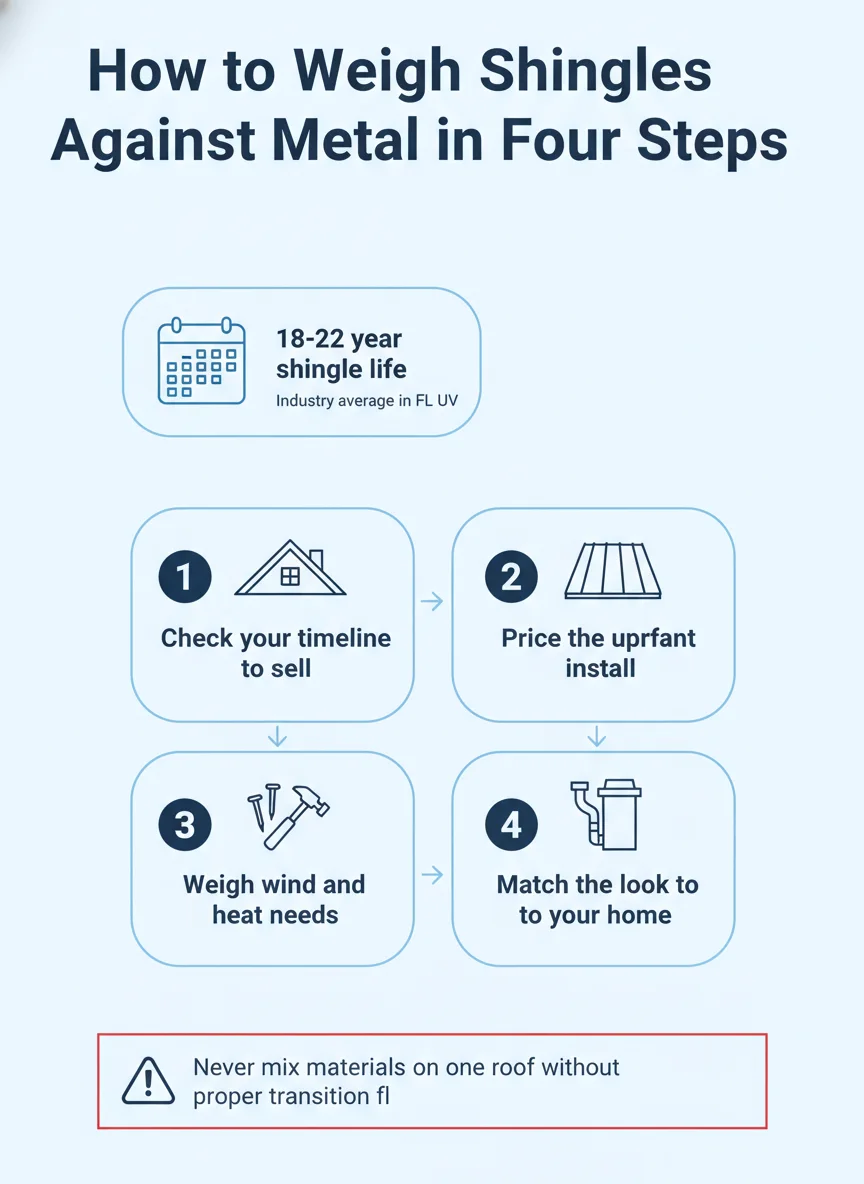
- Set your timeline: Decide whether you plan to stay in the home for decades or sell within the next several years, since that changes how much a longer-lasting material is worth to you.
- Review your budget: Compare what you can spend upfront against the idea of fewer future replacements, since metal costs more now but typically spans more years before it needs doing again.
- Think about heat load: If your energy bills spike every summer, a reflective metal roof may ease some of that burden more than a standard dark shingle would.
- Consider the look: Shingles offer more texture and color variety for traditional home styles, while metal gives a cleaner, more modern line that some HOAs regulate closely.
- Check wind exposure: Homes in more wind-exposed areas or on open lots may benefit from the higher uplift resistance that standing seam metal typically offers.
- Ask about warranty terms: Compare the manufacturer warranty vs. workmanship warranty for each material option your roofer quotes, since the two aren't the same thing.
- Get a written quote: Have a licensed roofer walk the property and provide a detailed quote for both materials so you're comparing real numbers for your specific roof, not generic averages.
What Homeowners Notice After the Install
Living Under Asphalt Shingles
Most homeowners under asphalt shingles report a quiet, familiar roof that blends in with the rest of the neighborhood. Rain sounds are muffled the same way they always have been, and the shingle texture hides minor imperfections in the deck below better than a flat metal panel would.
Over the years, granule loss shows up first as darker patches or grit collecting in gutters, which is normal aging rather than an emergency. Spot repairs on a shingle roof are usually quick because a roofer can blend in replacement shingles without redoing the whole surface.
Living Under a Metal Roof
Homeowners who switch to metal often mention the attic feeling noticeably cooler during peak summer afternoons, which lines up with how reflective metal sheds solar heat. The clean lines also tend to make the home look sharper from the street, especially on more modern or farmhouse-style builds.
Maintenance is lighter day to day, but metal isn't fully hands-off. Fastener heads on exposed-fastener panels can loosen slightly over years of thermal expansion, so an occasional check keeps small issues from becoming leaks.
DIY vs. Calling a Licensed Roofer
There's very little in either roofing system that's a realistic DIY project for a homeowner, and that's true whether you're leaning toward shingles or metal. Walking a steep or wet roof deck is genuinely dangerous, and a single mis-nailed shingle or mis-fastened panel can create a leak path that doesn't show up for months.
What homeowners can do themselves is the groundwork: researching materials, comparing a few written quotes, and keeping an eye on the roof from the ground for obvious sagging, missing pieces, or staining. Binoculars work fine for this and it doesn't require getting on a ladder.
The install itself, the underlayment, flashing, fastening pattern, and ventilation integration, needs a licensed roofer who pulls the proper permits and follows Florida Building Code wind requirements for your zone. This is also where roof repair work differs from new installs, since patching an existing system correctly requires matching the original installation method.
Making the Call for Your Florida Home
Both asphalt shingles and metal roofing are proven, code-compliant choices for a central Florida home, and plenty of houses in Lakeland and the surrounding towns run on either one without issue. The right pick comes down to how long you'll own the home, what you're comfortable spending upfront, and how much you value a cooler attic and longer lifespan against a lower initial cost.
Getting a side-by-side quote on both materials from the same roofer is the simplest way to see real numbers for your specific roof instead of guessing from averages. Quality Plus Roofing & Solar walks homeowners through that comparison on-site so the decision is based on your roof, not a generic chart.
Frequently asked questions
Is metal roofing actually better than asphalt shingles in Florida?
Neither material is universally better, they solve different problems. Metal tends to last longer and shed heat and wind more efficiently, while asphalt shingles cost less upfront and are easier to repair in small sections.
Does metal roofing make a house louder in the rain?
A properly installed metal roof with solid decking and underlayment is not noticeably louder than shingles during rain, the perception of a 'tin roof' sound comes from older open-rafter installs without decking. Modern metal roofing over a solid deck absorbs most of that noise.
Can I install metal roofing over existing asphalt shingles?
Some metal systems can go over a single layer of shingles depending on local code and the roof's condition, but a full tear-off is usually recommended for the best long-term result. Your roofer can tell you which approach fits your situation during an inspection.
Do metal roofs lower cooling costs in Florida?
Reflective metal roofing can reduce attic heat gain compared to dark asphalt shingles, which may ease the load on your air conditioner during peak summer months. The exact impact depends on your attic ventilation and insulation, not just the roof surface.
Which material holds up better in high wind?
Standing seam metal roofing is typically rated for higher wind uplift resistance than standard asphalt shingles, which is why it's popular in wind-exposed parts of Florida. Both materials can meet Florida Building Code wind requirements when installed correctly with the right fasteners and underlayment.