
Why Gutters Matter More Than Most Florida Homeowners Think
Gutters do one job: move the water that lands on your roof away from the parts of the house that can't handle it. That sounds simple, but Central Florida's heavy, fast rain puts real stress on a system that's often ignored until something overflows. A full gutter channel during a downpour can dump hundreds of gallons right next to a foundation in a matter of minutes.
That water has to go somewhere, and if the gutters aren't doing their job it ends up running down fascia boards, pooling against the slab, or finding its way under the roof repair line at the edge. A system that's working right is invisible. A system that's failing shows up as stains, soft wood, and standing water, usually long after the first small problem started.
What Actually Causes a Gutter System to Fail
Gutter failure almost never happens all at once. It's usually one of four things slowly going wrong: the pitch flattens out, a hanger pulls loose, a seam opens up, or a downspout clogs solid. Each one causes water to sit or overflow instead of draining, and each one gets worse the longer it goes unchecked.
Pitch and Hanger Problems
Every gutter run needs a slight slope toward its downspout, usually so small it's hard to see with the eye. Over years of sun exposure and the weight of debris, hangers can loosen and that pitch flattens or even reverses in spots, which is why you'll see water sitting in a section long after the rain stops.
Loose hangers are often the root cause. Once a hanger pulls even slightly out of the fascia, that section of gutter sags, the pitch changes, and water starts pooling instead of flowing. It's a small mechanical fix when caught early, and a much bigger fascia repair when it isn't.
Seams, Joints, and Downspout Clogs
Most gutter systems have seams where sections join at corners or downspout outlets, and those joints are sealed rather than welded. Sun and age break down that sealant over time, and a seam that's leaking usually shows as a drip or stain directly below the joint rather than along the whole run.
Downspouts fail differently. They clog from the top down as leaves and granules pack into the funnel at the gutter outlet, and once that happens water has nowhere to go but over the front edge. A downspout that's gurgling or running slow during rain is usually clogged, not undersized.
| Failure point | What you'll notice | What it usually means |
|---|---|---|
| Flat or reversed pitch | Standing water in the trough after rain stops | Loosened hangers or a section that's settled |
| Open seam or joint | A drip line or stain below one specific spot | Dried-out sealant at a corner or outlet |
| Clogged downspout | Water overflowing the front lip during rain | Debris packed in the outlet funnel |
| Rusted or rotted hanger | Gutter pulling away from the fascia visibly | Hardware or wood failure, usually a replacement job |
What a Gutter Guard Actually Does (and Doesn't Do)
A gutter guard is a cover or mesh that sits over the open channel and is designed to keep large debris like leaves and sticks from piling up inside. For a property under heavy tree cover, that alone can cut cleaning frequency noticeably, since the big material that used to pack the channel now sheds off the top instead.
What guards don't do is stop everything. Fine grit, pine needles, and roof granules are small enough to work past most guard designs and still settle in the bottom of the channel over several seasons. A guarded gutter still needs an occasional check, it just needs it less often than an open one.
Step-by-Step: The Twice-a-Year Gutter Check
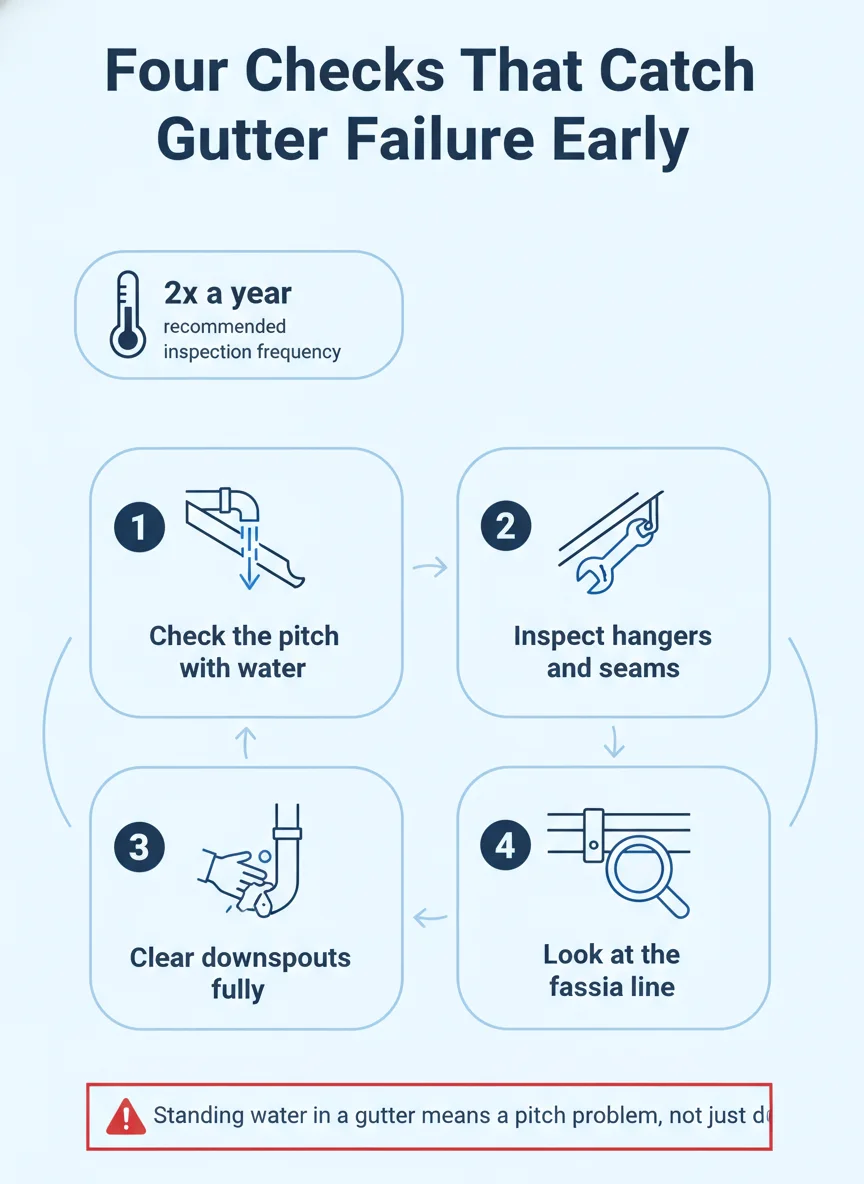
This routine takes most homeowners under an hour per pass and catches almost every failure before it turns into fascia or foundation damage. Spring and fall are natural timing in Florida, since both sit before the heaviest rain stretches of the year.
- Clear visible debris: Remove leaves, seed pods, and loose grit from the trough by hand or with a scoop, working from the downspout outlet outward.
- Run water through it: Use a hose to flush each section and watch where it pools. Standing water after the flow stops points to a pitch problem.
- Check every hanger: Press on each bracket along the run. Any give or separation from the fascia means that hanger needs attention before it fails.
- Inspect the seams: Look at every corner and joint for dried, cracked sealant or a visible gap, especially near downspout connections.
- Flush the downspouts: Run water down each spout from the top and confirm it exits freely at the bottom with no backup or gurgling.
- Walk the fascia line: Look along the board behind the gutter for soft spots, discoloration, or peeling paint, all early signs water has been getting behind it.
- Check splash blocks or extensions: Confirm water exits the downspout at least a few feet from the foundation rather than pooling right against the slab.
What You'll Find When Something's Actually Wrong
Signs the Gutter Itself Has Failed
A gutter that's visibly pulling away from the house, sagging in the middle of a run, or showing rust streaks down the face has moved past routine maintenance territory. These are structural signs, not cosmetic ones, and they usually mean a hanger or section has given out rather than just needing a cleaning.
Overflow marks on the fascia, even when the gutter looks fine from the ground, are another tell. That staining means water has already been running down the wrong side of the gutter during past storms, which is worth tracing back to its source before it happens again.
Signs the Problem Has Spread Beyond the Gutter
Soft or spongy fascia board behind the gutter line means moisture has already soaked into the wood, and that's a repair job that goes beyond the gutter hardware itself. Left alone, rotted fascia eventually takes the gutter hangers down with it since they no longer have solid wood to grip.
Pooling or soft ground right at a downspout's exit point is a sign the water isn't getting carried far enough from the foundation. That's an easy fix with an extension or splash block, but it's worth catching before it becomes erosion or a damp crawlspace.
What a Homeowner Can Handle and What Needs a Pro
Clearing debris, flushing a run with a hose, and a visual walk of the fascia line are all reasonable DIY tasks for anyone comfortable on a ladder. These checks don't require tools beyond a hose and a scoop, and doing them twice a year is the single best thing a homeowner can do to extend the life of the system.
Hanger replacement, seam repair, and anything involving the fascia board itself are a different story. Getting the pitch right on a gutter run takes a level eye and the right hardware, and fascia work often overlaps with roof edge and drip edge components that are easiest to address together rather than as separate projects.
If a section has visibly separated from the house, if rot has set into the fascia, or if water is tracking back up under the roof edge, that's a job for a licensed crew rather than a weekend fix. A professional rain gutter visit can also catch an early roof edge issue while the ladder's already up, which saves a second trip later.
Keep the Twice-a-Year Habit and the Rest Takes Care of Itself
Gutters are one of the cheapest parts of a home to maintain and one of the most expensive to ignore. Two honest checks a year, one before the wet season ramps up and one after it tapers off, catch almost every failure covered here before it reaches the fascia or the foundation. Pairing that with the after-the-storm checklist gives a full-year routine that covers both the quiet months and the aftermath of a hard rain.
Homes anywhere from Lakeland to the rest of Central Florida deal with the same heavy seasonal rain, so the routine doesn't change much by zip code, just by how much tree cover sits over the roof. Quality Plus Roofing & Solar is available if a check turns up something beyond a quick DIY fix.
Frequently asked questions
How often should gutters be cleaned in Florida?
Most Florida homes need gutters cleared at least twice a year, typically spring and fall, with more frequent checks if the property sits under oak or pine trees. Heavy summer rain exposes clogs fast, so a mid-season look after a few big storms isn't a bad idea either.
Do gutter guards really stop clogs?
Gutter guards reduce large debris like leaves and twigs from piling up, but they don't stop fine grit, pine needles, or shingle granules from settling in the channel over time. They cut down on cleaning frequency, they don't eliminate the need for it.
What happens if downspouts stay clogged too long?
Water backs up over the gutter edge and runs down the fascia board and siding instead of draining away from the foundation. Over months that moisture can rot wood trim, stain siding, and saturate the soil right next to the slab or crawlspace.
Can bad gutters damage my roof edge?
Yes, when a gutter overflows or sags away from the fascia, water can wick back up under the drip edge and starter course instead of running off cleanly. That's one of the more common ways a roof develops edge rot that has nothing to do with the shingles themselves.
How do I know if a gutter needs to be replaced instead of repaired?
A gutter usually needs replacement when the hangers have pulled out of soft or rotted fascia, the seams have separated in multiple spots, or the metal itself has rusted through. Isolated sagging or a loose section is often a repair, not a full replacement.