Why Attic Airflow Matters More in Central Florida
Central Florida homes spend most of the year under direct, intense sun, and that heat doesn't stop at the shingles. It pours straight into the attic space below, where it has nowhere to go unless the roof is built to move it. An attic that can't breathe turns into an oven, and that heat works against the roofing materials from underneath, not just the surface facing the weather.
Add in Florida's humidity and the stakes go up. Moisture that gets trapped in a poorly vented attic condenses on cool surfaces, soaks into insulation, and sits against wood decking for months at a time. Between the heat load and the moisture load, attic ventilation isn't a cosmetic upgrade here, it's part of what keeps a roof system lasting as long as it's supposed to.
How Does an Attic Ventilation System Actually Work?
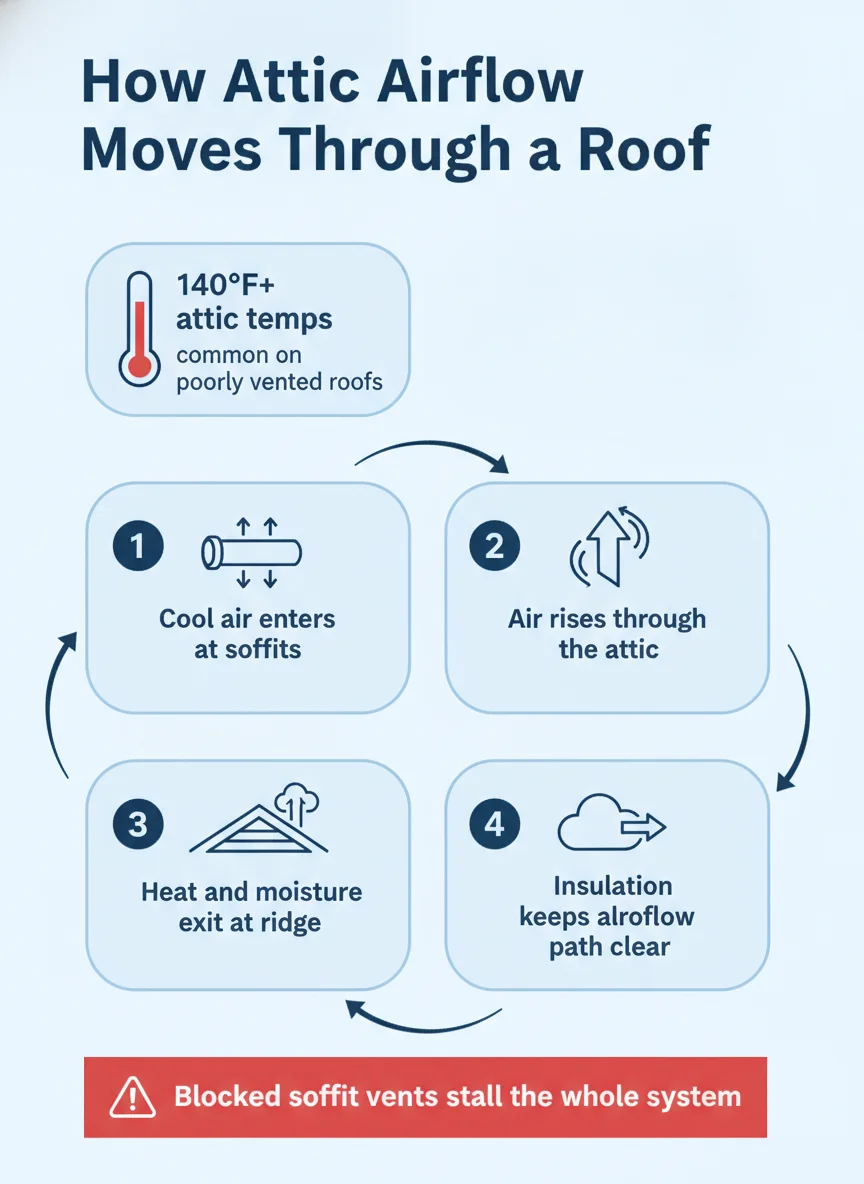
An attic ventilation system works by creating continuous airflow that enters low and exits high, carrying heat and moisture out before they can damage the roof structure. It relies on two matched components, intake and exhaust, working together rather than either one alone.
Intake: Where Air Gets In
Intake vents sit at the lowest points of the roof, usually in the soffits under the eaves. Their job is simple: let outside air into the attic space continuously, so there's always a fresh supply to push the hot, stale air out ahead of it. Without working intake vents, an exhaust vent has nothing to pull from and the whole system stalls.
Soffit vents get blocked more often than homeowners realize. Paint buildup, nesting insects, and insulation pushed too far into the eaves during an energy upgrade can all choke off the intake path. A roofer checking a ventilation complaint usually starts here, because a blocked soffit vent undermines everything above it.
Exhaust: Where Air Gets Out
Exhaust vents sit at or near the ridge, the highest point of the roof, where hot air naturally wants to rise and escape. A continuous ridge vent running the length of the roof line is the most common setup on newer homes, though box vents and powered fans show up on older or more complex rooflines.
For the system to work, exhaust capacity needs to roughly match intake capacity. Too much exhaust and too little intake and the attic can actually pull air from inside the living space instead of outside, which wastes energy and can pull moisture into the attic from the wrong direction.
| Condition | What's Happening | What It Leads To |
|---|---|---|
| Balanced intake and exhaust | Air moves steadily from soffit to ridge | Normal shingle life, stable attic temperature |
| Blocked soffit vents, open ridge vent | Exhaust has no fresh air to pull from | Heat buildup, higher cooling costs |
| Too much exhaust, too little intake | System pulls air from the house instead of outside | Energy loss, possible moisture intrusion |
| No ridge vent, static box vents only | Limited continuous airflow across the roof | Hot spots in the attic, uneven aging of materials |
What's Actually Up There: The Parts of the System
A complete attic ventilation system is made up of a handful of straightforward parts: soffit vents at the eaves, baffles that keep insulation from blocking those vents, a continuous air channel through the attic, and an exhaust vent at or near the ridge. On some homes a gable vent or powered attic fan supplements the ridge exhaust, especially on rooflines that don't have a long, continuous ridge to vent along.
None of these parts do much on their own. A ridge vent with no working soffit intake is just a hole in the roof. Soffit vents with no path through the insulation are just decoration. The system only works when every piece along the path, from eave to ridge, stays clear and properly sized for the attic space it's serving.
Step-by-Step: Checking Your Attic Ventilation
You don't need to climb onto the roof to get a basic read on how your attic is venting. A flashlight, a hot afternoon, and a few minutes in the attic access will tell you most of what you need to know.
- Pick a hot afternoon: Check the attic mid-afternoon on a sunny day, when heat buildup from poor ventilation will be most obvious.
- Feel the temperature: A properly vented attic will still feel warm but shouldn't feel like a furnace; extreme, stagnant heat is a red flag.
- Look at the soffits from inside: Shine a flashlight toward the eaves and confirm you can see daylight or clear airflow through the soffit vents.
- Check for frost or staining: In cooler months, look for frost on nail tips or dark staining on the decking, both signs of trapped moisture.
- Inspect the insulation at the eaves: Make sure insulation isn't piled against the soffit vents and blocking the intake path.
- Note any musty smell: A persistent musty odor in the attic usually points to trapped moisture that isn't being carried out.
- Write down what you find: Keep notes on temperature, smell, and any staining so a roofer has a clear starting point if you call one in.
What Poor Ventilation Looks Like on the Roof Itself
The damage from a poorly vented attic doesn't stay hidden up top forever. It eventually shows up on the roof surface and, in some cases, inside the house.
Signs on the Shingles
Shingles exposed to sustained attic heat from underneath tend to curl at the edges and lose granules faster than the same product on a well-vented roof nearby. Discoloration, a cupped or wavy look across sections of the roof, and shingles that feel unusually brittle to the touch are all consistent with heat damage building from inside.
This kind of wear often shows up unevenly, worse over rooms with cathedral ceilings or additions where the attic space is cramped and the ventilation path is harder to maintain. If one section of roof is aging faster than the rest, attic airflow in that area is worth checking before assuming it's a material defect.
Signs Inside the House
Inside, the first clue is usually the energy bill. An attic running hot forces the air conditioning to work harder against heat radiating down through the ceiling, and that shows up as higher summer cooling costs. Musty smells in upstairs rooms or closets that share a wall with the attic can also point to trapped moisture overhead.
In more advanced cases, homeowners notice ceiling stains or soft spots in the drywall directly below the attic, a sign that condensation or a slow leak related to decking damage has been going on for a while. By that point it's worth a full look at both the ventilation and the roof covering itself.
What a Homeowner Can Check and What Needs a Licensed Roofer
Clearing visible debris from soffit vents, confirming insulation hasn't been pushed over the eaves, and doing a basic attic walk-through for heat, smell, and staining are all reasonable for a homeowner to handle. These checks cost nothing but time and can tell you quickly whether a bigger problem is brewing.
Cutting in a new ridge vent, resizing soffit openings, or adding baffles behind existing insulation all involve working on or inside the roof assembly, and that's licensed roofer territory. Getting the intake-to-exhaust ratio wrong, or cutting into decking without sealing it properly, can turn a ventilation fix into a leak source.
If you're seeing shingle damage that looks tied to heat, or decking stains that suggest moisture has been sitting up there a while, it's worth pairing a ventilation check with a broader look at the roof covering. A roofer evaluating one should generally be evaluating both, since one so often drives the other.
Keeping the System Working Over Time
Attic ventilation isn't a one-time install and forget system. Insulation settles, gets added to, or gets disturbed during other home projects, and any of that can quietly choke off the soffit intake that the whole system depends on. A periodic check, especially after any attic insulation or electrical work, keeps the airflow path clear.
If your roof is due for other attention, a ventilation check is a natural add-on to a residential roofing inspection rather than a separate trip. For homeowners in Lakeland dealing with the kind of sustained heat that makes attic airflow a year-round concern, it's worth reading up on how roof ventilation needs vary by home alongside this guide. Quality Plus Roofing & Solar treats attic ventilation as part of a healthy roof system, not an afterthought.
Frequently asked questions
How do I know if my attic has enough ventilation?
A good first check is touching the ceiling on a hot day; if it's noticeably warm, heat is likely trapped above it. Other clues include a visibly hot, stuffy attic, frost or condensation on the underside of the decking in cooler months, and higher than expected cooling bills in summer.
Can too much attic ventilation be a problem?
Yes, an imbalance between intake and exhaust can actually pull conditioned air out of the house or draw in wind-driven rain during storms. The goal is a matched system, roughly equal intake at the soffits and exhaust at the ridge, not simply adding more vents everywhere.
Does insulation affect attic ventilation?
It can, especially when loose-fill or batt insulation gets pushed against the soffits and blocks the intake path. Baffles installed at the eaves keep a clear channel for air to enter even when insulation is piled up to code depth.
What does a poorly ventilated attic do to shingles?
Trapped heat bakes the underside of shingles and the adhesive that holds them down, which speeds up curling, cracking, and granule loss well before a shingle's expected service life is up. It's one of the more common reasons a roof underperforms its warranty.
Is attic ventilation something I can fix myself?
Clearing debris from existing soffit vents is a reasonable DIY task, but adding or resizing ridge and soffit vents involves cutting into the roof deck and should go to a licensed roofer. Getting the intake-to-exhaust ratio wrong can create leaks or wasted energy instead of fixing the problem.