
Why Knowing Your Roof's Age Actually Matters
Across Central Florida, roof age comes up constantly, not because homeowners are curious for curiosity's sake, but because it drives real decisions. Insurance carriers ask for it on every new policy and renewal. Buyers and their agents ask for it before closing. And a roof nearing the end of its service life behaves very differently in a summer storm than a roof installed five years ago, even if both look fine from the driveway.
The trouble is that most homeowners genuinely don't know the number, and they're not being careless, the information just doesn't travel well. People move into homes without full records, roofs get replaced between owners without anyone mentioning it, and the paperwork that does exist ends up in a drawer nobody opens again. The good news is that the real age is almost always recoverable if you know where to look.
Why the Roof's Age Gets Lost Over Time
Roof age goes missing for a handful of predictable reasons, and understanding them helps you know which records to chase first.
Records Change Hands With the House
Every time a home sells, there's a chance the roof's history gets passed along informally, or not at all. A seller might mention a recent roof replacement during negotiations, but that detail rarely makes it into any document the next owner keeps long-term. Permits filed with the city or county are the one record that stays put regardless of who owns the house.
Insurance files can also hold a clue, since many Florida policies require a roof age disclosure at binding or renewal. If you've had the same carrier for several years, your agent may have a roof age on file from a past inspection or application, even if you never requested one yourself.
Visible Wear Doesn't Follow a Calendar
Two roofs installed the same year can look nothing alike ten years later. Attic ventilation, roof slope, tree cover, and the quality of the original install all affect how fast granule loss and curling show up. That's part of why a visual read alone, without any record to confirm it, only gets you an estimate.
This mismatch is also why relying on memory is risky. A homeowner might recall 'a few years ago' for a repair that was actually closer to a decade back, especially if nothing has gone wrong since. Written records remove that guesswork entirely.
| Where to Look | What It Tells You | How Reliable It Is |
|---|---|---|
| County or city permit record | Filing date and often the contractor of record for a full replacement | Highly reliable when a permit was pulled |
| Closing documents and seller disclosure | Seller-reported install date, sometimes with an invoice attached | Reliable if documented, uncertain if only verbal |
| Previous owner or longtime neighbor | Approximate timing based on memory | Useful as a lead, not a confirmed date |
| Visual inspection by a roofer | Estimated age range based on wear patterns | Good supporting evidence, not a precise number |
House Age and Roof Age Are Two Different Numbers
This bears repeating because it trips up so many homeowners and even some real estate listings: the year a house was built tells you nothing reliable about the roof currently on top of it. A home built in 1998 could be on its original roof, its second roof, or a roof installed last month after storm damage. Builders install the first roof, but every replacement after that happens on its own timeline tied to weather, wear, and whoever owned the house at the time.
Treat 'house age' and 'roof age' as entirely separate facts you need to verify independently. If a listing or a past disclosure only gives you the build year, that's a starting point for research, not an answer.
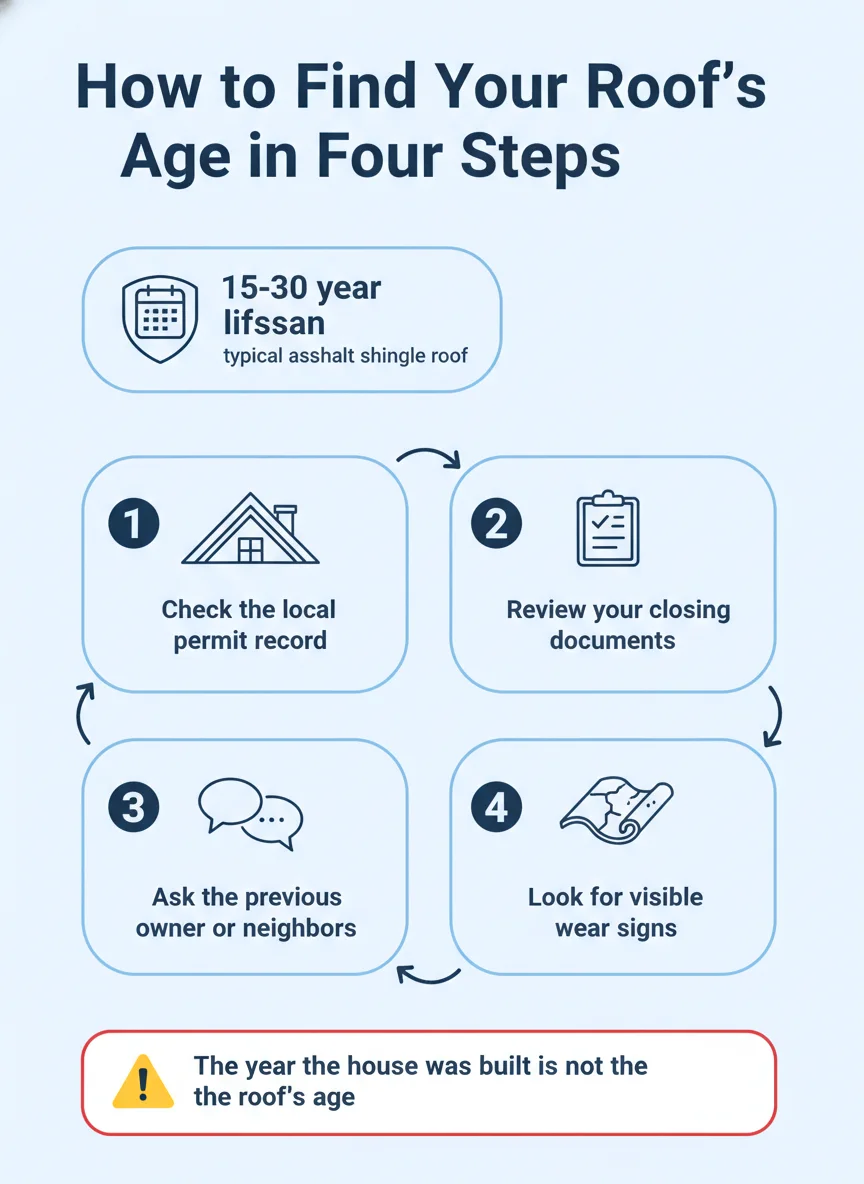
Step-by-step: Tracking Down Your Roof's Real Age
Work through these sources in order. Most homeowners find their answer within the first two or three steps.
- Search the permit portal: Look up your address on your county or city's online permitting system and search for roofing permits specifically, not just building permits.
- Pull your closing packet: Review your home's closing documents and seller's disclosure for any mention of roof replacement date, invoice, or warranty paperwork.
- Check your insurance file: Ask your insurance agent whether a roof age or roof inspection report is on file from a past application or renewal.
- Contact the previous owner: If you can locate the prior owner or a longtime neighbor, ask directly whether and when the roof was last replaced.
- Look for an attic stamp: Some shingle bundles or underlayment carry a printed manufacture date that's sometimes visible from inside the attic near the decking.
- Schedule a visual read: If paperwork turns up nothing, roof repair visits often include a general condition assessment that can narrow down an age range.
What the Evidence Usually Points To
Once you've gathered what you can, the picture usually falls into one of two categories.
If You Find a Recent Permit or Invoice
A dated permit or contractor invoice is about as solid as this gets. You now have an installation year you can use for insurance, for warranty tracking, and for planning ahead. It's worth keeping a copy of that document somewhere accessible, since it will come up again at your next policy renewal or if you sell.
If the record shows the roof is still well within its expected service life for its material, that's good news, but it's still worth a periodic check for wind-driven damage or wear in the years between now and a planned replacement.
If There's No Paper Trail at All
No records doesn't necessarily mean bad news, it just means you're working from visual evidence instead. Granule loss in the gutters, curling shingle edges, and soft spots underfoot all point toward an aging roof regardless of the exact year. A condition assessment focused on those signs, covered in more depth in When a Roof Is Past Repair: The Signs Roofers Look For, can help you plan even without a confirmed install date.
In this scenario, erring on the side of caution makes sense. If the visual signs suggest an older roof and you're also facing an insurance renewal, it's worth getting ahead of the conversation rather than waiting for the carrier to flag it first.
Should You Track This Down Yourself or Call a Pro?
The record-chasing part is entirely something a homeowner can do alone. Permit portals, closing documents, and a phone call to a past owner don't require any special access, just some patience and the right search terms. Most of this research can be done in an afternoon.
Where it makes sense to bring in a roofer is the visual side, especially if your paper trail comes up empty or gives you conflicting dates. A trained eye reading granule wear, flashing condition, and decking firmness can narrow an age range far more accurately than a homeowner walking the yard with binoculars, and it avoids the risk of climbing onto the roof yourself.
It's also worth asking a roofer to weigh in if your research turns up a roof that's clearly aging and you're trying to decide between further repairs and a full replacement. That's a judgment call that benefits from someone who's seen a lot of roofs at every stage of their life, not just the one on your house.
Getting a Real Number You Can Plan Around
Once you've pieced together a roof age from records, visual signs, or both, write it down somewhere you'll actually find it again, like a home maintenance file or a note in your insurance folder. That one number affects renewal conversations, resale disclosures, and how closely you watch for wear in the years ahead.
If your search turns up an older roof or conflicting information you can't resolve on your own, a condition assessment from a licensed local roofer can usually settle the question, and the team at Quality Plus Roofing & Solar can walk you through what the evidence on your specific roof is showing.
Frequently asked questions
Does the year my house was built tell me the roof's age?
No, and this is the single biggest mix-up homeowners make. A roof is often replaced once or twice over a house's life, so a 1985 build date could easily sit under a roof installed last year or one that's original and overdue.
Where do I find my roof's permit record?
Most Florida counties and cities keep permit records online through the building department's permitting portal, searchable by address. If a roof replacement was done with a permit, as code requires, the filing date and the contractor's name are usually both on record.
What if my home's permit history shows nothing for the roof?
A missing permit record doesn't always mean the roof is original, it sometimes means older records weren't digitized or the work predates the county's online system. In that case, closing paperwork, seller disclosures, or a visual inspection become the next best sources.
Can a roofer tell how old a roof is just by looking at it?
A trained eye can often narrow it down by reading granule loss, shingle curling, and flashing condition, but this gives an estimated age range rather than an exact date. Pairing a visual read with any paper trail you can find gets you the closest answer.
Why does my roof's age matter if it isn't leaking yet?
Roof age affects insurance eligibility and premiums in Florida, and many manufacturer and workmanship warranties are tied to install date rather than visible condition. Knowing the number lets you plan a replacement on your schedule instead of reacting to a failure.