Why Shingle Brand Names Confuse More Than They Clarify
Walk into any supply house in central Florida and you'll see the same handful of names on every pallet: Owens Corning, GAF, Tamko, Eagle, Westlake, New Point. Each one markets its top line as the toughest, the coolest looking, the longest covered. For a homeowner comparing quotes, that marketing noise makes it hard to tell what's actually different and what's just a different name on a nearly identical product.
The honest answer is that most major manufacturers build comparable architectural shingle lines at comparable price points. The differences that matter for a Florida roof are the wind rating, the impact rating, the warranty structure, and the algae resistance treatment on the granules, not the brand logo stamped on the wrapper. Knowing those four things lets you read any quote with confidence, whichever name ends up on your roof.
What Actually Varies Between Shingle Lines
Underneath the branding, a shingle line is defined by its fiberglass mat weight, its sealant strip, its granule treatment, and the testing it passed to earn its wind and impact classification. Two shingles can look nearly identical on a sample board and still carry different ratings because of what's happening inside the laminate.
Wind and Impact Ratings
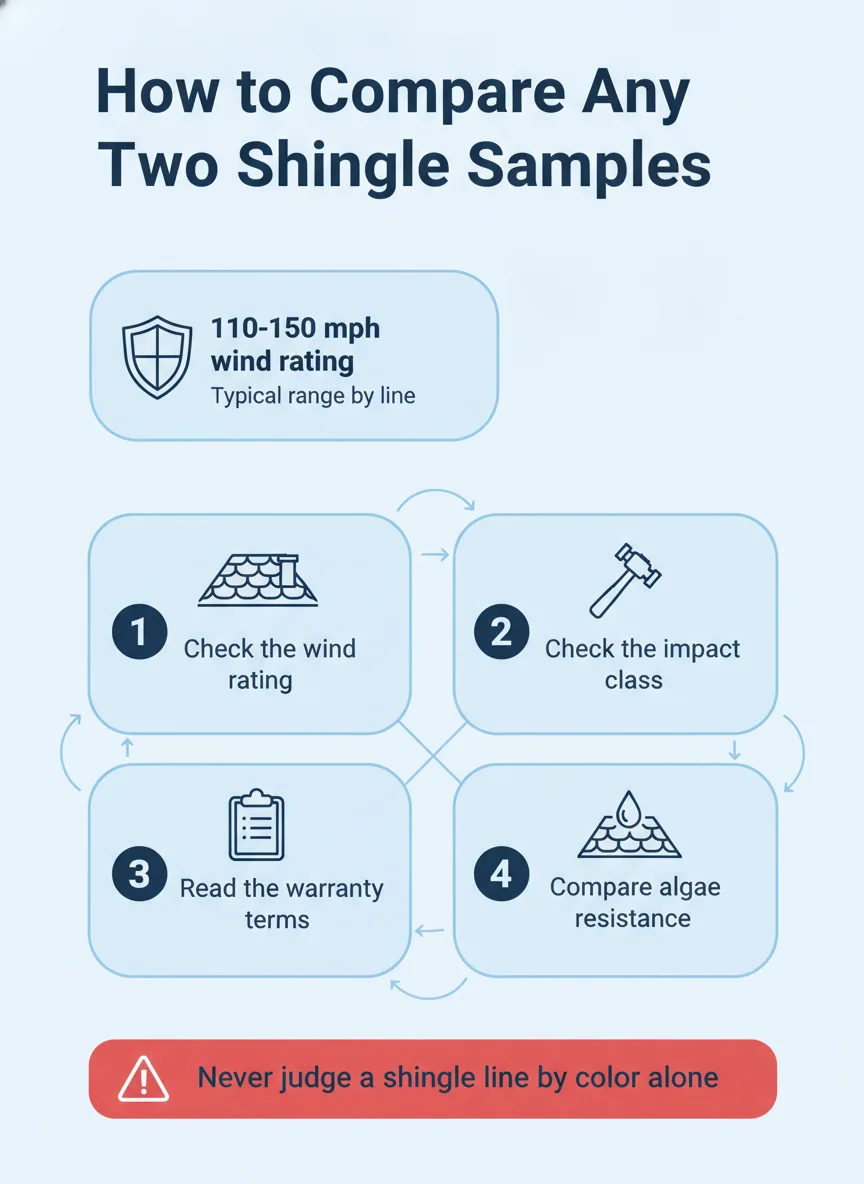
Wind ratings on architectural shingles typically fall in a range from around 110 to 150 mph depending on the line and the nailing pattern used, tested under ASTM and UL standards common across the industry. Impact ratings, often labeled Class 1 through Class 4, measure resistance to impact damage using a standardized ball-drop test, with Class 4 being the toughest rating a shingle can earn.
These numbers aren't marketing fluff, they're independently tested and printed on the manufacturer's technical data sheet for that exact product line. The rating only applies when the shingle is installed exactly to spec, which is why installation quality matters as much as the brand you pick.
Warranty Structures
Every major brand offers a limited material warranty, and most offer an enhanced warranty when the full roofing system, underlayment, starter strip, ridge cap, from that same manufacturer is installed together. The enhanced tiers usually require the installing contractor to carry a specific certification with that manufacturer.
Material warranties cover defects in the shingle itself, not normal weathering, fading, or damage from a falling limb. That's a separate thing from the workmanship warranty your roofing contractor offers on their own labor, which is worth understanding before you compare one quote against another.
| Manufacturer | What They're Known For | Where to Verify |
|---|---|---|
| Owens Corning | Broad architectural lineup with a widely available enhanced warranty tier | Manufacturer spec sheet for the specific product line |
| GAF | High-volume national brand with multiple impact-rated options | GAF product and warranty documentation |
| Tamko | Mid-market architectural lines common across the Southeast | Tamko technical data sheets |
| Eagle / Westlake / New Point | Regional and value-tier lines often used on budget-conscious re-roofs | Each manufacturer's published wind and impact test results |
Anatomy of an Architectural Shingle
An architectural shingle is built in layers: a fiberglass mat base, asphalt coating that gives it weight and water resistance, mineral granules on the surface for UV protection and color, and a factory-applied sealant strip that bonds each shingle to the one below it once the sun activates it after install. That lamination is what gives architectural shingles their dimensional look compared to flat three-tab shingles.
The granules do more work than most homeowners realize. Beyond color, they shield the asphalt from UV breakdown and, on algae-resistant lines, carry a copper-based treatment that slows the growth of the algae responsible for dark roof streaking. Granule quality and adhesion is one of the real, measurable differences between a budget line and a premium one from the same manufacturer.
Step-by-step: How to Compare Shingle Options for Your Home
You don't need to be a materials engineer to compare shingle options intelligently. Working through these in order will tell you more than reading five different brand brochures.
- Pull the data sheet: Ask for the manufacturer's technical data sheet for the exact product line being quoted, not just the brand name.
- Check the wind rating: Confirm the rated wind speed and the required nailing pattern that earns it on your roof's pitch.
- Check the impact class: Look for the Class rating if impact resistance matters for your situation, and confirm it's tested, not assumed.
- Compare warranty tiers: Ask whether the quote includes the manufacturer's standard or enhanced warranty, and what that enhanced tier requires.
- Ask about algae resistance: Confirm whether the line includes algae-resistant granules and how that's described in the warranty paperwork.
- Request a physical sample: Hold an actual shingle sample, not a photo, to judge color depth and granule texture in daylight.
- Confirm local availability: Ask your contractor which lines they stock regularly, since special-order shingles can add lead time to a project.
What You'll Find When You Compare Samples Side by Side
Algae Resistance
Most major brands now sell an algae-resistant version of their popular architectural lines, usually marketed under a name like StreakGuard or a similar term specific to that manufacturer. The copper-infused granules work by slowly releasing an ion that discourages algae growth over the life of the shingle, though resistance strength and duration differ by line, which is worth asking about directly rather than assuming every algae-resistant label performs the same.
If a home in Lakeland or elsewhere in central Florida already shows dark streaking on an existing roof, that's a separate maintenance issue from choosing a new shingle line, covered in more depth in our post on roof streaking.
Color and Dimension
Architectural shingles are built with layered tabs to create shadow lines and a more dimensional look than flat three-tab shingles, and most manufacturers offer dozens of color blends within a single line. The visual differences between brands at this level come down to how the granule blend is applied and how deep the shadow line reads from the street, which is genuinely a matter of personal taste.
Designer or premium shingle tiers within a brand's lineup often use a heavier mat and a more elaborate tab pattern meant to mimic the look of slate or shake. Those tiers typically carry the longest warranty period a manufacturer offers, but they also come at the top of that brand's price range.
DIY vs. Calling a Licensed Roofer
Comparing shingle brands and reading data sheets is something any homeowner can do on their own time, and it's worth doing before a contractor ever shows up with a sample binder. Understanding wind ratings, warranty tiers and algae resistance puts you in a stronger position to ask good questions during an estimate.
Where this stops being a DIY project is the installation itself. A shingle's tested wind rating only holds up when it's nailed exactly to the manufacturer's pattern, and enhanced warranty tiers typically require a certified installer, so the labor side of a residential roofing job needs a licensed roofing contractor, not a handyman, no matter which brand ends up on the roof.
A reputable local contractor will also know which lines they can get quickly and which require a special order, which matters if a roof repair needs to match existing shingles on part of a roof rather than replace the whole thing. That kind of practical knowledge is hard to get from a manufacturer's website alone.
Picking a Shingle That Fits the Home, Not Just the Brand
At the end of the comparison, the brand name matters far less than the specific product line, its tested ratings, and how well it's installed. A mid-tier line from one manufacturer installed correctly will outperform a premium line installed poorly, every time.
Quality Plus Roofing & Solar works with several of the major manufacturers named above and can walk through the data sheets, wind ratings and warranty tiers for any line before a homeowner commits to one.
Frequently asked questions
Is one shingle brand actually better than another?
Not in any blanket sense, most major manufacturers make a comparable architectural shingle line with similar wind and impact ratings. The real differences show up between tiers within a brand, not just between brand names, so compare the specific product line, not the logo.
What does a shingle's wind rating actually mean?
It's the sustained wind speed the shingle is rated to withstand when installed to the manufacturer's nailing pattern. A higher number sounds better on paper, but the rating only holds if the installation crew follows the exact fastening and sealant instructions that earned that rating.
Does a longer warranty mean a better shingle?
Not automatically, manufacturer warranties cover material defects, not wear from sun and weather, which is normal aging. A roof's actual lifespan depends more on ventilation, installation quality and local climate than on the number of years printed on the warranty paper.
Why do some shingles resist algae streaking better than others?
Algae-resistant shingles use granules treated with a copper or similar compound that discourages the blue-green algae that causes dark streaking. Most major brands now offer an algae-resistant option, though the strength and length of that resistance varies by product line.
Should I pick my shingle brand before choosing a roofer?
It's usually the other way around, most homeowners settle on a licensed, reputable installer first and let that company recommend which lines in their regular supply fit the home and budget. Installation quality affects how a roof performs far more than which brand name is on the wrapper.