
A Small Repair Question Every Central Florida Homeowner Eventually Faces
At some point a roof in central Florida throws up a small problem. A shingle tab lifts after a windy afternoon, a vent boot cracks in the sun, or a faint water stain shows up on a ceiling after a hard rain. The instinct is to call whoever is cheapest and fastest, and a handyman often fits that bill. The question is whether the fix actually holds.
This matters more in Florida than in drier climates because the roof deck underneath the shingles or tile sees near-constant UV exposure and seasonal downpours. A repair that looks fine on the surface but doesn't address the underlying water path can turn a small problem into a deck replacement a year or two later. Knowing which category your repair falls into before you make a call saves money either way.
Why the Same Repair Can Be Easy or Risky Depending on Where It Sits
A roof is a system of overlapping layers, not a single surface, and where the damage sits on that system determines how much roofing knowledge the fix requires. A shingle in the open field of a roof slope is relatively forgiving. A shingle near a valley, a chimney, a skylight, or a wall intersection is sitting on top of flashing, and flashing is what actually keeps water out at those transition points.
Open-Field Repairs
Repairs in the open field of a roof plane, away from any seam or penetration, are the lowest-risk category. A single lifted or cracked shingle here can sometimes be reset or replaced without disturbing anything around it. This is the kind of job where a handyman with basic ladder safety and a few roofing nails can do acceptable work, assuming the surrounding shingles are still in good shape.
Even here, matching the existing shingle color and profile matters more than people expect. Shingles fade with UV exposure over the years, so a patch using a newer bundle can stand out visibly, and mismatched or improperly nailed replacement shingles can blow off again in the next storm. It's a small job, but it still rewards some roofing familiarity.
Flashing and Penetration Repairs
Anything touching flashing around a chimney, skylight, vent pipe, or roof-to-wall junction is a different category of risk entirely. Flashing is metal or rubber formed to shed water around an interruption in the roof surface, and it has to be layered correctly with the surrounding shingles or tile, not just caulked over the top.
Caulk and roofing sealant are common handyman tools for this kind of repair, and they can buy time, but they aren't a permanent fix for failed flashing. Water finds the smallest gap, and a sealant-only repair around a penetration point tends to fail again within a season or two once the sun breaks the sealant down. This is where a licensed roof repair team earns its fee.
| Factor | Handyman | Licensed Roofer |
|---|---|---|
| Open-field shingle swap | Often capable | Capable, with matching materials on hand |
| Flashing or valley repair | Risk of a surface-only fix | Trained to rebuild the water path correctly |
| Permit-level work | Usually not licensed to pull one | Can pull permits when the scope requires it |
| Workmanship warranty | Rarely offered | Often backed by a written warranty |
What a Roof Repair Actually Involves Underneath the Surface
A roof repair that looks like 'replace a shingle' is often really 'confirm the underlayment and decking beneath that shingle are still sound.' Underlayment is the water-resistant barrier installed directly on the roof deck before shingles or tile go down, and it's the actual last line of defense if shingles fail. A repair that only addresses the visible shingle without checking what's underneath can mask a bigger issue.
This is also why a repair near an older section of roof sometimes reveals more damage than the original complaint. Decking that's been wet for a while can soften, and once a licensed roofer is up there anyway, they're trained to check for that before closing the repair back up. A handyman focused only on the surface symptom typically won't go looking for it.
Step-by-Step: How to Decide Who Should Fix It
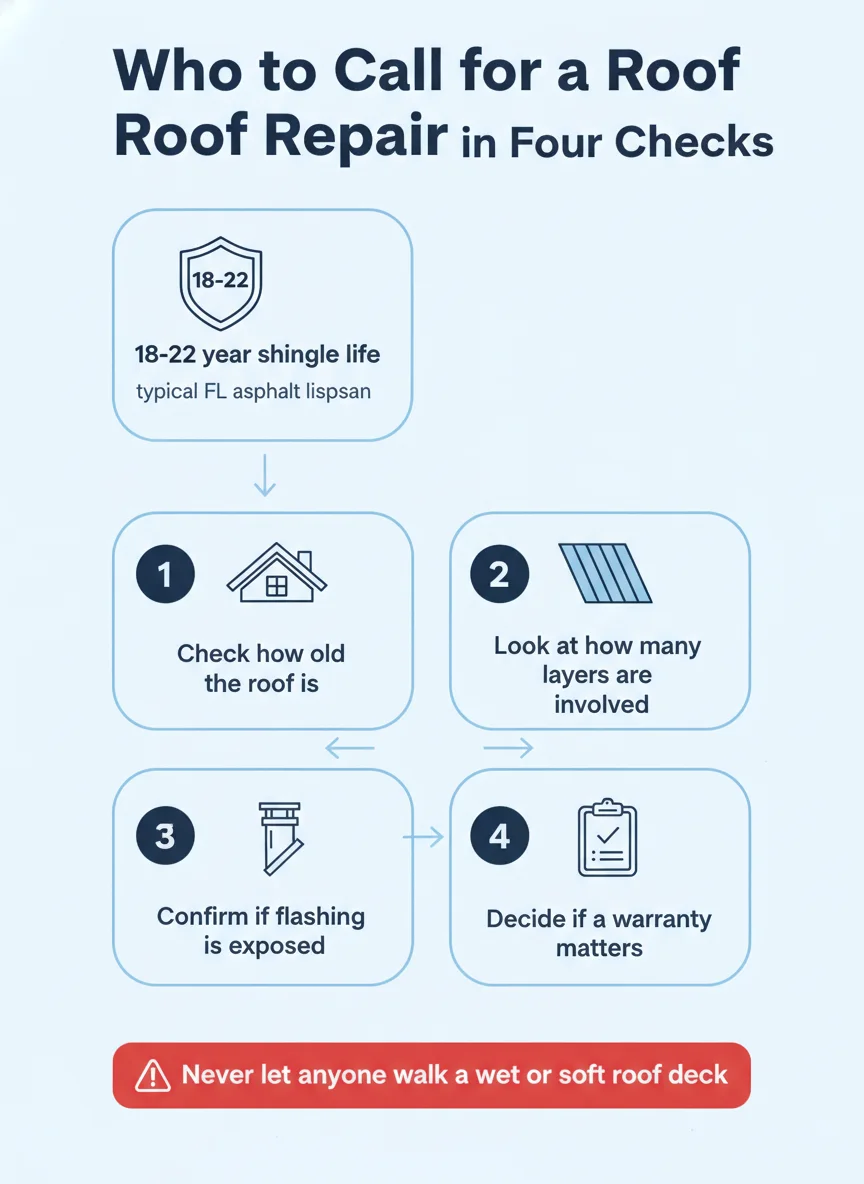
Walk through these checks before calling anyone, and you'll have a good sense of which category the job falls into.
- Locate the damage: Note whether it sits in an open field of the roof or near a valley, chimney, skylight, or wall junction.
- Check the roof's age: A roof nearing the end of its typical 18-22 year asphalt lifespan is more likely to have related issues nearby.
- Look inside the attic: A water stain on the ceiling or visible dampness in the attic suggests the issue has already moved past the surface.
- Ask about flashing: If the repair touches any metal or rubber flashing, treat it as a job for a licensed roofer, not a quick patch.
- Ask about documentation: If you'll want a workmanship warranty or a record for insurance purposes, a licensed company is set up to provide that.
- Get a second opinion: A quick look from a roof repair crew before you hire a handyman can confirm whether the scope is actually small.
What Homeowners in the Tampa Area Typically Find Once a Repair Is Opened Up
Isolated, Cosmetic Damage
Sometimes the damage really is as small as it looks. A single shingle lifted by wind, a cracked pipe boot with no attic staining, or a scuff from a fallen branch often turns out to be an isolated fix once a roofer or handyman actually gets eyes on it. In these cases the repair is quick and the cost difference between hiring a handyman and a roofer is usually small.
The way to confirm this is an attic check from the inside and a close look at the shingles immediately surrounding the damage. If there's no staining, no soft spots, and the surrounding shingles are still well-adhered, the job is probably exactly as small as it appears.
Hidden Water Tracking
Other times, what looks like one small leak point is actually water that traveled along the underlayment or decking from a different entry point entirely, sometimes several feet away. This is common enough in homes past repair territory that experienced roofers check for it as a matter of habit before closing up any repair.
If a handyman patches the spot where the stain appears on the ceiling without tracing the water back to its actual entry point, the leak often comes back in a new location during the next heavy rain. This is the single most common complaint homeowners have after a handyman-only roof repair.
DIY, Handyman, or Licensed Roofer: Where the Line Actually Falls
A homeowner can reasonably handle the smallest cosmetic checks themselves, like clearing debris off the roof, visually scanning for obviously lifted shingles from the ground with binoculars, or checking the attic for daylight or staining after a storm. None of that requires climbing on the roof itself, which is worth avoiding without the right fall protection and footwear regardless of skill level.
A handyman is a reasonable choice for small, open-field repairs on a roof that's otherwise in good condition, where the fix doesn't touch flashing, a valley, or a roof-to-wall junction. It's worth asking directly whether they're comfortable matching shingle profiles and whether they'll check the underlayment, not just the surface.
Anything involving flashing, a valley, a skylight, multiple layers, or a roof old enough that one issue is likely connected to others calls for a licensed roofer. Licensing generally means the ability to pull a permit when the scope requires one, carry insurance for the work, and back the repair with a written warranty, none of which a typical handyman arrangement includes.
Making the Call
The fastest way to avoid paying for the same repair twice is matching the person to the actual scope of the damage, not just the size of the visible symptom. A quick look from the ground, a check of the attic, and an honest read on where the damage sits relative to flashing will usually tell you which category you're in.
When the damage is anywhere near a seam, valley, or penetration, or the roof is old enough that one issue probably isn't the only one, it's worth having a licensed set of eyes on it before anyone starts patching. Quality Plus Roofing & Solar has handled both the small fixes and the ones that turned into something bigger across central Florida for 22 years.
Frequently asked questions
Can a handyman fix a small roof leak?
A handyman can often handle very minor, surface-level fixes like resealing a vent boot or securing a lifted shingle on a roof in good overall condition. Once the repair involves flashing, matching existing shingle courses, or anything near a valley or chimney, the risk of a repeat leak goes up without roofing-specific training.
What can go wrong if I hire a handyman for roof work?
The most common issue is a repair that stops the visible symptom but not the underlying path water is taking, so the leak reappears somewhere else in the house weeks or months later. A handyman also typically isn't licensed to pull a permit or carry the type of insurance a roof-specific job may call for.
Is it cheaper to use a handyman instead of a roofer?
It can look cheaper upfront, but cost depends on whether the repair is done once correctly or needs to be redone. A licensed roofer prices in matching materials and proper flashing work, which is often what prevents a second service call.
Does a roof repair need a permit?
Many municipalities require a permit for roofing work beyond the smallest cosmetic fixes, and permit requirements vary by city and by the scope of the repair. A licensed roofing company is set up to pull permits when the job calls for one; most handymen are not.
How do I know if my roof issue is small or serious?
A quick way to tell is whether the damage is isolated to one small, visible spot or whether it touches a seam, valley, or flashing point where multiple roof sections meet. Anything near those transition points is worth a second opinion from a [roof repair](/services/roof-repair) professional before anyone climbs up with a caulk gun.