
What a Windstorm Leaves Behind on a Florida Roof
Central Florida sees its share of strong wind events, from spring thunderstorm gusts to the broader bands that come with hurricane season, and asphalt shingle roofs take the brunt of it. A homeowner usually notices the obvious part first: a bare patch near a ridge, a corner, or an edge where the wind had the most leverage. What's harder to see from the ground is everything the wind did to the shingles that didn't tear off.
That's the real reason missing shingles deserve a proper look rather than a quick patch job from a ladder. Wind doesn't damage a roof in a straight line, it works on weak points, and a roof that lost a handful of shingles in one storm often has dozens more with broken seals sitting right next to the gap, waiting for the next gust to finish the job.
Why Wind Takes Shingles and What It Does to the Ones Left Behind
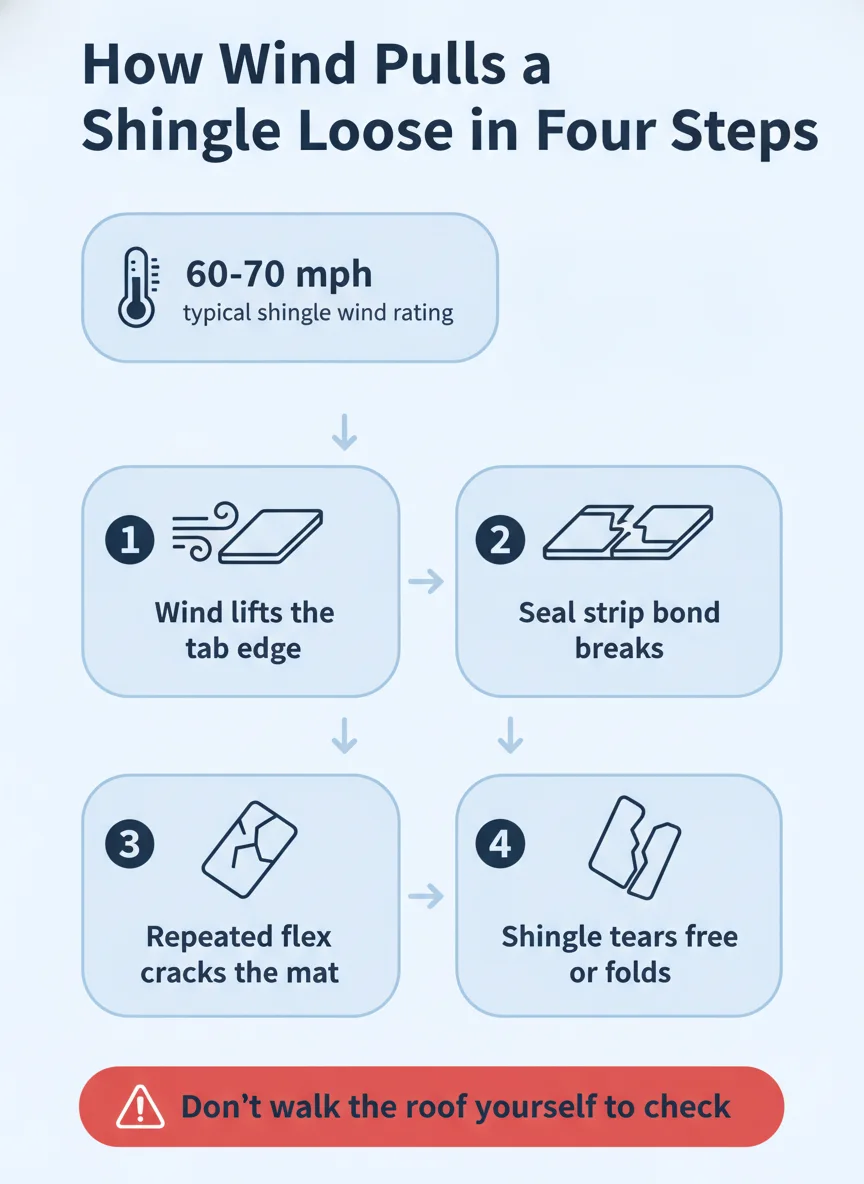
Every shingle relies on a factory-applied seal strip, a thin band of adhesive that bonds to the shingle below it once the sun warms it after install. That bond is what keeps a shingle flat against the roof deck in wind. When gusts get up under a tab edge, especially on an older roof where that seal has weakened with age and heat cycling, the bond breaks and the shingle starts to flap.
What Happens to the Shingles That Tear Off
A shingle that fully separates usually tears along its nail line or cracks across the mat from repeated flexing before it finally lets go. That leaves bare felt or deck exposed, along with exposed nail heads on the shingles around it. This is the damage you can see driving by, and it's the part that gets water into the house fastest if it isn't covered.
In most cases the nails that held that shingle are still in the deck, sometimes bent or backed out slightly from the flexing. A roofer checks those nail holes during a repair, because an open nail hole under a new shingle is its own small leak point if it isn't sealed properly as part of the fix.
What Happens to the Shingles That Stay Put
The shingles around the missing ones have usually been through the same wind load without tearing off, but that doesn't mean they came through clean. A broken seal strip on a shingle that's still lying flat isn't visible from the ground, and it won't announce itself until the next storm lifts that tab too. This is the main reason a roofer walks the whole slope rather than just the gap.
Creasing is the other thing to check for. A shingle that got lifted and snapped back down without tearing off can develop a crease across the tab, a weak line that cracks further every time it flexes in future wind. Creased shingles aren't missing yet, but they're on their way if they're left in place.
| Sign | Usually Means Repair | Usually Means Replacement |
|---|---|---|
| A handful of shingles missing on one slope | Yes, if the rest of the field is sealed and sound | Only if the roof is already near the end of its life |
| Missing shingles on multiple slopes | Rare, this often points to a wider wind event | Yes, especially combined with an aging roof |
| Deck soft spots or staining found during inspection | No, a patch over a weak deck won't hold | Yes, deck repair is usually paired with new shingles |
| Shingle color discontinued or heavily faded | Possible, with a visible but acceptable patch | Common on street-facing slopes for appearance |
The Roof System Behind the Shingles
Shingles are the visible layer, but they're only doing their job if the underlayment and deck beneath them are intact. Underlayment is the water-resistant barrier laid across the deck before shingles go down, and it's the backup line of defense any time a shingle tears loose in wind. On an older roof, that underlayment has usually been through years of heat cycling and may be brittle in spots even if it looks fine at a glance.
The deck itself, typically plywood or OSB sheathing, is what everything else is nailed to. Repeated water exposure from a missing shingle, even a small gap left uncovered for a week or two, can soften that deck enough that a simple shingle swap isn't enough anymore. That's why a wind damage inspection checks underlayment condition and taps the deck for soft spots, not just the shingles you can already see are gone.
Step-by-Step: How a Wind Damage Inspection Works
A thorough wind damage check follows a pattern, moving from the obvious damage outward to the parts of the roof that look fine but might not be.
- Document the gaps: We note where shingles are missing, how many slopes are affected, and whether the deck underneath is exposed.
- Check surrounding seals: We press and test shingles around each gap to find broken seal strips that haven't let go yet.
- Look for creasing: Creased tabs get flagged even if they're still attached, since they're likely to fail in the next windstorm.
- Inspect the deck: Any area that's been exposed to rain gets checked for soft spots, staining, or rot before a repair plan is set.
- Compare shingle age: We factor in how old the existing residential roofing is to decide if a patch makes sense long term.
- Match materials: Where a repair is the right call, we pull shingles as close to the existing style and color as current stock allows.
- Present both options: Homeowners get a clear read on what a targeted repair covers versus what a full re-roof would solve.
What the Inspection Usually Finds
On a Roof Under 10-12 Years Old
Younger roofs tend to come through a wind event in better shape overall, with damage mostly limited to the shingles that actually tore off plus a few neighboring tabs with compromised seals. The deck underneath is usually dry and sound because the roof hasn't had years of smaller leaks working on it. These are the clearest repair cases, where swapping the missing and compromised shingles solves the problem.
Even on a younger roof, though, it's worth checking flashing points like valleys, chimneys, and pipe boots, since wind can work loose fasteners in those spots even when the shingle field looks mostly fine. A repair that only addresses the missing shingles and skips those details can leave a leak path behind.
On an Older Roof Past Its Expected Lifespan
A roof that's already in its later years tells a different story. The shingles that didn't blow off are often brittle, with seal strips that have lost most of their adhesive strength from decades of UV and heat exposure. In these cases, a repair might hold for a while, but the next wind event is likely to take more shingles with it.
This is where the conversation usually shifts toward replacement, especially if the inspection also turns up deck staining or soft spots. Patching an aging roof after wind damage can buy a season, but it rarely buys years, and most homeowners want to know that math before deciding.
What Homeowners Can Check and What Needs a Licensed Roofer
From the ground, a homeowner can do a lot of the initial legwork safely. Walking the yard after a storm to look for shingle pieces, checking gutters and downspouts for granule buildup, and scanning each roof slope with binoculars for bare patches all give useful information without any risk.
What shouldn't happen without a licensed roofer is anything on the roof itself. Testing seal strips, checking deck integrity, and replacing shingles all require knowing how to walk a roof safely and how to tie a repair into the existing underlayment without creating a new leak path. A roof is also a system, and a repair that doesn't account for flashing, ventilation, or the shingle's remaining service life can end up costing more down the line than it saved.
The deposit and payment process on a repair is usually straightforward, a quote covering the scope of work, a deposit to schedule the crew, and final payment once the work is done and the slope is watertight again. A clear scope upfront is the best way to know exactly what's being fixed.
Getting a Straight Answer After the Next Windstorm
Missing shingles are rarely the whole story, and the shingles still sitting on the roof after a windstorm often matter more than the ones that are gone. A proper inspection looks at seal strips, deck condition, and the roof's overall age before recommending a repair or a replacement, rather than guessing from the bare patches alone.
If a recent windstorm left your roof with missing or lifted shingles, Quality Plus Roofing & Solar can walk the whole field, not just the obvious gaps, and give you a straight read on what it actually needs.
Frequently asked questions
Why do shingles go missing after high wind but the rest of the roof looks fine?
Wind doesn't hit a roof evenly. It catches edges, ridgelines, and any shingle whose seal strip was already weak, so a few tabs tear free while the field around them holds. Those gaps often sit next to shingles with broken seals that haven't let go yet, which is why a full inspection matters more than counting the visible bare spots.
Can you just replace the missing shingles instead of the whole section?
Often yes, if the surrounding shingles are still sealed, flexible, and a reasonably close match in color and style. The harder call is when the roof is older or the shingle line is discontinued, because new shingles can sit noticeably different from sun-faded ones nearby.
How do I know if wind damage means I need a full roof replacement?
A full replacement usually comes into play when the missing shingles are spread across multiple slopes, the roof is already near the end of its service life, or the deck underneath shows soft spots or staining. A roofer checks seal strip condition across the whole field, not just the open patches, before recommending one path over the other.
Is it safe to leave a few missing shingles until I can schedule a repair?
No, exposed deck and underlayment take on water fast, especially in Florida's rain pattern, so even small bare spots deserve a tarp or temporary cover within a day or two. A short gap in coverage can turn into rot or interior staining if a few more rain events hit before the repair happens.
Will a roofer match the shingle color exactly on a repair?
We aim for the closest match available from current stock, but sun-faded shingles rarely match new ones perfectly, especially on an older roof. On a visible slope, some homeowners choose to re-shingle that whole plane rather than live with a patch that stands out.