
Why This Decision Matters for Florida Homeowners
Central Florida roofs deal with sun, humidity, and wind cycles that break down materials faster than in milder climates. A shingle roof rated for 20-plus years elsewhere might show its age sooner here, which means the repair-or-replace question comes up more often for homeowners in this region than in other parts of the country.
Getting this decision right protects your budget two ways. Replace too early and you spend money you didn't need to. Repair too long and you risk interior damage that costs more to fix than the roof itself would have. The goal is matching the fix to where the roof actually is in its life.
What Actually Wears Out a Residential Roof
Roofing materials age from the outside in. UV exposure breaks down the surface layer first, then heat cycling loosens fasteners and seams, and finally water finds its way through whatever gaps open up. Understanding which stage your roof is in tells you whether a repair addresses the real problem or just buys a little time.
Age and Material Type
Asphalt shingles, metal, and tile all age differently. Shingles tend to show granule loss and curling as they near the end of their service life, while metal and tile can last considerably longer if the fasteners and underlayment hold up. Knowing your material's typical lifespan gives you a baseline to compare against.
A 10-year-old shingle roof with one damaged section is a very different conversation than an 18-year-old roof with the same damage. Age alone doesn't decide the call, but it narrows the odds of what you'll find once someone gets a closer look.
Pattern of Repairs
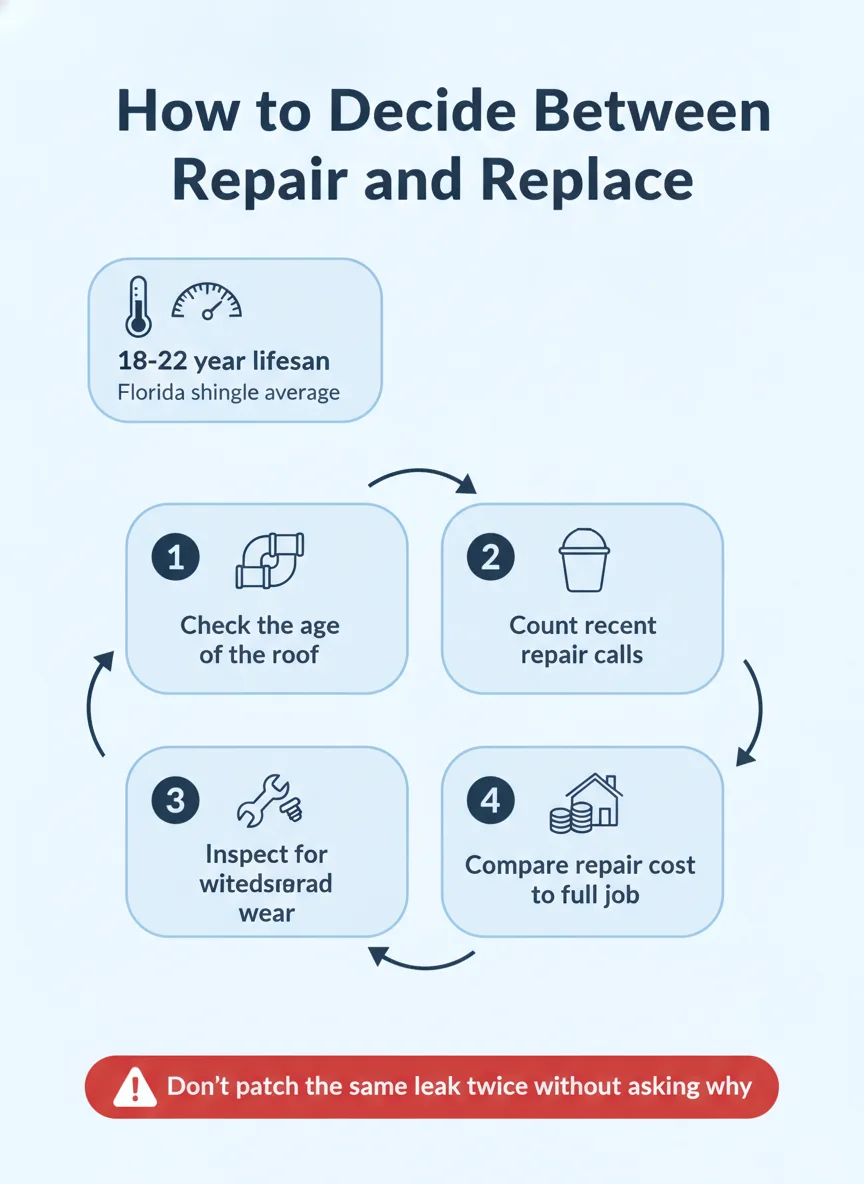
One repair call in five years tells you very little. Three repair calls in eighteen months tells you the roof is entering decline. Tracking how often you've needed a fix, and whether it's the same spot or different spots each time, is one of the clearest signals available to a homeowner without any special tools.
If repairs are clustering near the end of a warranty period or coming from the same section of roof, that's usually the material telling you it's done, not the workmanship.
| Signal | Points to Repair | Points to Replace |
|---|---|---|
| Age vs. material lifespan | Roof is under half its expected life | Roof is at or past its expected life |
| Number of recent leaks | One isolated leak, first occurrence | Multiple leaks in different spots within a year |
| Surface condition | Damage limited to a small area | Wear or granule loss spread across the roof |
| Interior signs | No staining or soft spots inside | Ceiling stains or soft decking in more than one room |
What's Actually Under the Surface
A roof is a system, not just the visible material. Underneath the shingles or tile sits an underlayment layer that provides the actual water barrier, decking that gives everything structure, and flashing around penetrations like vents and chimneys that seals the trickiest spots. A repair can fix the top layer, but if water has been getting to the decking, that's a bigger job.
This is why a visual check from the ground can miss the real story. Damage to the decking or underlayment often isn't visible until a contractor gets on the roof or into the attic to look directly at the wood and insulation.
Step-by-Step: How the Decision Gets Made
A thorough evaluation follows a consistent process whether the answer ends up being a repair or a full residential roofing job.
- Ground-level walkaround: A visual check of the roofline, gutters, and visible flashing points out obvious wear before anyone climbs a ladder.
- On-roof inspection: A closer look at the material surface, seams, and fastener condition reveals damage that isn't visible from the ground.
- Attic and decking check: Checking the underside of the roof deck for staining or soft spots shows whether water has already gotten through.
- Repair history review: Comparing past repair calls against the roof's age helps separate a one-off problem from a pattern.
- Cost comparison: Weighing the repair cost against the roof's remaining useful life clarifies whether a patch makes financial sense.
- Recommendation: A clear recommendation, repair or replace, with the reasoning behind it so the homeowner can decide with full information.
What You'll Actually Find Once Someone Looks Closer
When It's a Repair
Most single-source leaks trace back to a failed seal around a vent pipe, a cracked tile, or a section of shingles lifted by wind. These are contained problems. Fixing them restores the roof to full function without touching the rest of the surface, and a solid repair on a roof that's otherwise healthy can hold for years.
If the rest of the material tests sound and the decking underneath is dry, a repair is the right call and there's no reason to spend more than necessary.
When It's a Replacement
Widespread granule loss, multiple soft spots on the decking, or a pattern of leaks in different rooms usually means the roof as a whole has reached the end of its service life. At that point, individual repairs are treating symptoms of a problem that's spread across the entire surface.
A full replacement resets the clock and, done right, comes with a workmanship warranty that gives you a long runway before you have to think about the roof again.
What a Homeowner Can Check, and What Needs a Pro
You can absolutely do the ground-level parts yourself. Walk the perimeter of your home after a windy day and look for shingles on the lawn, sagging gutter lines, or debris buildup that traps moisture. Check ceilings and closets for new staining. These checks cost nothing and catch a lot of early warning signs.
What you can't safely do is get on the roof itself or into a tight attic space to check decking condition. That work involves fall risk and requires knowing what healthy versus failing material looks like up close, which is where a licensed contractor earns their keep.
The honest answer for most homeowners is to handle the ground-level watching yourself and call in a professional once something looks off, rather than waiting until there's active water inside the house. Catching a problem early is almost always the cheaper path, whether the fix turns out to be a repair or a replacement.
Making the Call With Confidence
There's no universal rule that applies to every roof, but the pattern holds across most homes: young roofs with isolated damage lean toward repair, and older roofs with spread-out wear lean toward replacement. Reading the age, the repair history, and the condition underneath together gives you a much clearer answer than any one factor alone.
If you're staring at a roof and not sure which category it falls into, a straightforward inspection settles the question, and Quality Plus Roofing & Solar can walk you through exactly what your roof needs and why.
Frequently asked questions
How do I know if my roof needs to be replaced instead of repaired?
If the roof is past the typical lifespan for its material, has had multiple repairs in the same area, or shows wear across most of the surface rather than one spot, replacement usually makes more sense than another patch. A single isolated issue on a roof that's otherwise in good shape is usually a repair.
Is it cheaper to repair a roof than replace it?
A single repair almost always costs less upfront than a full replacement, but repeated repairs on an aging roof can add up to more than the roof was worth saving. The real comparison is total cost over the next few years, not just the next invoice.
Can a roof be repaired more than once?
Yes, and many roofs get several repairs over their lifespan without issue. The concern is when the same area keeps failing or repairs are happening more often each year, which usually signals the underlying material is wearing out.
Does insurance cover roof repair or only full replacement?
Insurance coverage depends on the cause of damage and the policy itself, not on whether the fix is a repair or a full replacement. Both can be covered when the damage is from a covered event.
How long does a roof repair take compared to a replacement?
A repair is usually a same-day or next-day job, while a full replacement takes longer because it involves tear-off, material delivery, and inspection steps. Your contractor can walk you through the expected timeline once they've seen the roof.