
Why this decision matters more in Florida than most places
When a roof wears out, homeowners across central Florida face a choice: pay to strip the old layer down to bare decking, or let a new layer go directly over what's already there. It's a real fork in the road, not a minor detail, because what's happening under that first layer stays hidden for another decade or two if you choose the roof-over route.
Florida's heat and humidity make this call higher stakes than in drier climates. Moisture that gets trapped between layers has nowhere to go, and decking that's already soft or rotted doesn't announce itself until it's a bigger problem. That's part of why most roofers recommend a full tear-off whenever the budget and situation allow it.
What's actually happening underneath those shingles
A roof is a system, not just the visible shingle layer. Underneath sits the decking (usually plywood or OSB), flashing around chimneys and vents, and a ventilation path that lets heat and moisture escape the attic. A roof-over leaves all of that exactly as it is, good or bad, and simply adds a fresh surface on top.
What a roof-over hides
Soft decking, rusted flashing, and blocked ventilation all stay buried when you roof over instead of tearing off. If there's already a leak path or trapped moisture, a second layer won't fix it, it'll just put a new roof on top of an existing problem and buy you a few more years before it resurfaces.
Nail patterns are another issue. Shingles need to bite into solid decking at the right depth, and a layover changes that geometry. Installers have to work around the existing layer's profile, which can affect how flat the new shingles sit and how well they handle wind uplift over time.
What a tear-off reveals and fixes
Stripping the roof down to the deck lets a crew see exactly what they're working with. Rotted plywood gets replaced, damaged flashing gets swapped, and ventilation can be corrected or upgraded before the new layer goes on. It's the only way to confirm the structure underneath is actually sound.
A tear-off also resets the clock cleanly. The new residential roofing install goes on fresh decking with proper nailing, which is usually what manufacturers require for their full warranty terms to apply in the first place.
| Factor | Roof-Over | Tear-Off |
|---|---|---|
| Hidden damage | Stays hidden, unresolved | Found and repaired |
| Weight on structure | Adds a second layer | Single layer, lighter |
| Manufacturer warranty | Often reduced or voided | Typically full coverage |
| Code limits | Usually capped at two layers | No layer restriction |
The parts of the system a tear-off exposes
Once the old shingles are off, a crew can inspect the decking board by board, check flashing around every penetration, and confirm intake and exhaust vents are actually doing their job. Any of these can quietly fail over the years without ever showing a visible leak inside the house.
This is also the point where upgrades make sense, better underlayment, corrected ventilation, or flashing details that weren't done right the first time. None of that is possible if the old layer stays buried under a roof-over.
How do roofers decide between a roof-over and a tear-off?
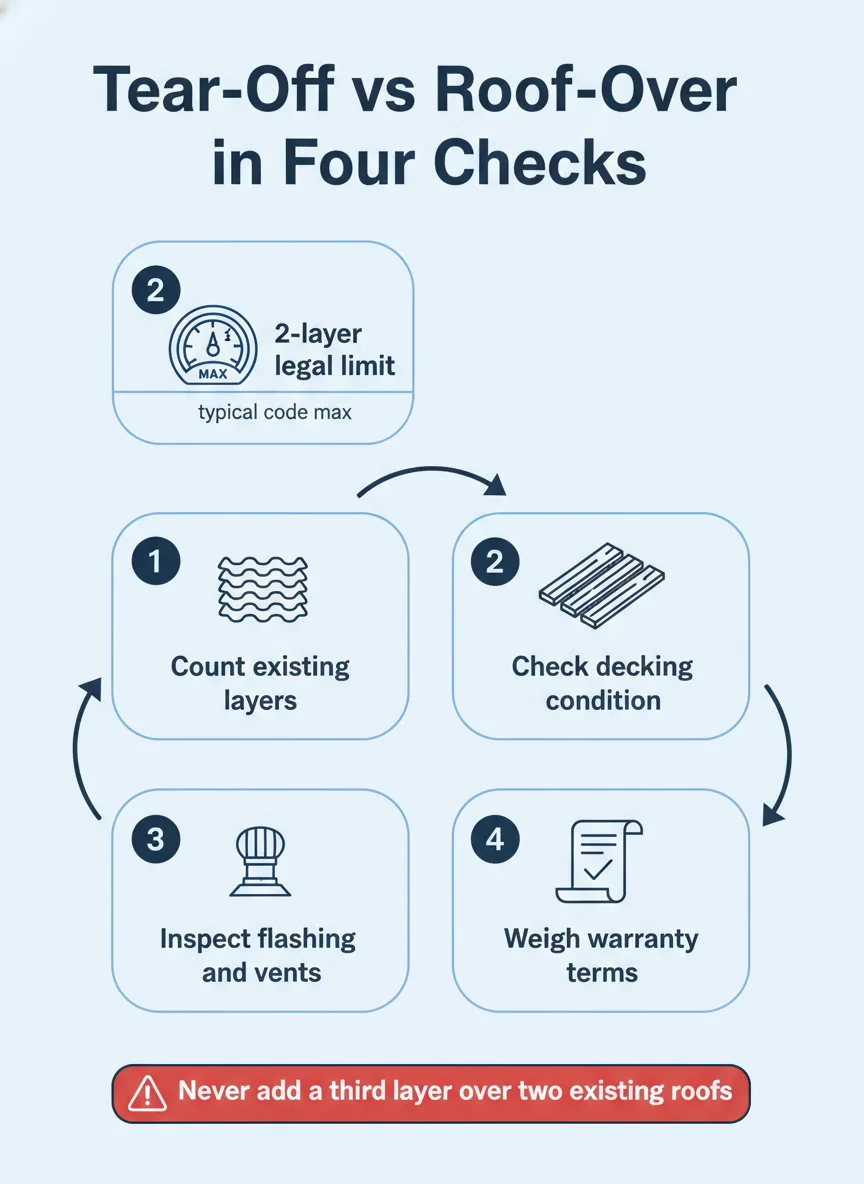
Roofers generally walk through a short checklist before recommending either option, starting with how many layers are already up there and ending with what the manufacturer warranty requires.
- Count existing layers: Most codes cap roofs at two layers total, so a home already roofed over once is usually down to a tear-off by default.
- Check deck condition: Soft spots, soft decking near valleys, or visible sagging all point toward needing a tear-off to repair the structure underneath.
- Review flashing age: Flashing around chimneys, skylights, and walls wears out independently of the shingles and can't be replaced in a roof-over.
- Confirm ventilation path: Blocked or undersized attic ventilation often needs correcting, which only a tear-off allows access to fix.
- Check manufacturer terms: Some warranties require installation on bare decking, which rules out a roof-over if full coverage matters to you.
- Weigh the timeline: A tear-off takes longer and costs more upfront, so budget and project timing play into the final call too.
What you'll actually find once the old layer comes off
Common decking issues
Delamination, soft spots around old leak points, and nail pops are common finds once the old shingles come off. Most of these are easy to repair during a tear-off but impossible to spot or fix through a layover.
Discovering these issues mid-project isn't a red flag, it's the tear-off doing its job. A roofer who finds and documents decking problems before closing up the new layer is giving you a roof that won't have a hidden weak point for the next 15 to 20 years.
Flashing and vent surprises
Flashing around older additions or skylights sometimes wasn't installed correctly the first time, something a layover would never reveal. Vents can also be undersized for the attic space, a detail that affects heat buildup more than most homeowners realize.
Catching these during a tear-off means they get corrected once, rather than compounding under two layers of shingles for another decade.
DIY vs calling a licensed roofer
This isn't a DIY decision. Counting layers from the ground or peeking in the attic can give you a rough sense of condition, but confirming deck soundness, flashing integrity, and code compliance requires someone trained to evaluate roofing systems up close.
A licensed roofer can also pull the right permits, which matters because most jurisdictions track how many layers a roof has had over its life. Skipping that step can create problems later when you sell the home or file an insurance claim.
What a homeowner can reasonably do is ask questions before the work starts: how many layers are currently up there, what the manufacturer warranty requires, and whether a tear-off makes more sense given the home's age. A straightforward answer to those questions tells you a lot about who you're hiring.
Making the right call for your home
A roof-over can be a reasonable short-term move on a newer home with a single existing layer and no signs of trouble underneath. But for most homes reaching the end of a shingle's service life, a full tear-off gives you the chance to fix what's hidden and start the warranty clock clean, something worth weighing against a missing shingles repair in the meantime if damage shows up sooner.
If you're deciding between the two for a home in Lakeland or anywhere else across central Florida, Quality Plus Roofing & Solar can walk the roof with you and lay out what each option actually means for your specific situation.
Frequently asked questions
Can you put a new roof over an old one?
In many cases yes, if the existing layer is in decent shape and local code allows it, but a roof-over only works for one additional layer in most jurisdictions. It also means any decking or flashing problems underneath stay hidden and unresolved.
Is a roof-over cheaper than a tear-off?
A roof-over usually costs less upfront because it skips the labor and disposal of removing the old layer. The tradeoff is that hidden damage doesn't get fixed, which can cost more down the road if the deck or flashing was already compromised.
Does a roof-over void the manufacturer warranty?
Many shingle manufacturers either shorten or void their warranty when the product is installed over an existing layer instead of bare decking. Check the warranty language before assuming full coverage carries over.
How do I know how many layers are already on my roof?
A licensed roofer can tell during a visual inspection or by checking the edge where the roof meets the fascia, where layered shingles are visible in cross-section. Permit history at your local building department can also show prior roof-over work.
Does a roof-over add noticeable weight to the house?
Yes, each layer of shingles adds weight the roof structure has to carry, and in Florida's heat that extra mass also holds more heat against the decking. A structural check is worth doing before stacking a second layer, especially on older framing.